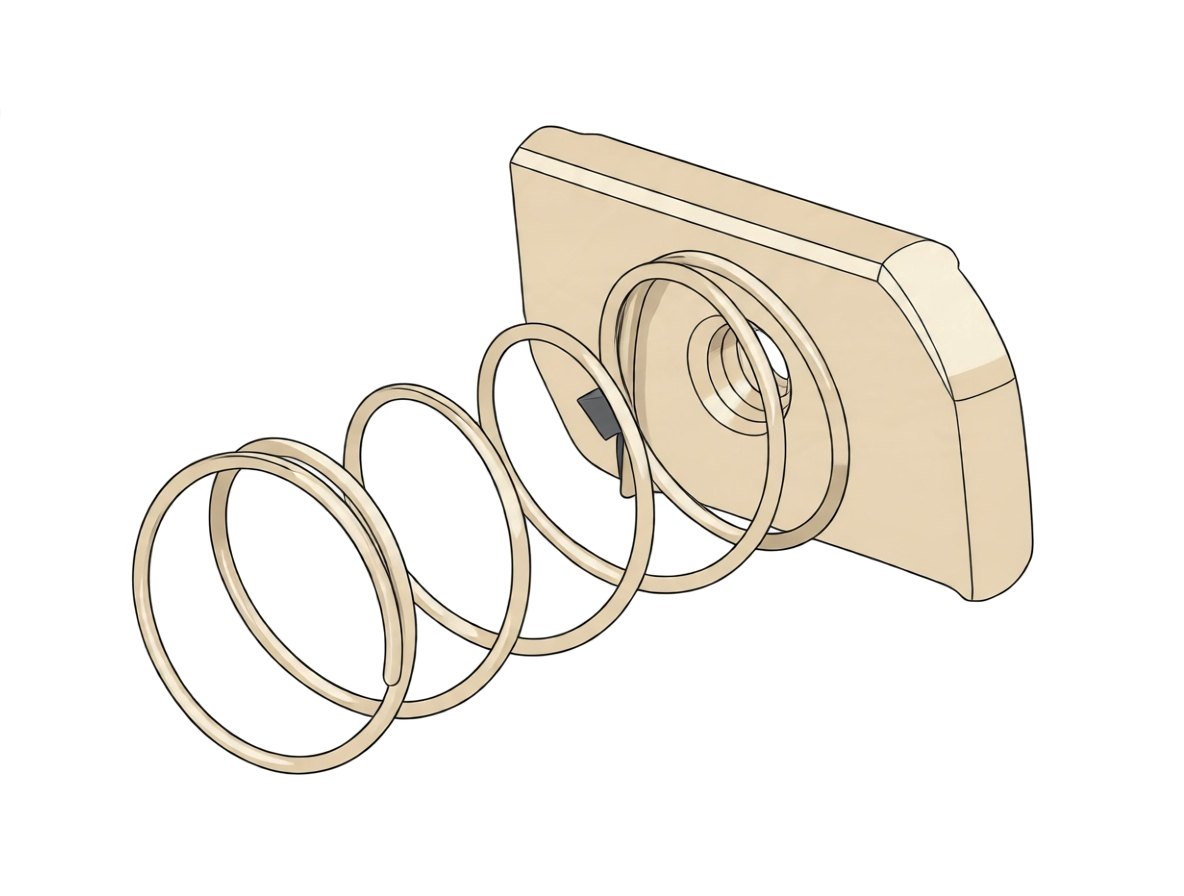
How it connects
Nut is pushed into the channel slot, turned a quarter turn so it spans the slot, then held up by a spring (or ridge); tightening a bolt clamps the channel lips between the nut's serrated grooves and the fitting above.
Male and female halves
Not male/female in the usual sense: the channel's inturned lips are the receiving half and the nut's grooved shoulders are the inserted, capturing half. The nut's tapped hole separately takes a male bolt.
Usually connects to
- Matching inward lips of 1-5/8 in continuous-slot strut, including Unistrut P1000, Superstrut A/C and B-Line B22 equivalents
- Matching bolt or threaded rod in the nut’s tapped hole
Common sizes
- Fits 1-5/8 in (about 41–41.3 mm) channel, with a lip opening near 7/8 in (22.2 mm); one listed engagement depth is about 6 mm.
- Threads span 1/4-20–7/8-9 or M6–M16, including 5/16-18, 3/8-16, 1/2-13, 5/8-11 and 3/4-10.
- Spring choices include regular, short for shallow channel, no spring and versions for 13/16 in channel.
Where it is used
Modular strut framingElectrical conduit/cable traysMechanical piping and HVAC duct hangingSolar rackingShelves/racks
Variations
- Regular/long/short spring nut
- Rod-spring nut
- No-spring nut
- 13/16 in channel version
- Nylon-cone nut
- Top-spring/squeeze nut
- Stud nut
How to recognise it
Rectangular galvanized steel plate about 1-5/8 in. long with a central tapped hole, two parallel grooves across the top face, two opposite corners rounded so it can rotate in the slot, and often a conical coil spring on the bottom.
Often confused with
| Confused with | How to tell them apart |
|---|---|
| T-slot nut (aluminum extrusion) | T-slot nuts fit 20/30/40 mm aluminum profiles and have no serrated grooves; strut nuts are rectangular steel with two grooves matching 1-5/8 in. steel channel lips. T-slot nuts are used in extruded aluminum framing (80/20) and slide into smooth T-slots, whereas strut channel nuts have toothed/serrated grooves specifically sized to bite into the rolled inward steel lips of strut channels. T-slot nuts typically have smooth shoulders for machine table T-slots rather than parallel toothed/serrated channels designed to bite into rolled sheet metal inturned lips. |
| Square/hex nut | A strut nut is a long rectangular plate with grooved top shoulders, rounded diagonal corners for turning, and usually a coil spring. |
Also called
Strut/channel nutUnistrut/Superstrut nutSpring/quarter-turn nut channel gripSerrated channel-nut clamping face
Good to know
Spring nut, channel nut and quarter-turn nut describe the same lip-capture interface. A/C-series refers to Superstrut’s 1-5/8 in channel. MFMA-4 is a general reference rather than a confirmed product-specific compliance claim.
Design with real parts
Crafti checks which parts connect, right in your browser.