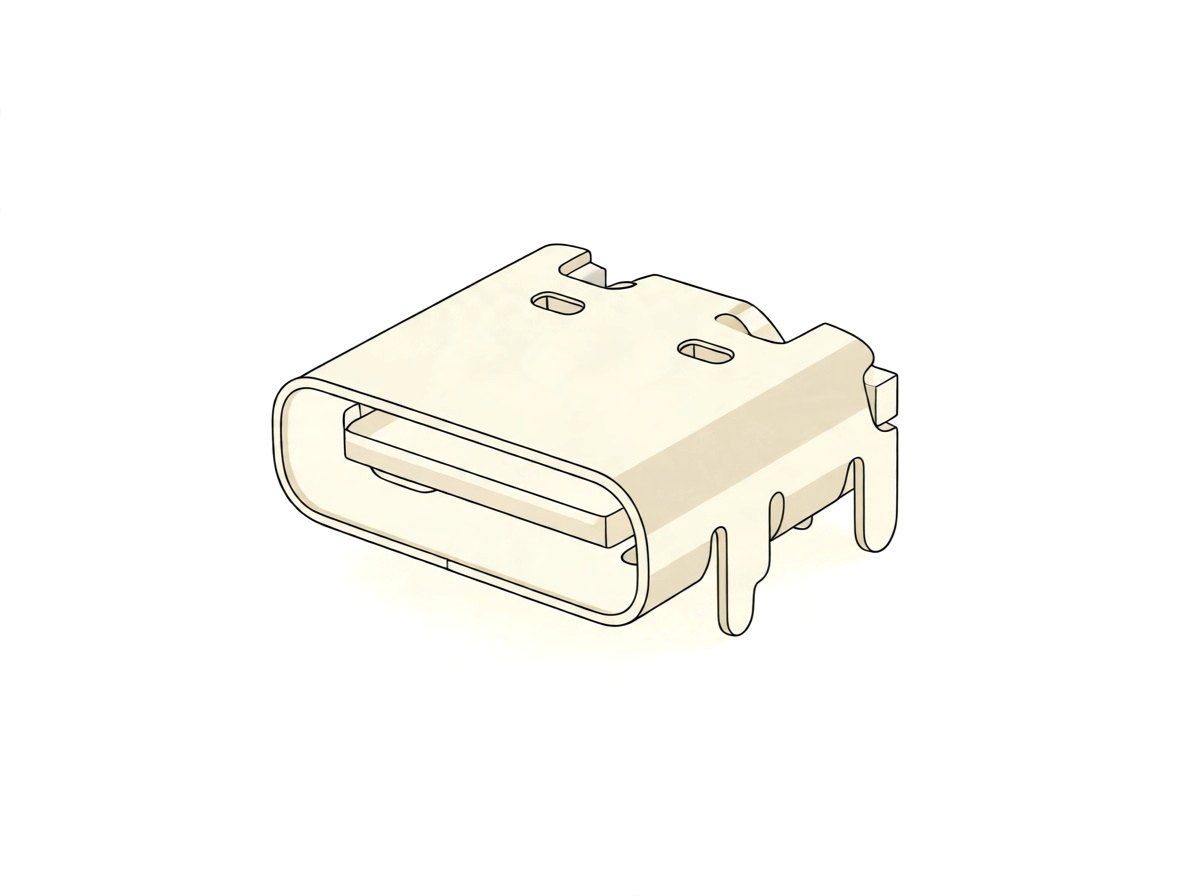
How it connects
A USB-C plug is pushed straight in (either orientation); spring latches/friction hold it and contacts on the receptacle's center tongue mate with the plug. Power level (5 V up to 20 V, or 48 V with EPR) is negotiated over the CC line by PD.
Male and female halves
The receptacle (female, with a central contact tongue inside an oval shell) is this one; the plug (male) is on the cable.
Usually connects to
- USB Type-C plug (male) on a cable or adapter
Common sizes
- One Type-C mating format: opening about 8.3–8.4 × 2.5–2.6 mm (one listed example is 8.34 × 2.56 mm).
- 24-, 16-, 6- and 2-contact versions; SMT, through-hole, mid-/top-mount, vertical and panel housings vary.
- PD wall-outlet versions are typically 20–30 W; charging wattage does not define mating size.
Where it is used
USB charging wall receptaclesConsumer electronicsPhones/laptops and their chargingChargers and power banksElectronics/PCB design
Variations
- 24-pin full-feature USB 3.x/USB4
- 16-pin USB 2.0
- 6- or 2-pin power-only
- PD-capable or non-PD 5 V-only
- Waterproof/panel mount
- Vertical/right-angle PCB mount
How to recognise it
A small capsule-shaped opening with rounded ends (about 8.4 x 2.6 mm), a metal rim and a flat tongue centered inside. On wall outlets it is often marked 'USB-C', 'PD' or a wattage. Whether it supports PD can't be seen from the shape; check the markings or datasheet.
Often confused with
| Confused with | How to tell them apart |
|---|---|
| Micro-USB (Micro-B) receptacle | Type-A is a larger rectangular slot with a tongue on one side; Type-C is a small oval/rounded slot with a centered tongue. Micro-USB is trapezoidal and fits one way only; USB-C is symmetrical with rounded ends. Micro-B is trapezoidal (chamfered on one side) and not reversible; Type-C is symmetric oval. |
| Apple Lightning receptacle | A Lightning port has no central tongue (the plug is a flat blade with contacts); USB-C has a tongue inside the port. Lightning port has no central tongue; contacts are inside the walls. Type-C has a tongue in the middle. Lightning sockets have no central tongue; the contacts are on the inside walls and the plug is a solid blade. |
Also called
USB Type-C female connectorUSB-C PD portUSB-C charging port
Good to know
The name repeats 'USB Type-C'. Physically this is a standard USB-C receptacle; 'Power Delivery charging' describes the electrical capability and should not be a separate connection type. Sample part: Decora duplex NEMA 5-15R with USB-A + USB-C PD.
Related connections
Design with real parts
Crafti checks which parts connect, right in your browser.