How it connects
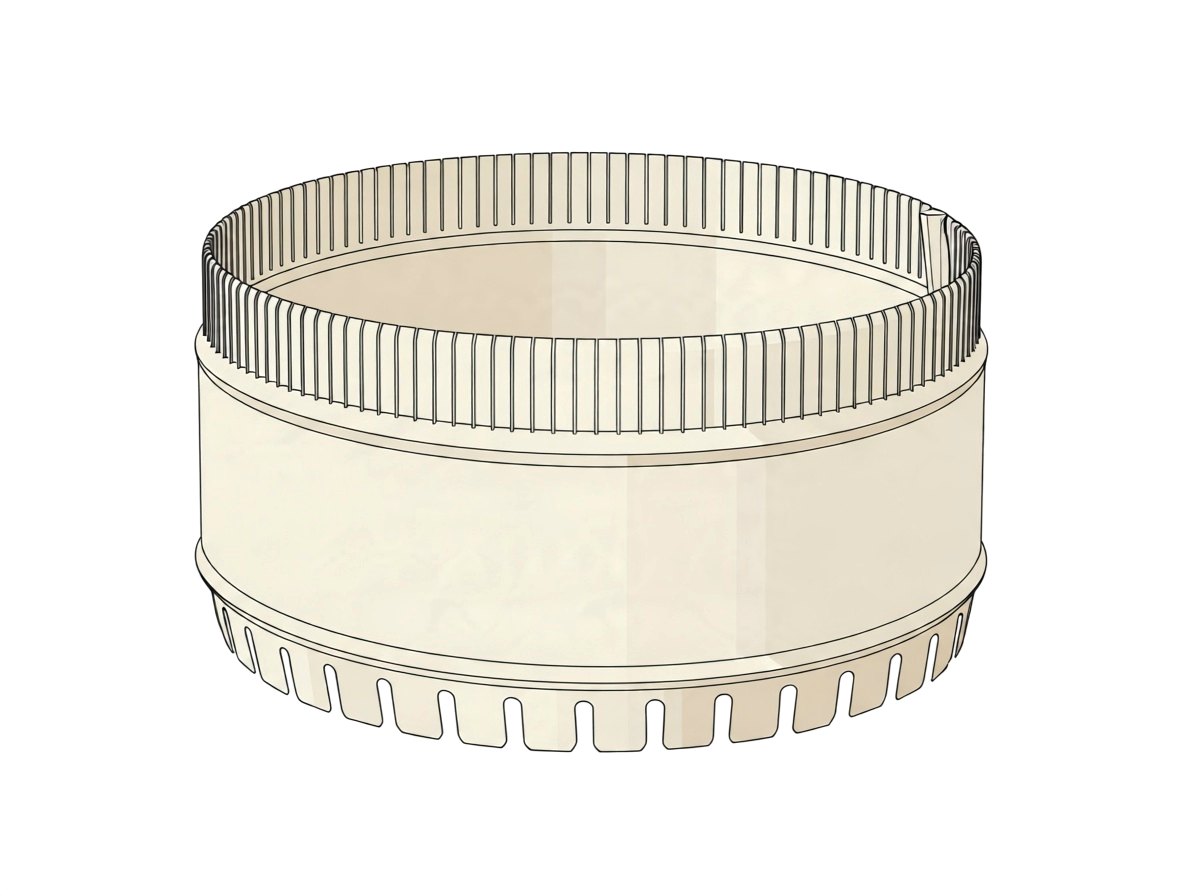
The tabbed end inserts into a circular cutout in the plenum wall until the outer flange stops against the exterior. The projecting sheet-metal tabs are then manually bent radially flat against the interior plenum wall to clamp it tight.
Male and female halves
Male spigot with bendable locking tabs mating into a circular cutout/hole receptacle in a plenum or trunk duct wall.
Usually connects to
- circular hole in sheet metal plenum or trunk duct
- circular hole in fiberglass duct board plenum
Common sizes
- Typically 4 in to 20 in (100 mm to 500 mm) nominal diameter, most commonly 5 in to 14 in for residential branch takeoffs.
Where it is used
residential HVACcommercial HVAC air distributionplenum and trunk duct branching
Variations
- short tab (for sheet metal plenums)
- long tab (designed to penetrate and clinch thicker fiberglass duct board)
- takeoff collar with integrated balancing damper
- flat flange vs flared bead flange
How to recognise it
Recognized by a circular galvanized steel collar having an outer ring of slotted, finger-like sheet metal tabs around one end, positioned just past a stop flange or bead.
Often confused with
| Confused with | How to tell them apart |
|---|---|
| Adhesive-flange or gasketed sheet metal takeoff | Uses a flat solid flange fastened with sheet metal screws or peel-and-stick mastic rather than bendable through-hole tabs. |
| Crimped male duct connector | Has continuous corrugations for slip-fitting into pipe rather than slotted bendable fingers/tabs. |
Also called
tabbed starting collartabbed takeoff collardovetail collartabbed spin-in collartabbed start collar
Good to know
Commonly referred to in HVAC trades as a tabbed starting collar or dovetail collar. In practice, after tabs are bent outward, installers frequently seal the joint exterior using mastic or foil tape to prevent air leakage.
Design with real parts
Crafti checks which parts connect, right in your browser.