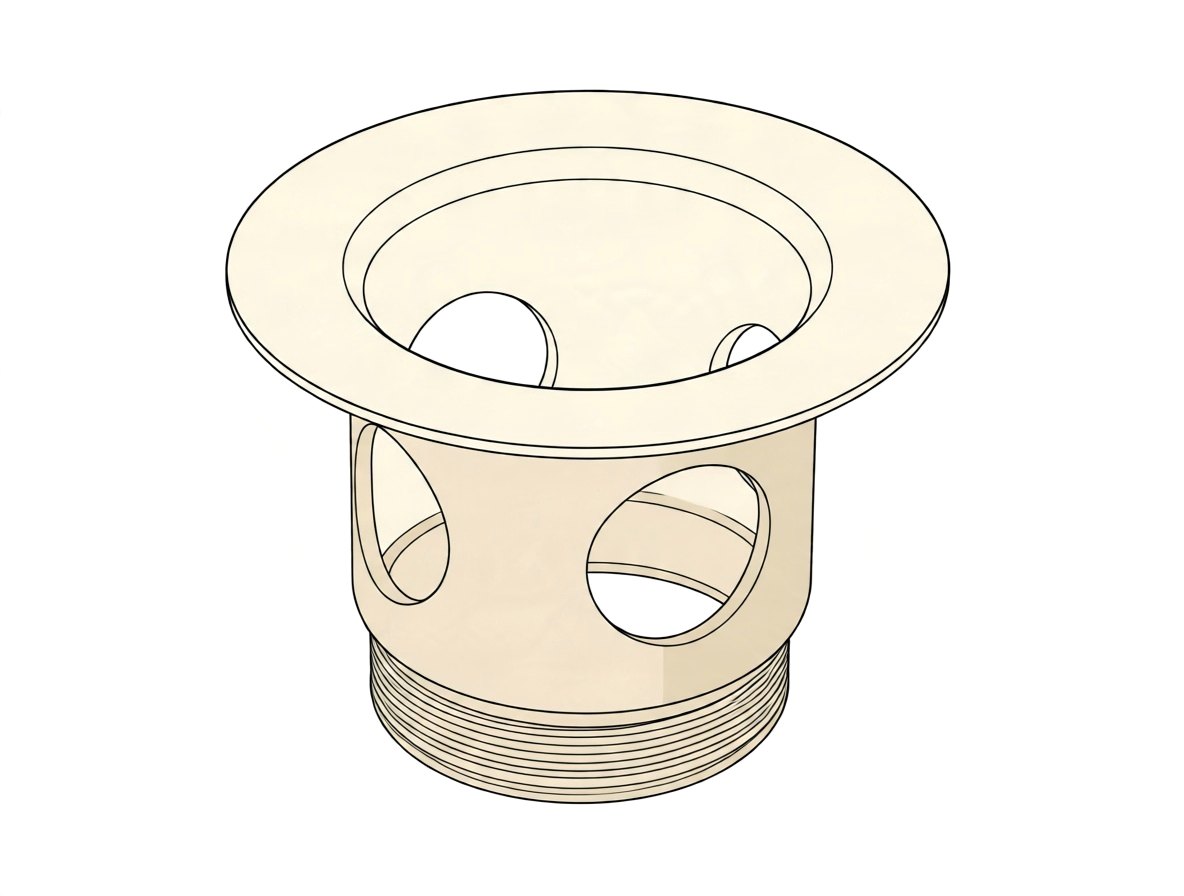
How it connects
The threaded body passes through the sink hole; the upper flange seals against the top basin surface (using plumber's putty, silicone, or a gasket), while a lower locknut and rubber bevel washer thread up to clamp the sink wall.
Male and female halves
Male externally threaded drain body; clamps through a female through-hole in the sink fixture and mates with an internally threaded locknut/collar.
Usually connects to
- lavatory sink drain opening
- lavatory drain mounting nut
- lavatory sink tailpiece
Common sizes
- Body outer diameter typically 1-1/4 in (approx. 32 mm) to 1-1/2 in (approx. 38-40 mm); flange outer diameter 2 in to 2-1/2 in; fits standard sink holes 1-1/2 in to 1-3/4 in.
Where it is used
residential plumbingcommercial plumbingbathroom fixtures
Variations
- with overflow holes (for basins with built-in overflow)
- without overflow (for vessel sinks)
- grid strainer flange
- pop-up drain flange
How to recognise it
A tubular metal or plastic fitting featuring a wider, visible top lip/flange, straight external machine threads along the body for a friction/mounting nut and rubber washer, and often side overflow cutouts.
Often confused with
| Confused with | How to tell them apart |
|---|---|
| Kitchen sink strainer flange | Kitchen sink flanges are much larger (typically 3-1/2 in / 90 mm diameter hole) compared to 1-1/4 to 1-1/2 in lavatory drains. |
| Lavatory tailpiece slip-joint | The tailpiece is the tubular extension below the drain body connecting to the P-trap, whereas the flange mount is the upper threaded body clamping the sink bowl. |
Also called
lavatory drain bodysink drain flangepop-up drain bodylavatory waste flange
Good to know
Corresponds to the mounting interface between the lavatory drain body and the sink fixture cutout. Tailpiece outlets below are typically standard 1-1/4 in tubular connections.
Design with real parts
Crafti checks which parts connect, right in your browser.