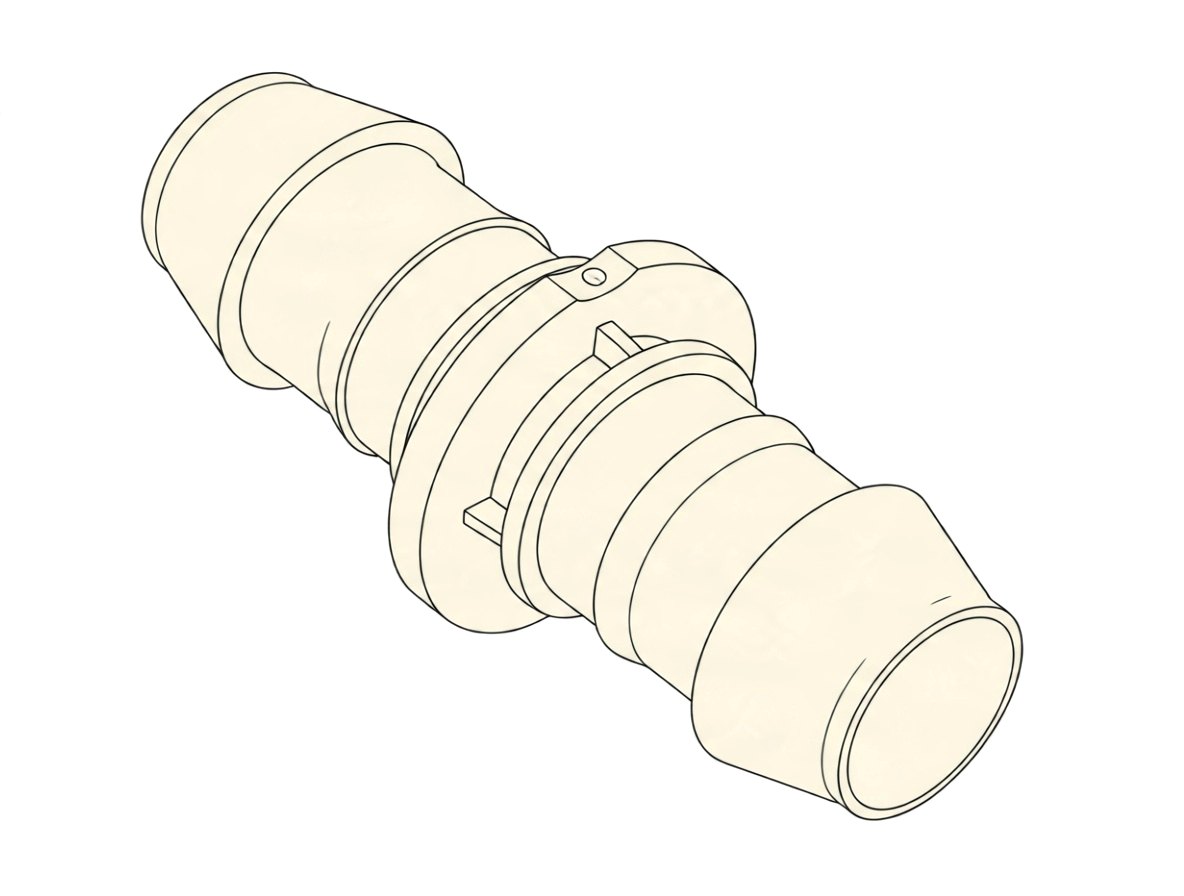
How it connects
The barb is pushed directly into the flexible tubing; its tapered leading edge expands the tube while the sharp trailing shoulder grips the interior wall to resist pull-out and form a watertight seal up to ~50 psi.
Male and female halves
Male insertion barb mating with the female internal lumen (ID) of flexible tubing.
Usually connects to
- Flexible polyethylene (PE) or vinyl drip irrigation tubing ID
Common sizes
- Nominal 1/4 in (micro-tubing, ~4 mm ID), 1/2 in / 16-17 mm (0.520 in to 0.620 in ID / 0.600 in to 0.710 in OD), and 3/4 in nominal drip line.
Where it is used
landscape irrigationagricultural micro-irrigationresidential gardeninggreenhouse drip systems
Variations
- Double barb
- Multi-barb
- Locking collar / spin-loc / twist-lock barb
How to recognise it
Recognized by a plastic (typically black or brown UV-resistant acetal/nylon/polypropylene) spigot with one or two pronounced tapered conical ribs with sharp backward-facing shoulders, designed for direct push-in insertion into poly tubing.
Often confused with
| Confused with | How to tell them apart |
|---|---|
| General hose barb | Standard hose barbs typically feature longer multi-rib stems for flexible braided rubber or vinyl hoses and require hose clamps, whereas drip irrigation barbs are sized specifically for thin-walled polyethylene tubing with steep, sharp retaining ribs. |
| Drip lock / push-fit fitting | Drip lock or push-fit fittings grip the exterior outside diameter (OD) of the tubing using internal teeth, whereas a barb inserts into the internal diameter (ID). |
Also called
drip tubing barbdrip irrigation insert barbdrip line barb fitting17mm drip barbmicro tubing barb
Good to know
Nominal 1/2 in drip tubing has slight variations in ID (e.g., 0.520 in, 0.580 in, 0.600 in, 0.620 in); 17 mm insert barbs are designed to fit common 0.550 to 0.600 in ID tubing.
Design with real parts
Crafti checks which parts connect, right in your browser.