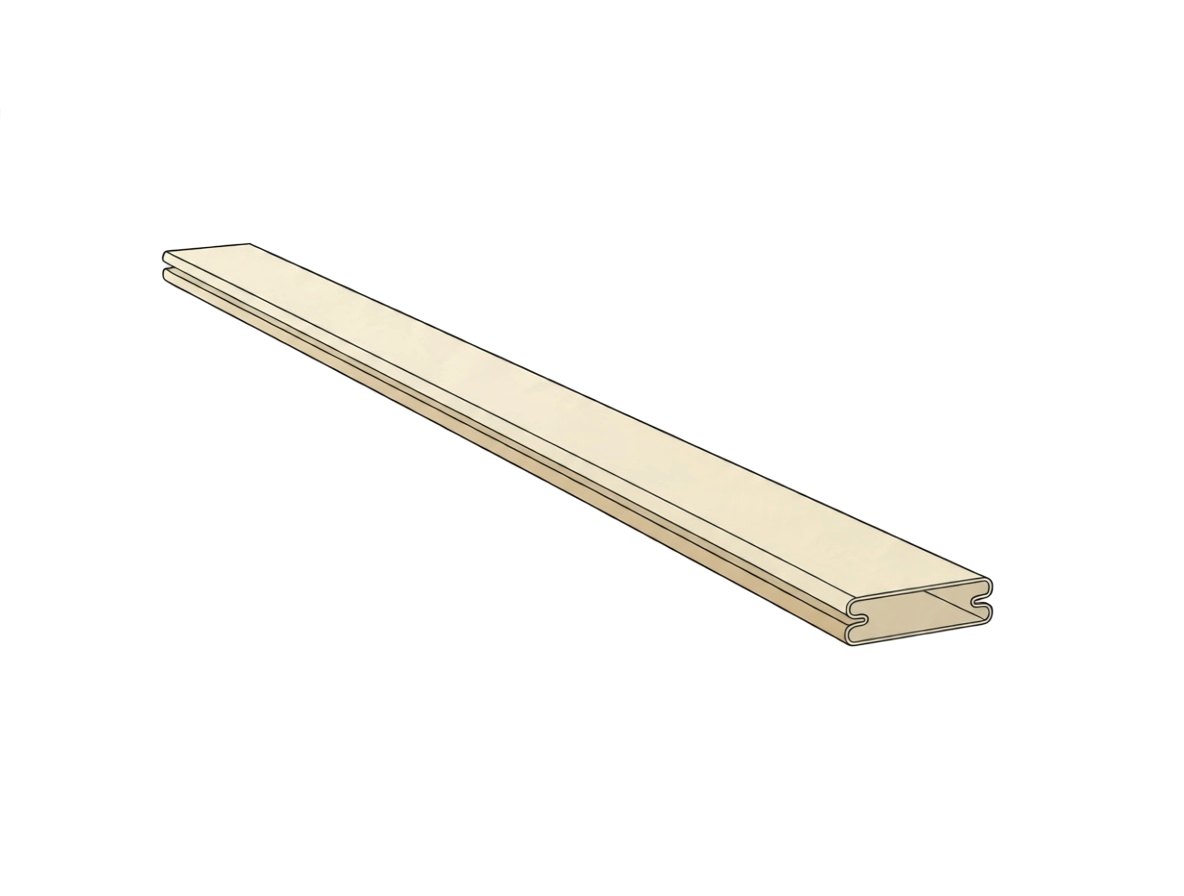
How it connects
The flat duct edge slides into the cleat's folded pocket; the hem grips by friction. Used on the top and bottom (wide) sides of rectangular duct, with drive cleats on the short sides locking the joint. Sealed afterward with mastic or foil tape.
Male and female halves
The S-cleat pocket is the female (receiver); the plain duct sheet edge is the male. Each S-cleat has two female pockets facing opposite directions, one per duct section.
Usually connects to
- plain flat edge of rectangular sheet-metal duct
- duct fittings and plenum edges
Common sizes
- Sold in stick lengths, commonly 60 in. (1524 mm); also cut to duct width. Typical 26-30 gauge galvanized steel for residential, heavier for commercial; pocket roughly 1 in. deep.
Where it is used
HVAC ductworkresidential and light commercial rectangular duct
Variations
- flat S cleat
- standing S cleat
- hemmed S
- standing S with drive
How to recognise it
Long thin galvanized strip; from the end the cross-section looks like an S (two stacked loops opening to opposite sides). Found on the long sides of rectangular duct joints, paired with drive cleats on the short sides.
Often confused with
| Confused with | How to tell them apart |
|---|---|
| Drive cleat (drive slip) | A drive cleat is a C-channel with both edges hemmed inward over a flat back, hammered on over turned-up duct flanges; an S-cleat is a Z/S fold with two pockets opening in opposite directions that a flat duct edge slides into. |
Also called
S-slipflat S cleatS cleat pocketslip cleatS-lock
Good to know
The flat S-cleat differs from a drive cleat or standing-S open channel. Female describes the receiving pocket here rather than a standard trade gender.
Design with real parts
Crafti checks which parts connect, right in your browser.