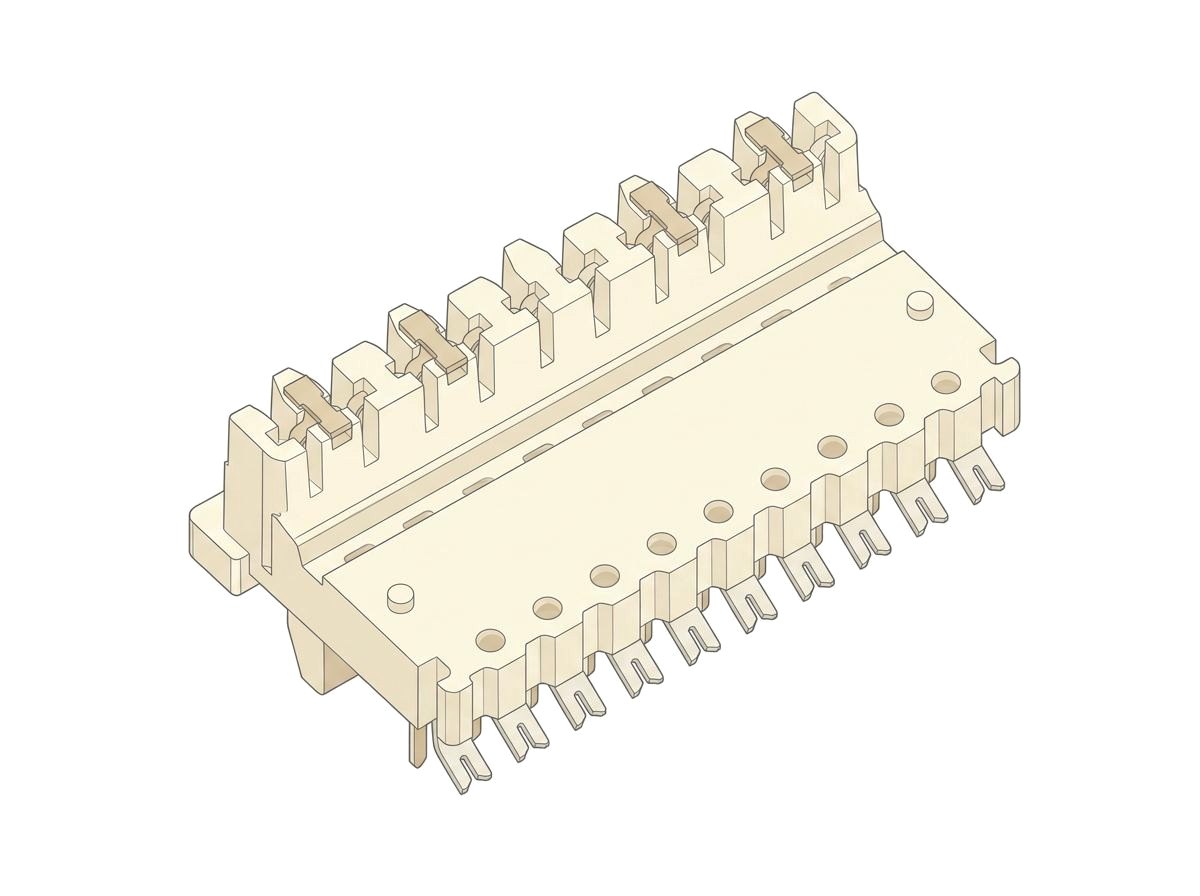
How it connects
Each insulated conductor is laid in a forked metal slot and forced down with a punch-down tool (or a lacing/termination cap); the slot edges cut through the insulation and grip the copper in a gas-tight cold contact. No stripping is needed.
Male and female halves
Ungendered in the plug/socket sense: the jack body carries the IDC slots (the receiving, 'female' side) and the bare insulated wire is the inserted member. The other end of the jack is an RJ45 (8P8C) female socket.
Usually connects to
- Insulated solid copper twisted-pair conductors, typically 22–26 AWG, including Cat 3/5e/6/6A cable within the terminal’s wire specification
- 110 connecting blocks with C-4/C-5 clips
- 110 patch cords with 110 plugs
- 110 punch-down tool blade
Common sizes
- 22–26 AWG solid copper (about 0.4–0.65 mm); some terminals also accept 22–24 AWG stranded. Insulation OD limits are roughly 1.0–1.5 mm, depending on the maker.
- One wire per slot; jacks usually have 8 positions (4 pairs), with 4- or 6-slot voice versions and rows of 4 or 8.
- Blocks use 4- or 5-pair clips; block capacities include 25–300 pairs, commonly 50–300.
Where it is used
Structured copper communications cablingEthernet keystone jacks, wall plates and patch panelsTelephone/voice wiringTelephone/data cross-connect blocks
Variations
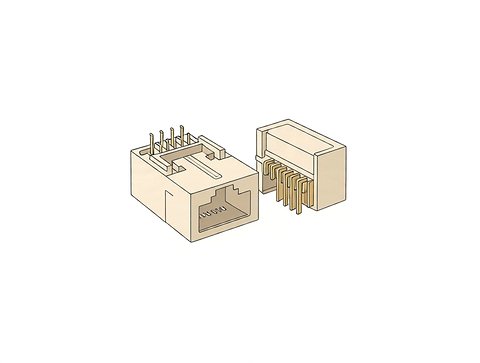
- 110-type on keystone jacks/patch panels, including 90° and 180° inline layouts
- 110 wiring-block base and C-4/C-5 connecting clips
- Toolless IDC with lacing cap
- Krone/LSA-PLUS IDC
- Older 66-block telephone terminals
- BIX
How to recognise it
On the back or top of a keystone jack/wall insert: two rows of four small plastic posts with narrow metal fork slots between them, plus a colour-coded label showing T568A/T568B wire colours and pin numbers. Often a separate plastic dust/termination cap.
Often confused with
| Confused with | How to tell them apart |
|---|---|
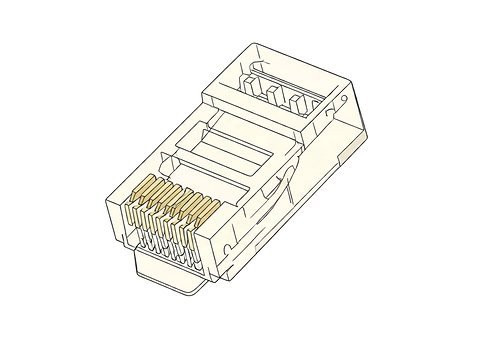
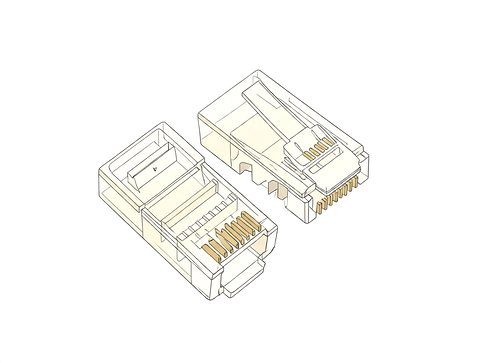
| RJ45 / 8P8C modular jack | The RJ45 socket is the front opening that accepts a patch-cord plug; the IDC punchdown is the row of slotted posts on the back where cable wires are terminated. |
| Krone/LSA IDC | Krone slots sit at a 45-degree angle in the contact and need a Krone tool blade; 110 slots are straight forked posts in parallel rows. Krone contacts sit at 45° and need a Krone tool; 110 contacts are straight slots in line with the comb. |
| Toolless keystone jack | Toolless jacks still use IDC slots but terminate by closing a hinged cap instead of a punch-down tool. |
| 66 block | 66 blocks use rows of individual metal clips with forked tops on a large block; 110 has a dense plastic comb with slots between teeth. |
| BIX | BIX uses double-sided connectors on mounts and a BIX tool. |
Also called
110 IDC/punch-down termination110 punch-down blockInsulation-displacement connectorPunch-down terminal/contactIDC slotKrone/LSA IDC (different variant)
Good to know
This is an 8-position IDC wire-to-device termination, separate from the RJ45 female port on the same part. Wire gauge and insulation limits vary by manufacturer.
Related connections
Design with real parts
Crafti checks which parts connect, right in your browser.