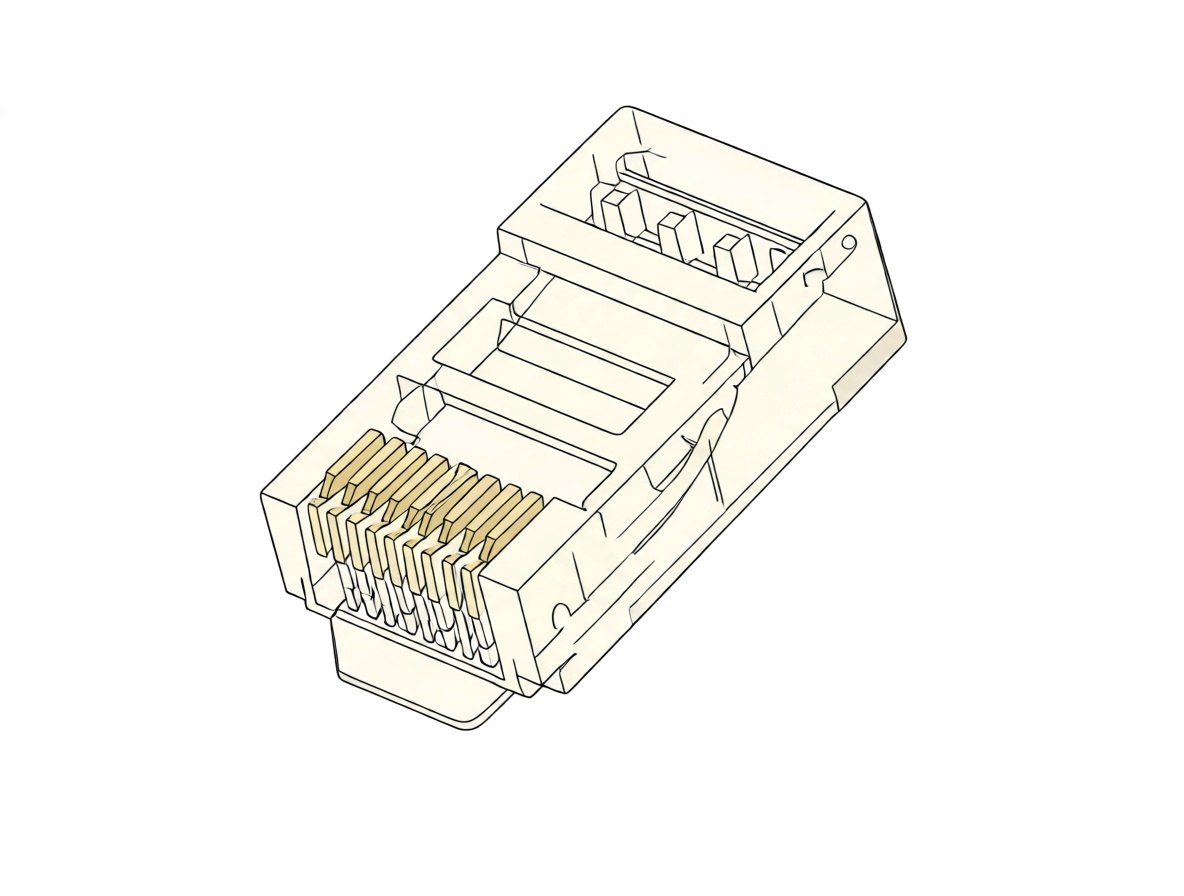
How it connects
Insert the eight arranged insulated conductors into the plug. A modular crimp tool drives contacts through the insulation and secures the jacket with the plug’s strain-relief feature. The termination provides no inherent environmental seal.
Male and female halves
The rear opening receives bare-ended cable; calling it female is descriptive, not a standardized mating gender. The assembled connector is a male RJ45/8P8C plug whose front mates with a female jack.
Usually connects to
- Four-pair, eight-conductor Cat5e/Cat6/Cat6A cable, round jacket, UTP/U/UTP or shielded STP/F/UTP; match conductor type, insulation and jacket dimensions to the plug
- Solid or stranded conductors as the plug permits; listed wire examples span 23–26 AWG, including 23–24, 23–24/24–23 and 24–26 AWG descriptions
- RJ45/modular-plug crimp tool
Common sizes
- 8 conductors in 4 pairs; match conductor type, gauge, insulation diameter and jacket diameter to the specific plug.
- Cat5e examples use 24–26 AWG with about 0.9–1.0 mm insulation; listed cable OD ranges include 4.5–6 mm and 5–6.5 mm.
- Cat6/Cat6A entries and load bars can be larger, with insulation up to about 1.5 mm; jacket entries across plugs are roughly 5–9 mm.
- Shielded/unshielded and pass-through/closed-end versions do not define one universal cable-entry bore.
Where it is used
Twisted-pair Ethernet patch-cord assembly and field terminationStructured copper data-network cablingPoE cabling/devices
Variations
- Closed-end or pass-through/EZ plug
- Shielded STP/FTP with ground clamp or unshielded
- Solid-conductor contacts, including three-prong types
- Stranded-conductor piercing contacts
- Contacts approved for both constructions
- Load-bar insert
- Toolless field-terminable plug
How to recognise it
Look at the rear of an 8-contact modular plug for a cable opening leading to eight conductor channels and a jacket-retention feature. A boot may surround the entry. Check the plug datasheet for cable compatibility; appearance alone cannot verify Cat5e performance.
Often confused with
| Confused with | How to tell them apart |
|---|---|
| RJ45 jack punch-down termination | A jack accepts the latched modular plug at its mating face; this opening accepts cable for permanent termination. Punch-down jacks expose wire termination slots; a conventional crimp plug has internal conductor channels and contacts driven by a modular crimp tool. |
| RJ45 female jack (keystone) punch-down IDC | Jacks use 110/Krone punch-down slots on the back with a punch tool; plug crimp terminations are inside a clear plug body crimped with a modular crimp tool. |
| RJ45 8P8C mating interface | The mating face is the front latch-and-contacts end; this is the back opening where the cable enters. |
| 110 / Krone punch-down IDC termination | Punch-down terminates in slots on a jack, panel or block using an impact tool; crimp termination is inside a plug closed by a crimp tool. |
| RJ45 female jack (front) | The jack is the mating socket; this is the permanent cable side of a plug. |
Also called
RJ45/8P8C plug crimp terminationCat5e/modular-plug cable entryPass-through/EZ-RJ45 termination or crimp endModular plug crimpIDC crimp termination
Good to know
This is the cable side of a male crimp plug. A boot provides strain relief and is not a separate standardized female connector. Pass-through and shielded plugs are variations of the family.
Related connections
Design with real parts
Crafti checks which parts connect, right in your browser.