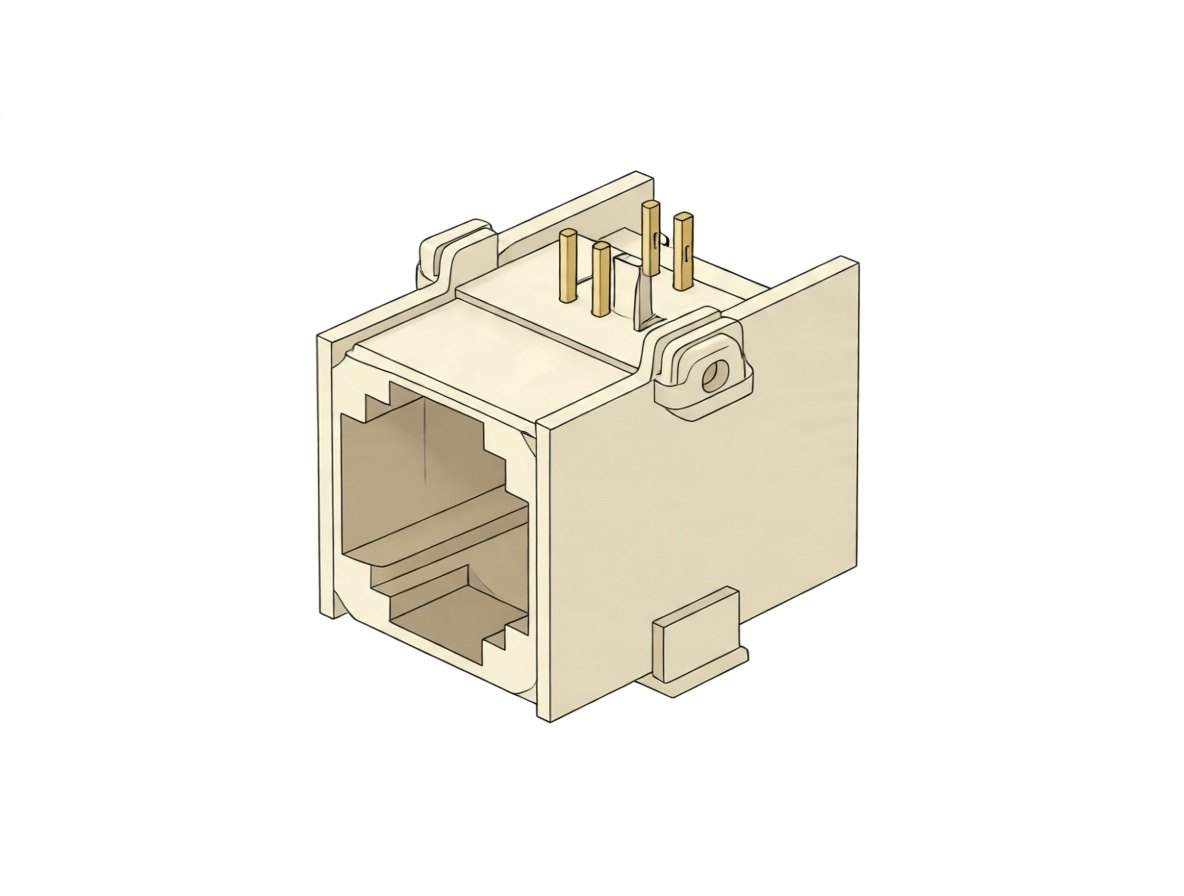
How it connects
The plug is pushed straight into the jack until its flexible plastic tab snaps into the latch recess; gold spring wires in the jack press on the plug's blade contacts. Released by pressing the tab. Not sealed.
Male and female halves
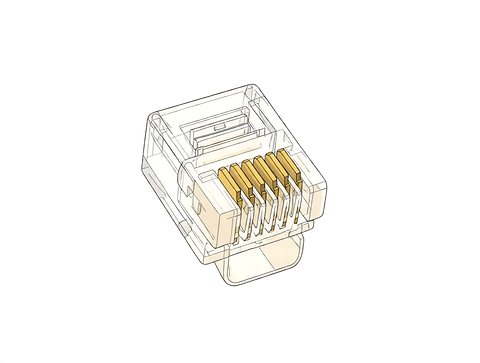
The jack (socket, receptacle) is the female half, with spring-wire contacts; the plug is male, with blade contacts and a latch tab. This connection is the female jack.
Usually connects to
Common sizes
- 6-position body, about 9.65–9.85 mm (0.38 in) wide, narrower than 11.68 mm 8P/RJ45.
- 2, 4 or 6 contacts (6P2C/6P4C/6P6C), on 1.02 mm (0.040 in) pitch.
Where it is used
Residential landline telephone wiring and wall platesDSL modems/filtersDial-up modemsFax machinesIntercomsLow-voltage data/control, including RS-232 adapters and sensors
Variations
- 6P2C/RJ11: one line, 2 contacts
- 6P4C/RJ14: two lines, often sold as RJ11
- 6P6C/RJ12/RJ25: 6 contacts, up to three lines
- Keystone insert
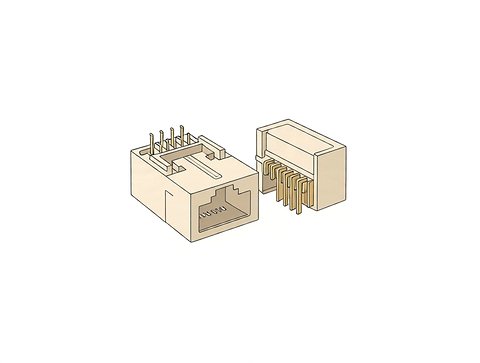
- PCB mount
- Wall plate
- Surface box, including 625D
- D-type panel mount
How to recognise it
A rectangular opening about 9.7 mm wide, with a narrower latch notch on one side and 2-6 gold spring contacts across the other side. On wall plates it is often labelled 'Phone' or 'Line'. Check the contact count to tell 6P2C/4C/6C apart.
Often confused with
| Confused with | How to tell them apart |
|---|---|
| 8P8C modular jack (RJ45) | RJ45 opening is wider (about 11.7 mm vs 9.7 mm) with 8 contacts; an RJ11 plug fits loosely into an RJ45 jack, but an RJ45 plug will not go into an RJ11 jack. 8P8C is noticeably wider (approx 11.7 mm wide) with 8 contact slots, commonly used for Ethernet networking. |
| RJ9 / 4P4C handset jack | The 4P handset jack is narrower (about 7.6 mm) and is used for coiled handset cords, not line cords. |
| RJ12 / RJ14 / RJ25 | Same 6P body; they differ only in how many contacts are fitted and wired. Count the gold contacts. |
| 4P4C handset jack | 4P4C (often mistakenly called RJ9/RJ10/RJ22) is physically narrower (around 7.7 mm wide) and used specifically on telephone handset coiled cords. |
Also called
6P4C modular jack6P2C jackphone jacktelephone modular jackRJ12/RJ14 jack (same 6P body)RJ11 keystone jack6-position 4-contact modular socket
Good to know
'RJ11' strictly names a wiring arrangement: one line on the centre pair. Stores also use the name for other 6P jacks, regardless of contact count.
Related connections
Design with real parts
Crafti checks which parts connect, right in your browser.