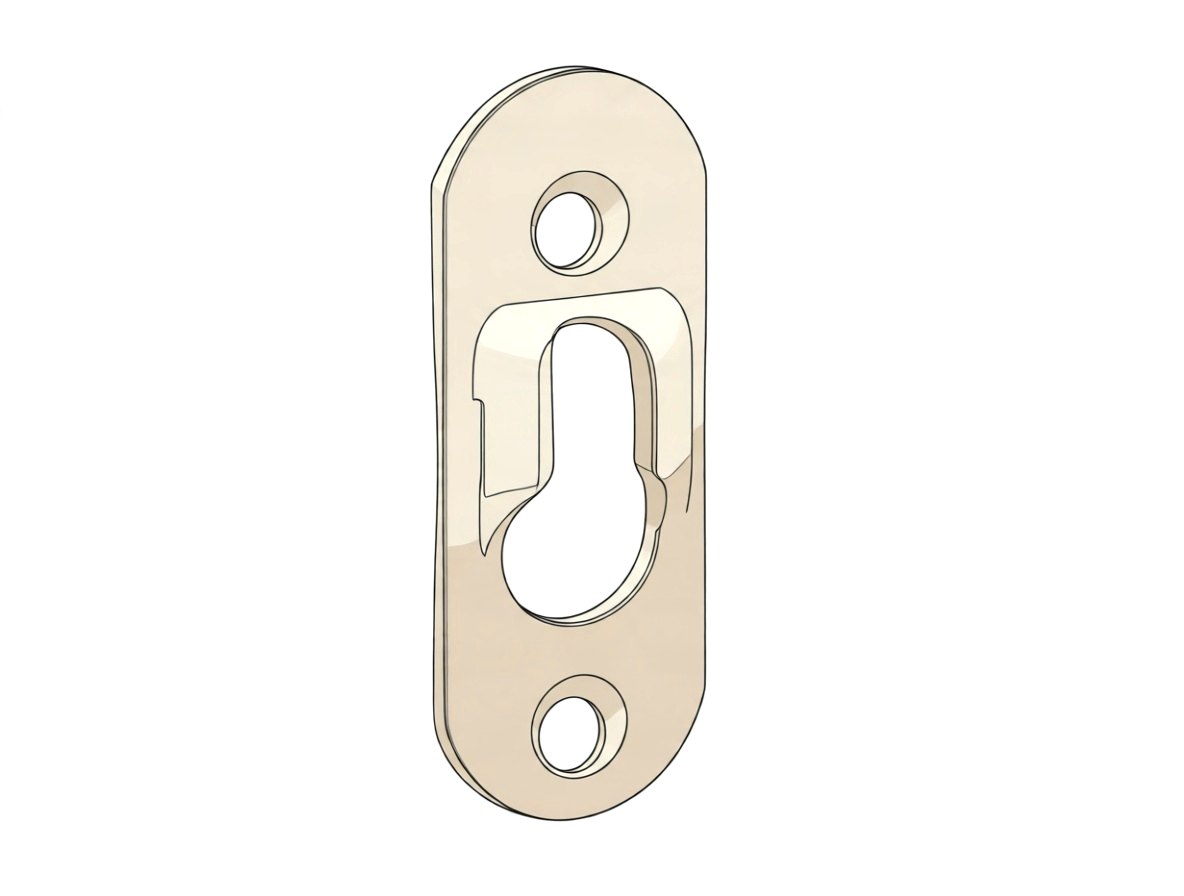
How it connects
The screw head passes through the large hole, then the part slides down so the shank sits in the narrow slot and the head sits behind the slot edges. Gravity holds it there. It does not seal and is not locked in place.
Male and female halves
This is the female (receiving) side: the slot in the part or bracket. The male side is the headed screw sticking out of the wall.
Usually connects to
- Protruding headed screw/bolt in a wall, stud, anchor or cabinet; shank fits the narrow slot, head fits the entry and is retained by the narrow slot
- Pan-, round-, washer- or suitable flat-head wood/drywall screw, shoulder screw or headed stud
- Suitable nail/hook head
Common sizes
- No universal keyhole size. Common screws are #6–#10 or M3.5–M5; typical head entries 8–12 mm, slots 4–6 mm and centre spacing 10–25 mm.
- Examples include 10.41/5.97/22.29 mm entry/slot/spacing, a 10.4 mm entry with 6 mm slot, and a raceway-box 6 mm entry/3.5 mm slot/10 mm overall length.
- Other estimated examples give 12/6/22 mm or a 10 mm entry with 6 × 15 mm slot; about 6.5 mm (1/4 in) clearance is not a confirmed fastener specification.
- Match tab thickness and under-head clearance as well as the opening and slot.
Where it is used
Wall-mounted appliances, water filters, electrical boxes/raceway and electronics enclosuresSpeakersFurniture, shelves and cabinetry3D-printed mountsPicture/frame hangingSecurity devices
Variations
- Through-punched sheet-metal slot
- Molded plastic slot
- Routed blind keyhole in wood
- Separate metal plate, screwed/recessed into wood
- Raised/offset hanger for screw-head clearance
- Double-ended/teardrop slot
How to recognise it
Look for a through-cutout shaped like a light bulb or keyhole, usually on the back plate or bracket with the narrow end pointing up. The round lower end is wider than the slot above it, and there are usually two cutouts at the same height for wall mounting.
Often confused with
| Confused with | How to tell them apart |
|---|---|
| Slotted (oblong) mounting hole | A slotted hole is the same width all the way along and the screw is put in after the part is in place. A keyhole has a large round end that the screw head passes through. |
| Tapped (threaded) hole such as M6 | A keyhole has no thread. It is a plain clearance cutout. |
| T-slot / 80/20 extrusion slot | A T-slot is a long channel with an undercut, used with T-nuts. A keyhole is a short cutout through flat sheet. |
| Fastener clearance hole | A clearance hole is one round hole that the screw goes straight through. A keyhole has a larger round hole joined to a narrower slot. |
| Plain clearance hole or straight mounting slot | A keyhole has a distinct enlarged head-entry opening joined to a narrower shank-retaining section. |
Also called
keyhole mounting hole; keyhole hanger slot; keyhole mounting slotkeyhole bracketkey hole fastenerkeyhole mountkeyhole fastenerkeyhole hanging slot; Keyhole screw slotkeyhole plate; keyhole cutoutkeyslot
Good to know
The maker sets the keyhole size. The screw head must be smaller than the round opening but larger than the narrow slot, and the shank must fit the slot. FNPT pipe ports are separate connections.
Design with real parts
Crafti checks which parts connect, right in your browser.