How it connects
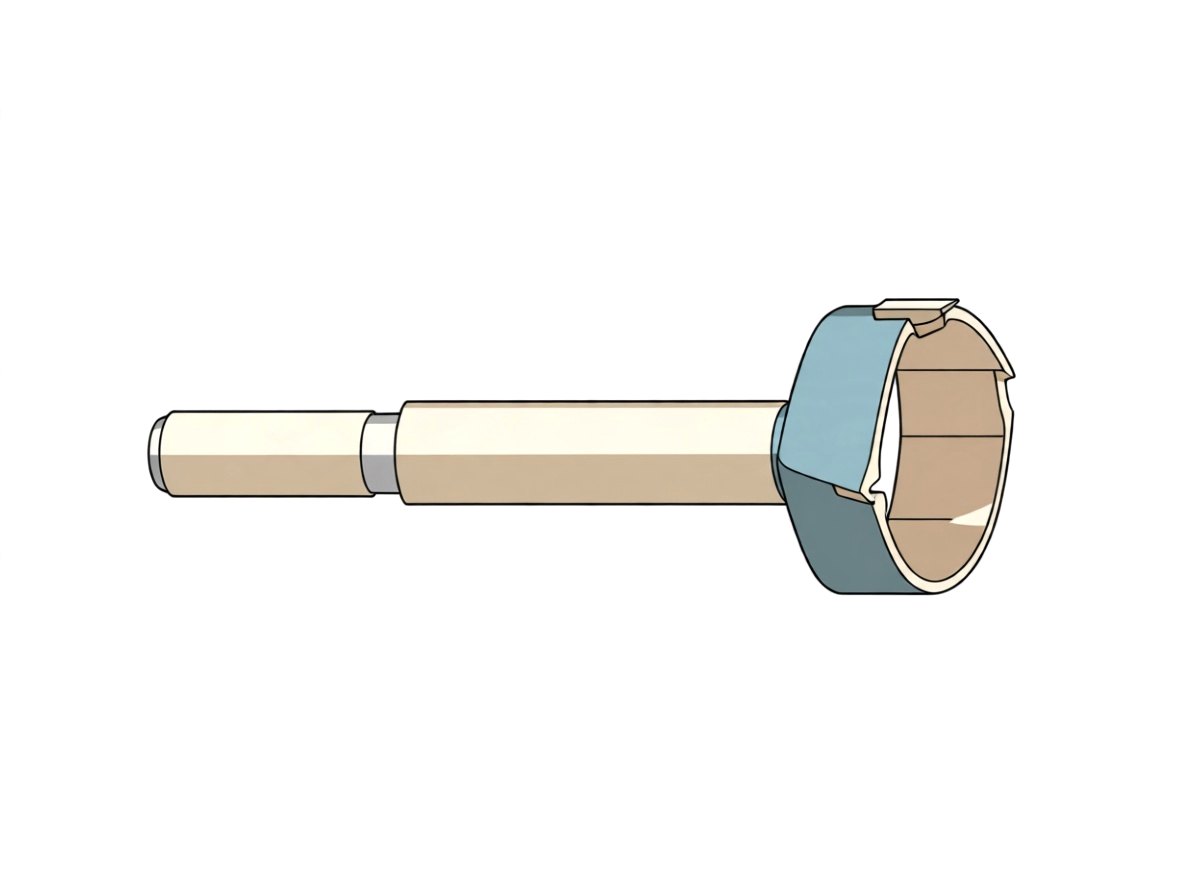
Inserts into the cylindrical guide sleeve of the jig to provide perpendicular alignment and linear sliding while rotating, with a stepped shoulder locating the stop collar.
Male and female halves
Male cylindrical shaft mating with the female guide sleeve/bushing of the Kreg Concealed Hinge Jig body.
Usually connects to
- Kreg Concealed Hinge Jig drill guide bushing female bore
- Kreg stop collar
- Standard 3/8-inch or 1/2-inch drill chuck
Common sizes
- Approximately 11 mm diameter guide shank section with standard stepped drill chuck arbor (for 35 mm hinge cup Forstner bit)
Where it is used
woodworkingcabinetry
Variations
- Kreg KHI-BIT replacement bit shank
- Foreman pocket hole jig stepped bit shank
How to recognise it
Recognised by a cylindrical steel drill bit shank featuring an upper drive section for drill chucks and an enlarged ground bearing surface with a collar positioning shoulder just above the 35 mm carbide cutter head.
Often confused with
| Confused with | How to tell them apart |
|---|---|
| Standard Forstner bit 3/8 in shank | Standard Forstner bits have uniform straight shanks without the stepped shoulder specifically dimensioned for the Kreg guide bushing and stop collar. |
| Kreg pocket-hole drill bit shank | Pocket hole drill bits feature a stepped twist drill bit rather than a 35 mm carbide cup cutter and have a different guide collar diameter. |
Also called
Kreg Concealed Hinge Jig bit shankKHI-BIT shank35 mm concealed hinge bit guide shank
Good to know
Proprietary tool interface on the Kreg KHI-BIT (Concealed Hinge Jig bit) designed specifically to interface with the guide collar of Kreg KHI-HINGE jig base.
Related connections
Design with real parts
Crafti checks which parts connect, right in your browser.