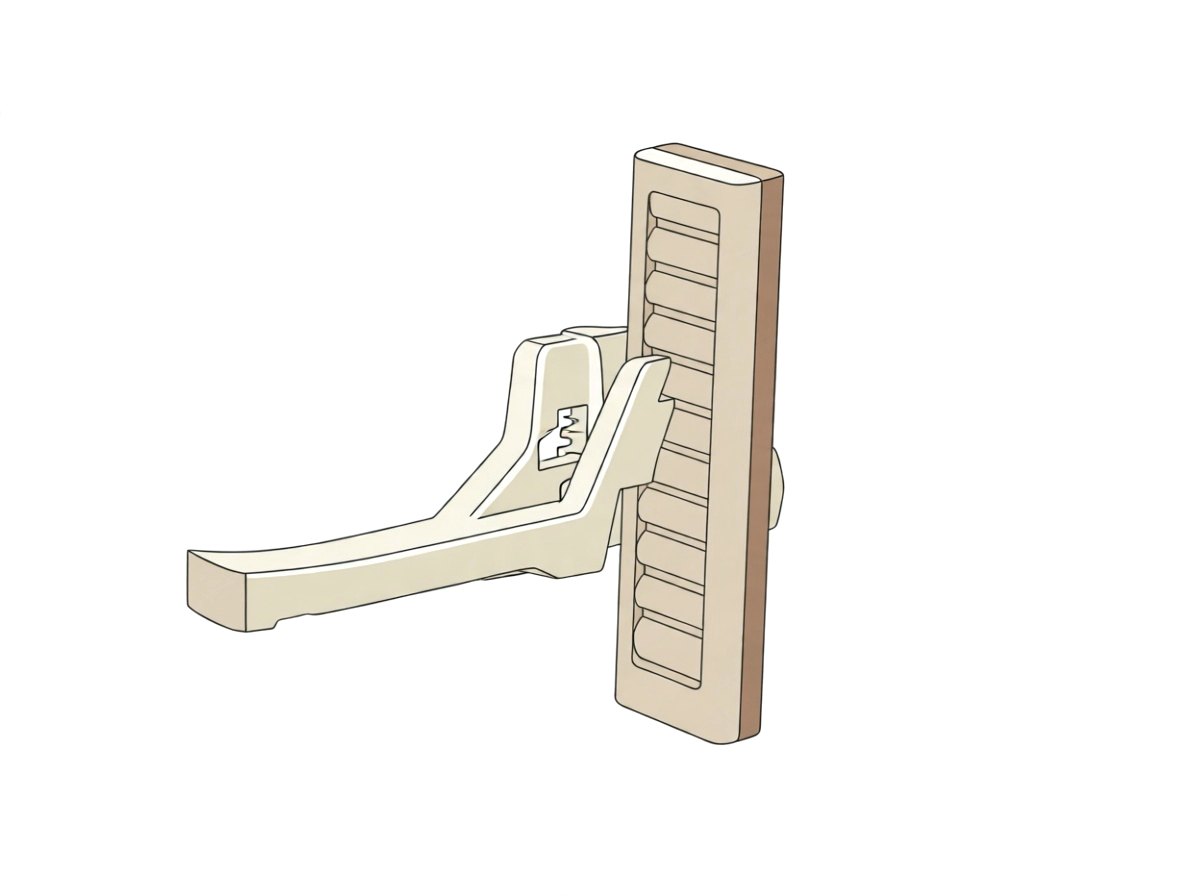
How it connects
The strap tail is pushed through the head slot; the pawl rides over the strap's ratchet teeth and engages them, preventing withdrawal (one-way ratchet). Not sealed; releasable versions have a lever on the pawl.
Male and female halves
The head is the receiving (female) half; the serrated strap tail is the inserted (male) half. Usually both are on the same part.
Usually connects to
Common sizes
- Slot matches strap width, commonly ~2.5 to 12.6 mm wide straps (e.g. 2.5, 3.6, 4.8, 7.6, 9 mm), lengths ~100 to 1000+ mm.
Where it is used
electrical cable bundlingautomotive harnessesgeneral fasteningpackaging
Variations
- nylon pawl (one-piece) head
- metal-barb pawl head (e.g. Panduit Barb-Ty)
- releasable/reusable head
- low-profile/inline head
- mounting-head ties
How to recognise it
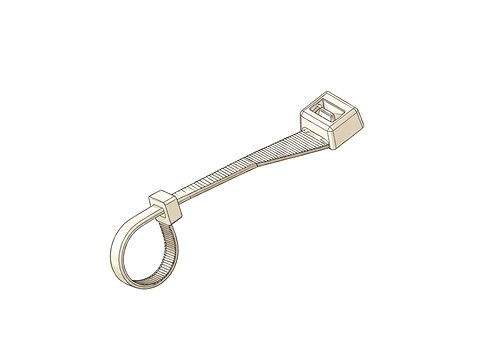
Small square/rectangular block at one end of a flat plastic strap, with a rectangular through-slot; looking in, a toothed tongue (pawl) is visible. The strap's other side carries transverse teeth.
Often confused with
| Confused with | How to tell them apart |
|---|---|
| Stainless steel ball-lock cable tie | Metal strap with a rolling ball lock and no teeth, versus nylon serrated strap with pawl |
| Hook-and-loop strap | Fabric strap with no rigid head or slot |
Also called
cable tie locking headzip tie headtie wrap headpawl head
Good to know
Proprietary per manufacturer; strap widths are not interchangeable across sizes. Typical performance specs (UL 62275 / IEC 62275 cable-tie standards) cover tie strength, not head geometry, so no dimensional standard listed. Both halves are on the same part, so the port is self-mating.
Related connections
Design with real parts
Crafti checks which parts connect, right in your browser.