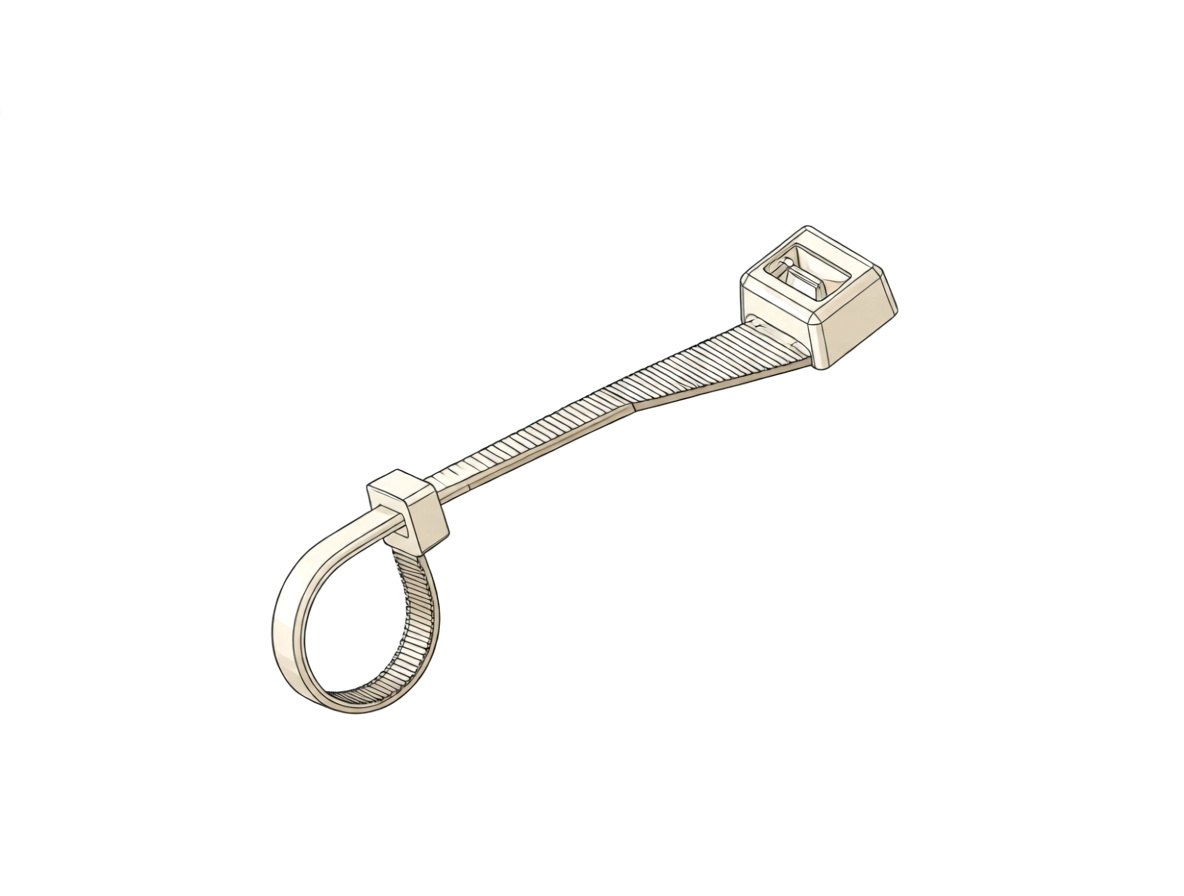
How it connects
Tail is pushed through the head's strap channel; a flexible pawl rides over the serrations and catches against them, giving a one-way ratchet lock. No sealing. Standard ties are permanent; release-type ties have a lever to lift the pawl.
Male and female halves
Tail/strap is the male (inserted) half; the head with strap channel and pawl is the female (receiving) half. This port is the male tail.
Usually connects to
Common sizes
- Strap widths roughly 2.5-9 mm (e.g. 2.5, 3.6, 4.8, 7.6, 9 mm), lengths about 100-1000 mm; mates only with heads of the same tie width/series.
Where it is used
electrical cable bundlingautomotive wiring harnessesgeneral fastening
Variations
- releasable/reusable cable ties
- mount-head and push-mount ties
- stainless steel ball-lock ties
- inside-serrated vs outside-serrated straps
How to recognise it
Long flat nylon strap with fine transverse teeth on one face and a tapered, unserrated tip; the opposite end has a square block head with a rectangular slot containing a pawl.
Often confused with
| Confused with | How to tell them apart |
|---|---|
| hook-and-loop strap | Hook-and-loop has no head or teeth; a cable tie tail has transverse serrations and a tapered tip. |
| hose clamp band | Hose clamp bands are metal with a screw/worm drive, not a plastic pawl head. |
Also called
cable tie tailzip tie strapratchet strap tongueserrated strap
Good to know
The male tail and female head are normally on the same cable tie. Widths are nominal and vary by maker, so cross-brand mating is not guaranteed. IEC 62275/UL 62275 address electrical cable-tie performance rather than mating dimensions; product applicability must be checked.
Related connections
Design with real parts
Crafti checks which parts connect, right in your browser.