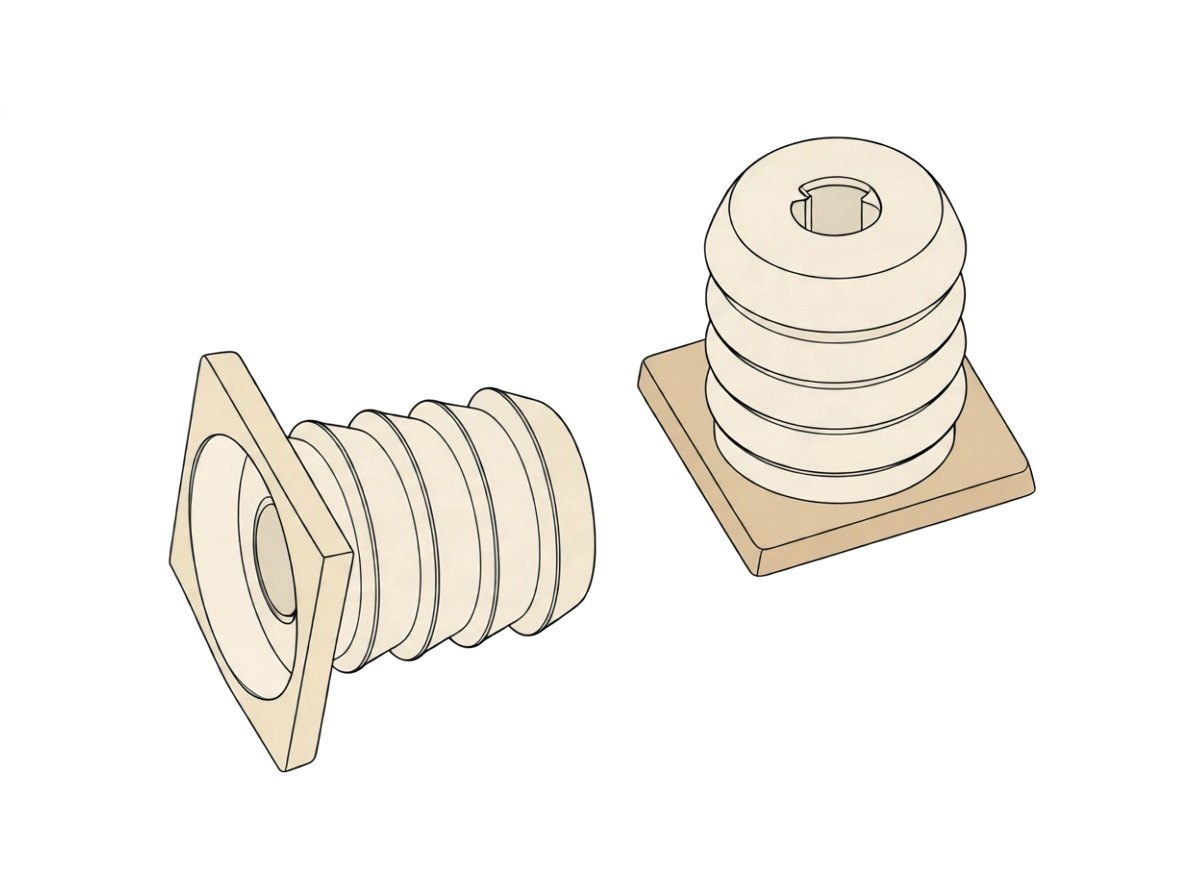
How it connects
Press-fitted or knocked into predrilled boreholes in wood/MDF/particleboard; internal screw expands the ribbed nylon dowel against borehole walls for friction retention.
Male and female halves
Male ribbed expansion sleeve mating into a female pre-drilled cylindrical blind borehole in a cabinet door panel.
Usually connects to
- Predrilled 8 mm or 10 mm cylindrical hole in cabinet door or carcass panel
Common sizes
- Typically 8 mm or 10 mm nominal outer diameter, commonly 8.5 mm to 11.5 mm insertion depth.
Where it is used
cabinetryfurniture manufacturingcaseworkarchitectural millwork
Variations
- 8 mm cylindrical dowel
- 10 mm cylindrical dowel
- non-flanged dowel insert
- pre-attached factory knock-in dowel
How to recognise it
Short, ribbed or barbed hollow plastic (often nylon) plug protruding from the mounting tabs of a concealed cabinet hinge cup, or supplied as separate inserts with expansion screws.
Often confused with
| Confused with | How to tell them apart |
|---|---|
| Wooden furniture dowel | Wooden dowels are fluted solid wood glued into matching holes; plastic hinge dowels are hollow ribbed/barbed nylon sleeves expanded by mounting screws or press-fitted mechanically. |
| Screw-on hinge mounting hole | Screw-on hinge tabs feature simple clearance holes for wood screws without pre-mounted barbed dowels and require smaller pilot holes. |
Also called
knock-in dowelhinge expansion dowelcabinet hinge plastic dowel insertpress-in hinge dowelbarbed plastic dowel
Good to know
Commonly used in European / System 32 style concealed cabinet hinge cups (such as Blum, Grass, or Salice) for rapid machine insertion or strong holding power in particleboard/MDF. Dowels can often be unscrewed or driven out if converting to direct screw-in mounting.
Related connections
Design with real parts
Crafti checks which parts connect, right in your browser.