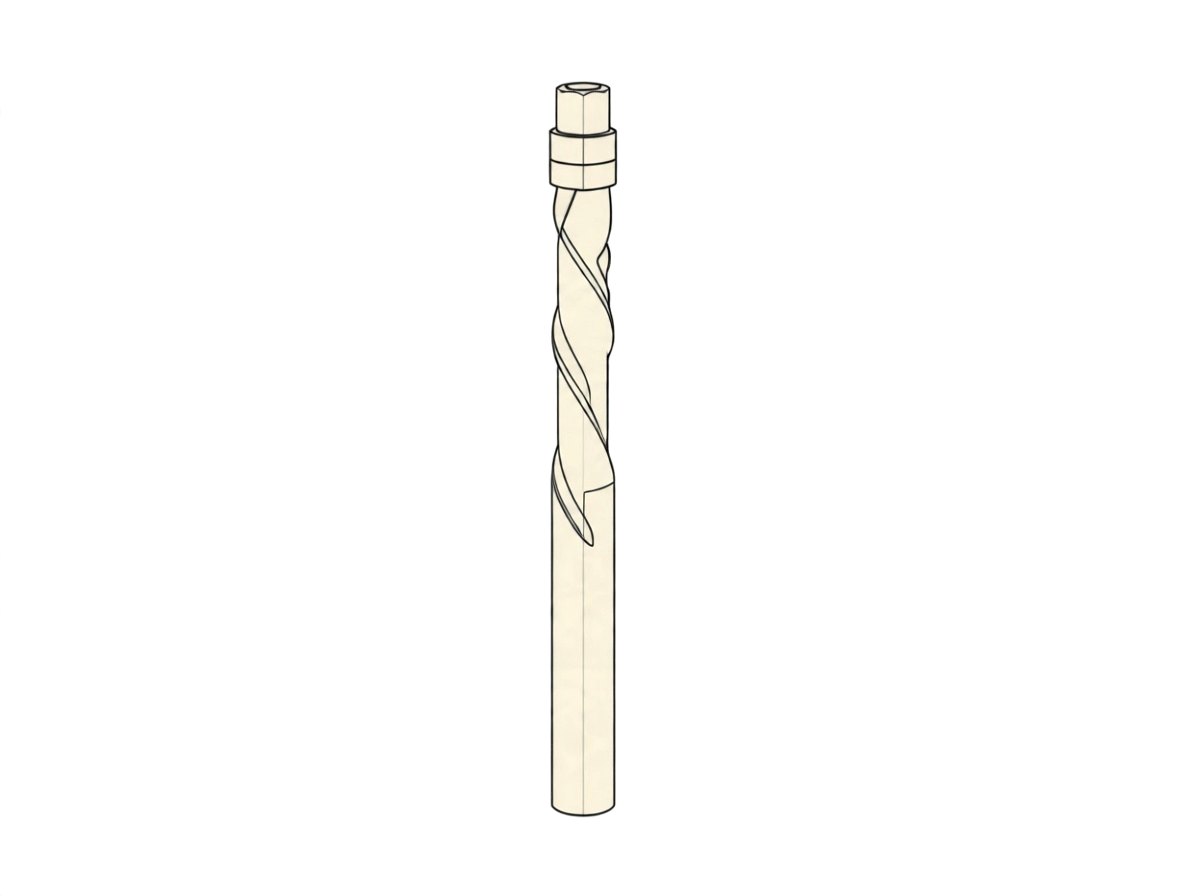
How it connects
Inserts axially into a slotted, tapered collet sleeve that contracts radially around the cylindrical shank when the collet nut is tightened, gripping it securely via high friction.
Male and female halves
Male cylindrical shank that inserts into a female router collet chuck/cone.
Usually connects to
- router collet chuck
- router collet reducer/adapter sleeve
Common sizes
- Commonly 1/4" (6.35 mm) and 1/2" (12.7 mm); less commonly 8 mm, 3/8" (9.525 mm), 12 mm, or 1/8" (3.175 mm for rotary tools/small CNC).
Where it is used
woodworkingCNC routingcabinetryedge profilingjoinery
Variations
- 1/4-inch shank
- 1/2-inch shank
- 8mm shank
- 12mm shank
How to recognise it
Smooth, polished cylindrical steel or solid carbide rod forming the base/mounting end of a router bit, without splines, threads, or hex flats (often laser-etched with minimum insertion markings or diameter).
Often confused with
| Confused with | How to tell them apart |
|---|---|
| hex shank | Hex shanks have six flat sides designed for quick-release drill/driver chucks; router shanks are precisely ground, completely round cylinders. |
| weldon shank | Weldon shanks have one or more machined set-screw flats, whereas standard router shanks are smooth cylindrical. |
Also called
router bit shankstraight router shankcylindrical router shank
Good to know
Routers utilize interchangeable split collets sized precisely to the shank diameter. Mismatched shanks (e.g., placing a 1/4" shank in an 8mm or 1/2" collet without a reducing sleeve) will slip or cause catastrophic failure.
Related connections
Design with real parts
Crafti checks which parts connect, right in your browser.