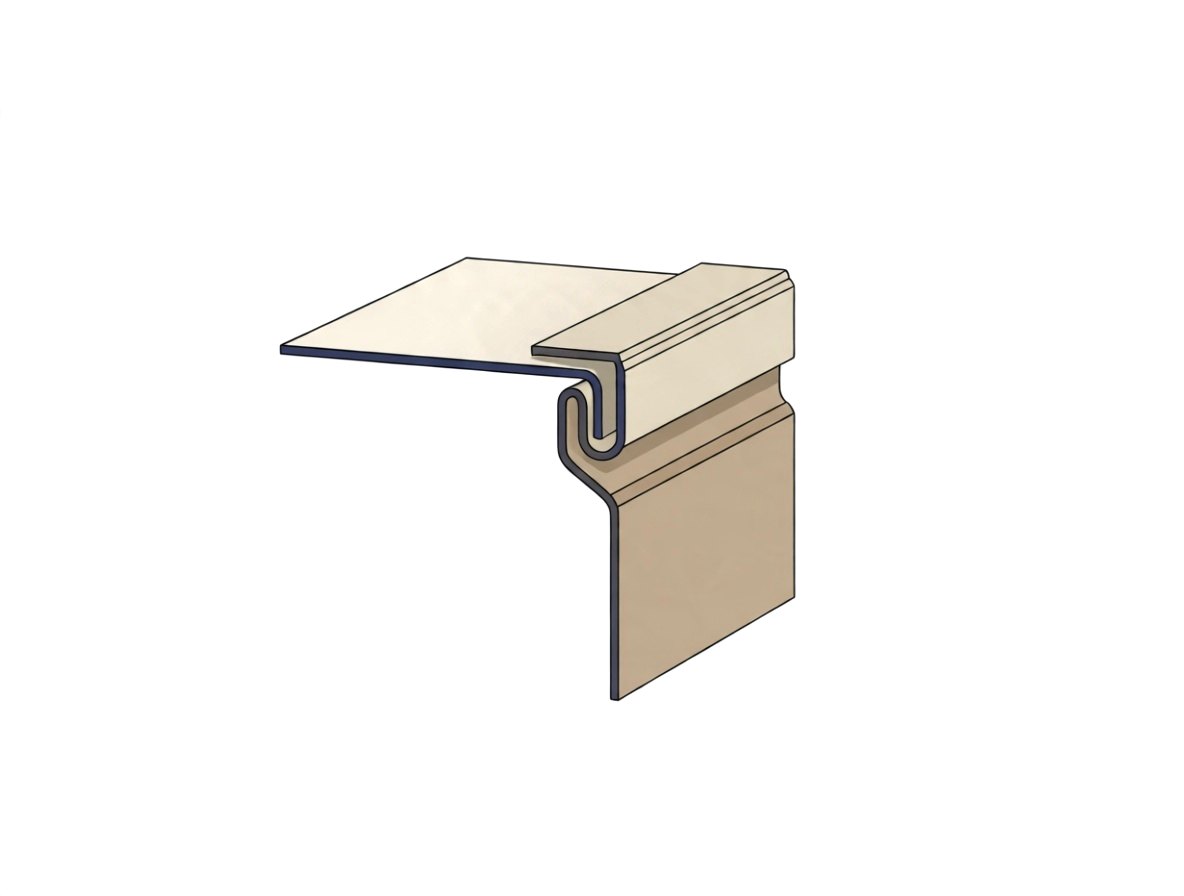
How it connects
The flanged edge is pushed into the pocket along the seam length; a formed lip or button-punch dimples catch it so it cannot pull out. Not airtight by itself; sealed with duct mastic or foil tape.
Male and female halves
Male = flanged edge / tongue (this port); female = the pocket or receiver formed by a roll former (often a Pittsburgh/snap-lock machine). Two L-halves join at two corner seams to make a rectangular duct.
Usually connects to
Common sizes
- Light-gauge duct examples span about 30–18 gauge, with 28–18 gauge described as 0.48–1.2 mm.
- Male flanges commonly 1/4–1/2 in (6–13 mm); female pockets about 1/2–5/8 in, depending on gauge/machine.
- Duct lengths commonly 4–5 ft, with examples 3–10 ft; round pipe about 3–12 in diameter and rectangular examples 6 × 8–14 × 30 in.
Where it is used
Residential/light-commercial HVAC fabricationRound, rectangular, stack and wall ductworkSheet-metal ventilation/exhaustDust collection
Variations
- Round-pipe longitudinal snap-lock
- Button-punch profile, including 20/24 gauge
- Reeves snap-lock
- Pittsburgh male right-angle flange
- Rectangular half-section stack-duct snap seam
- Factory-sealed seam, such as GreenSeam
How to recognise it
Look along a duct corner: one sheet edge ends in a short bent-up flange (sometimes with dimples/a crimp), the other has a folded U-shaped pocket running the full length. The flange edge is the male tongue.
Often confused with
| Confused with | How to tell them apart |
|---|---|
| Pittsburgh lock seam | Pittsburgh pocket receives a plain 90° flange that must be hammered over the pocket after insertion; snap lock just snaps in with no hammering and has a catch on the flange/pocket. Pittsburgh's male flange is plain (no buttons) and the pocket's lip is hammered over after insertion; snap lock has dimples on the flange and snaps in without hammering. |
| Transverse Duct Joint (e.g. S-Cleat, Drive Cleat, TDC/TDF) | Cleats join duct sections end-to-end (transverse); snap lock runs along the length (longitudinal) joining duct halves. Longitudinal seams run parallel to airflow down the duct length to form the tube/box profile, whereas transverse joints join successive duct sections end-to-end perpendicular to airflow. |
| Standing/snap-lock roof panel seam | Standing seam projects outward as an upright rib; snap lock is a corner seam flush with the duct wall. Roofing seams are on wide roof panels standing up from the roof plane, not duct corners. |
Also called
snaplock seamsnap lock seam male edgeflanged edge (snap lock)button punch snap lock (with dimples); button punch snap lock (male side)Pittsburgh-style snap locksnap-lock male flangePittsburgh Male FlangeLongitudinal Seam Male Tongue
Good to know
The longitudinal snap-lock edge is separate from the cleated transverse ends of a duct section.
Related connections
Design with real parts
Crafti checks which parts connect, right in your browser.