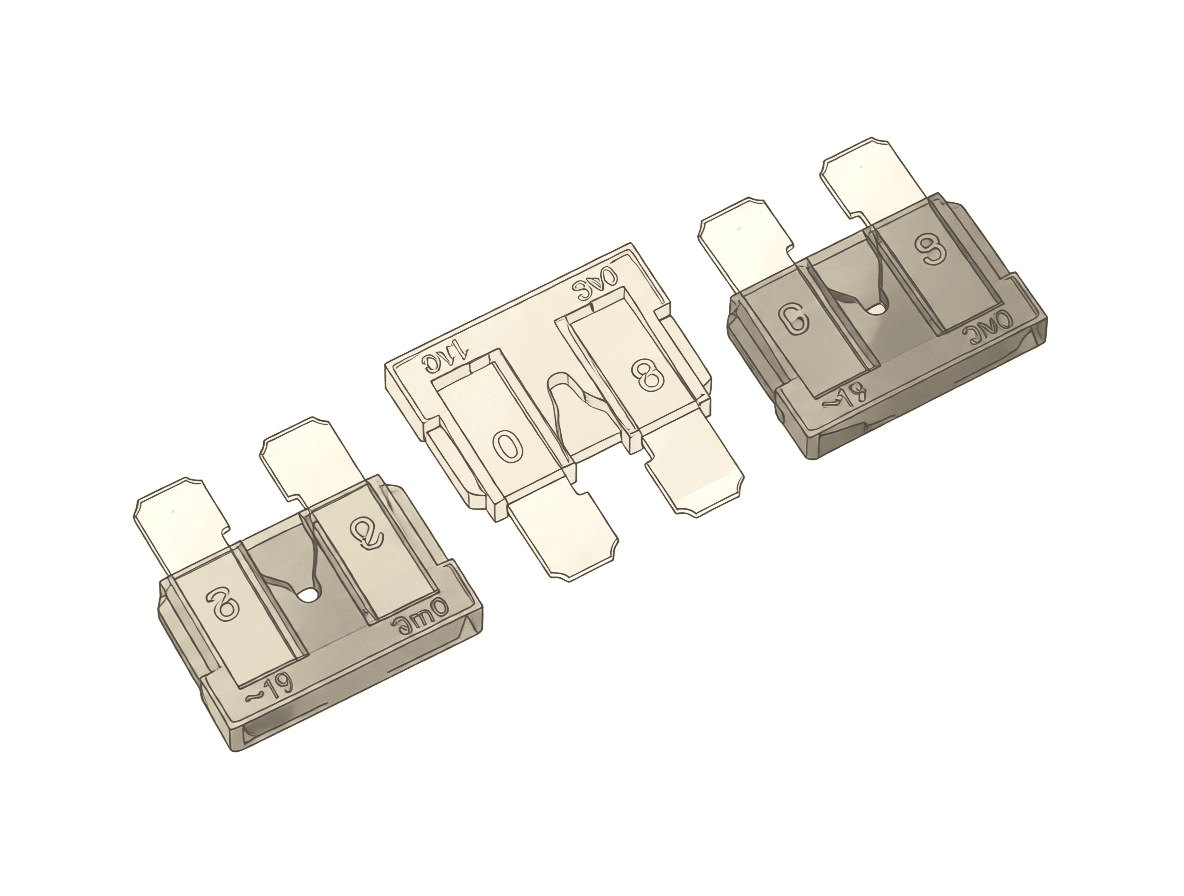
How it connects
Blades push straight into two female tuning-fork/spring contacts and are held by contact pressure; no lock, not sealed by itself (waterproof holders have a cap).
Male and female halves
The fuse carries the male blades; the fuse holder/fuse box carries the female contacts. This port is the male side.
Usually connects to
- ATO/ATC fuse holder / fuse box socket (female spring clips)
- add-a-circuit fuse tap
Common sizes
- Standard ATO/ATC body about 19 x 5 x 18 mm (blades ~6.3 mm wide, ~0.6-0.8 mm thick, spaced ~5 mm); ratings 1-40 A, colour coded (10 A red). Other blade sizes: micro2, micro3, mini (APM/ATM), low-profile mini, maxi (APX).
Where it is used
automotive electricalmarineRV and 12/24 V DC systems
Variations
- ATO (open element)
- ATC (closed element)
- mini/ATM
- low-profile mini
- micro2
- micro3
- maxi
How to recognise it
Coloured translucent plastic body with an amp number on top and two parallel flat metal blades protruding from one edge; ~19 mm wide body distinguishes the standard size from mini or micro.
Often confused with
| Confused with | How to tell them apart |
|---|---|
| Mini (ATM/APM) blade fuse | Mini is about 11 mm wide vs ~19 mm for standard ATO/ATC; blades are shorter and closer together. |
| 6.3 mm (1/4 in) quick-connect spade terminal | A quick-connect is a single crimped wire tab with a detent hole; fuse blades are a pair moulded into a plastic fuse body. |
Also called
ATO fuseATC fuseregular blade fusespade fuseplug-in fuse
Good to know
The connection is the fuse-size family, not a generic spade; choose the connection type by blade size (standard ATO/ATC here, per the sample part '10 A standard blade fuse'). Standard references are from general knowledge.
Related connections
Design with real parts
Crafti checks which parts connect, right in your browser.