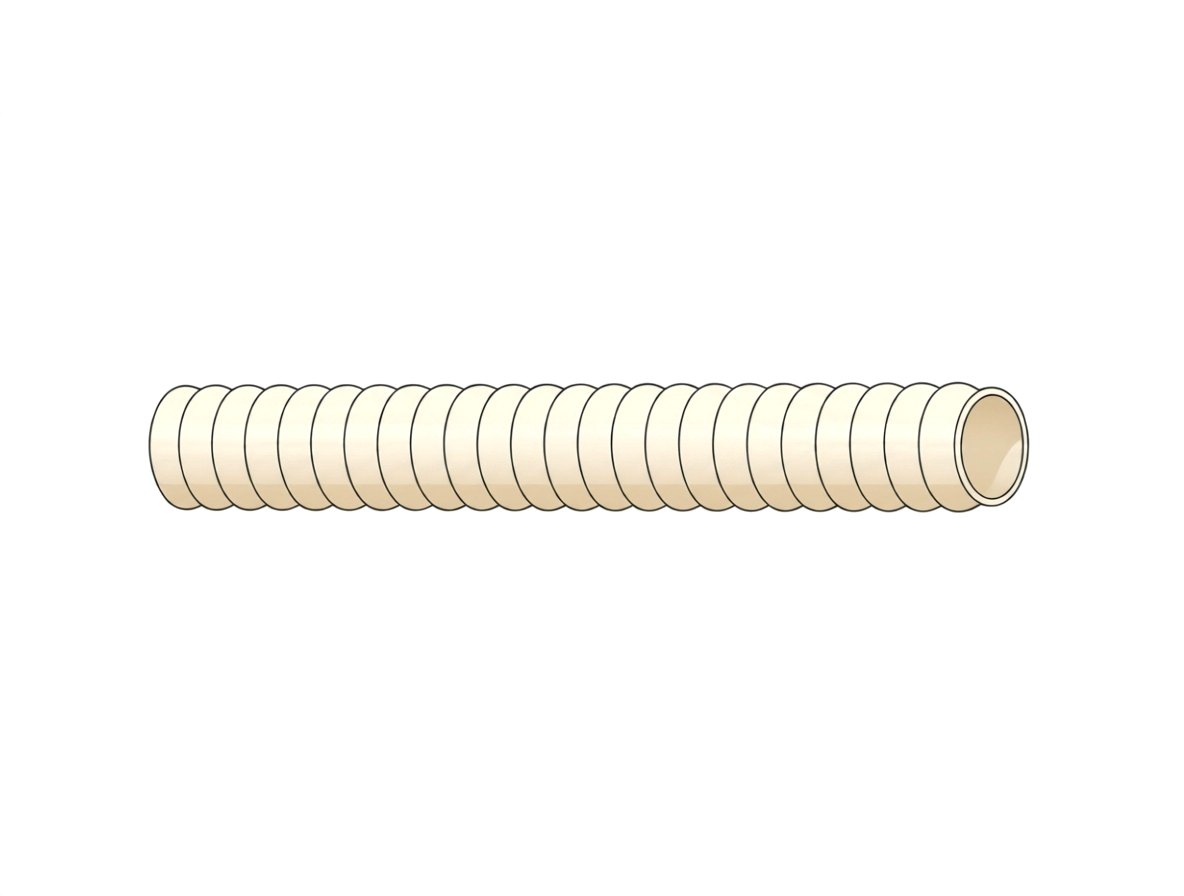
How it connects
The cut conduit end is received and mechanically retained by a compatible listed FMC fitting; the exact gripping mechanism depends on the fitting. The bare conduit end itself provides no liquidtight seal.
Male and female halves
“Male FMC” describes the conduit entering a receiving fitting here; it is not a standardized male pipe thread. The separate fitting may also have a male threaded box-entry end.
Usually connects to
- Listed matching FMC connector: squeeze/clamp, screw-in/twist-in or set-screw type, including duplex insert versions
- Listed FMC coupling
- FMC-to-EMT/rigid combination coupling
- Electrical-box knockout through the appropriate connector
Common sizes
- FMC trade sizes 3/8–4 in (metric designators 12–103); 1/2, 3/4 and 1 in are common.
- Southwire RWA 3/8 in example: ID 0.375–0.393 in (9.525–9.9822 mm), OD 0.560–0.610 in (14.224–15.494 mm). Trade size is not OD.
Where it is used
Electrical conductor and cable racewaysPower and lighting branch circuitsEquipment and motor wiringcommercial and residential electrical wiringmotor and equipment whipslight fixture whips
Variations
- Different FMC trade sizes
- Reduced-wall aluminum FMC (the cited example)
- steel or aluminum FMC
- heavy-wall FMC
How to recognise it
Look for an open bore at the cut end of a flexible, helically interlocked metal strip tube, without an attached connector or machined pipe thread. Verify FMC marking, material and trade size from documentation; the spiral alone does not establish fitting compatibility.
Often confused with
| Confused with | How to tell them apart |
|---|---|
| Male NPT conduit connector | NPT has a machined tapered pipe thread on a fitting. This end is the open helically interlocked conduit itself. |
| Rigid conduit plain end | Rigid conduit has a solid tube wall; FMC consists of interlocked metal strip and bends flexibly. |
| Liquidtight flexible metal conduit end | Liquidtight conduit has an outer jacket and requires its compatible sealing fitting; the cited FMC is bare interlocked aluminum. |
| Liquidtight flexible metal conduit (LFMC) | LFMC has a smooth PVC jacket over the metal core and uses sealed liquidtight connectors with a ferrule; FMC has bare interlocked metal. |
| Armored cable (AC/MC) | AC/MC comes with conductors already inside and uses cable connectors; FMC is an empty raceway. |
Also called
Plain FMC endCut flexible metal conduit endAluminum flex conduit endGreenfieldreduced-wall flex (RWS)
Good to know
This is a plain FMC conduit end rather than a male-thread standard. Choose a listed FMC fitting instead of relying on a generic slip fit.
Related connections
Design with real parts
Crafti checks which parts connect, right in your browser.