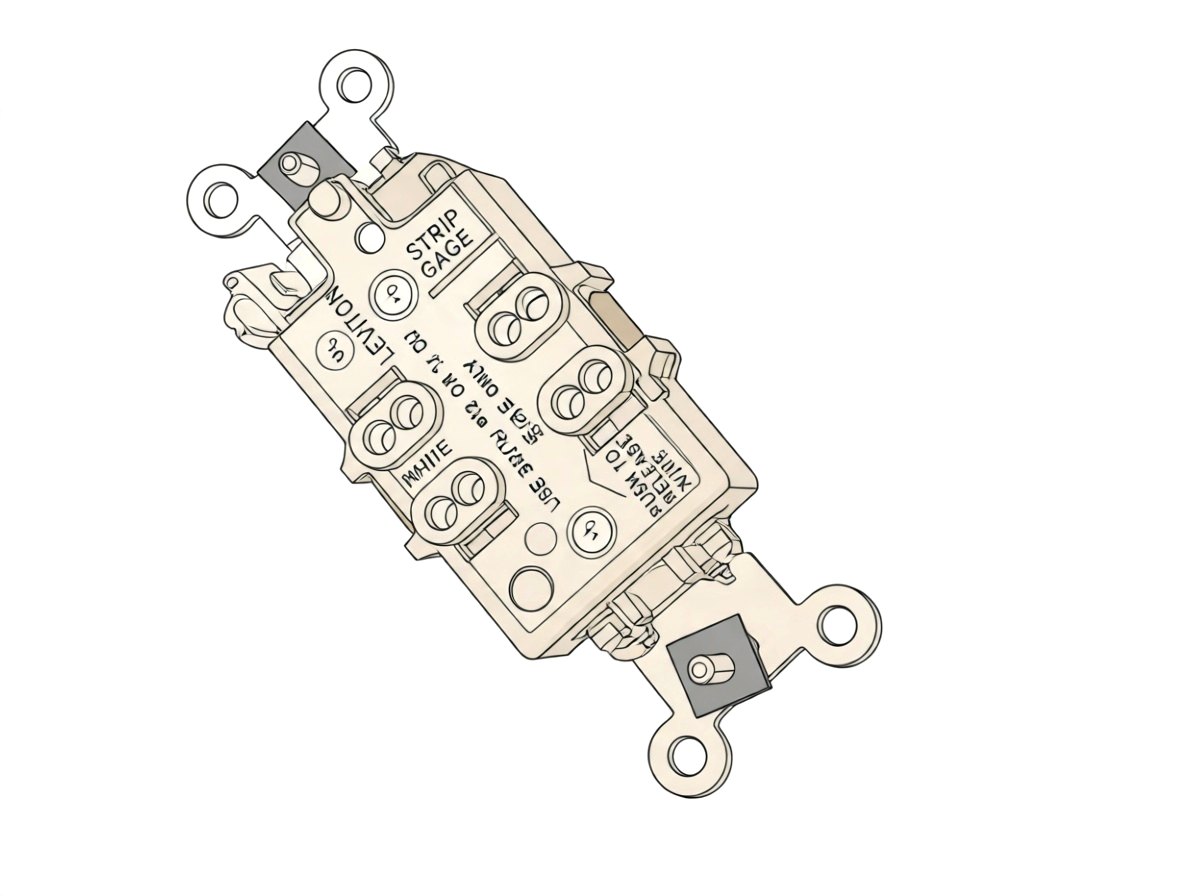
How it connects
Stripped wire (length set by the strip gauge molded on the device) is pushed straight into the hole; a spring brass/copper leaf grips it and makes contact. Released by pushing a screwdriver into the adjacent release slot. No seal.
Male and female halves
The terminal hole is the receiving (female) side; the bare wire end is the inserted part. This port is the female terminal.
Usually connects to
- stripped solid copper building wire, #14 AWG (on 15 A devices); #14 AWG solid copper building wire (stripped end)
Common sizes
- Current 15 A Quickwire devices accept #14 AWG solid copper only (about 1.6 mm); some older devices also accepted #12.
- Side-wire screws on the same Leviton device accept #10–#14 AWG; this is separate from the push-in rating.
Where it is used
residential electrical wiring deviceswall switcheswiring devices (receptacles, switches)
Variations
- push-in plus side-wire screw terminals (combo)
- screw-and-clamp back wire (different: screw-tightened pressure plate)
- Push-in only (no release)
- Push-in with release slot
- Push-in combined with side-wire screw terminals
How to recognise it
Small round holes in the back of the device body, often labelled 'push to release' with a slot beside each, a molded 'STRIP GAGE' and text like '#14 CU WIRE ONLY'; white/neutral and hot side holes. Side screw terminals often present too.
Often confused with
| Confused with | How to tell them apart |
|---|---|
| Back-wire clamp (screw-pressure plate) terminal | Back-wire clamp holes sit beside a terminal screw that tightens a plate and usually take #12/#14 straight wire; push-in has no screw, only a small release slot. Back-wire clamps have a screw that tightens a plate onto the wire and accept 10-14 AWG. Quickwire has no screw for the hole and is 14 AWG only. |
| lever/push-in wire connector (e.g. Wago) | Those are standalone splice connectors, not holes in the back of a device. |
| Push-in splice wire connector (e.g. Ideal In-Sure, Wago) | Those are separate splice blocks that join wires together. Quickwire is built into the device body. |
| Pipe push-to-connect fitting | Pipe push-fit fittings take tubing and seal fluid. This terminal takes an electrical conductor. |
Also called
backstabback-stab terminalpush-in back wirepush-in wire terminalspeed wiring
Good to know
This terminates building wire rather than mating with a plug. The Leviton 5320 example accepts #14 AWG only; follow its strip-gauge marking.
Related connections
Design with real parts
Crafti checks which parts connect, right in your browser.