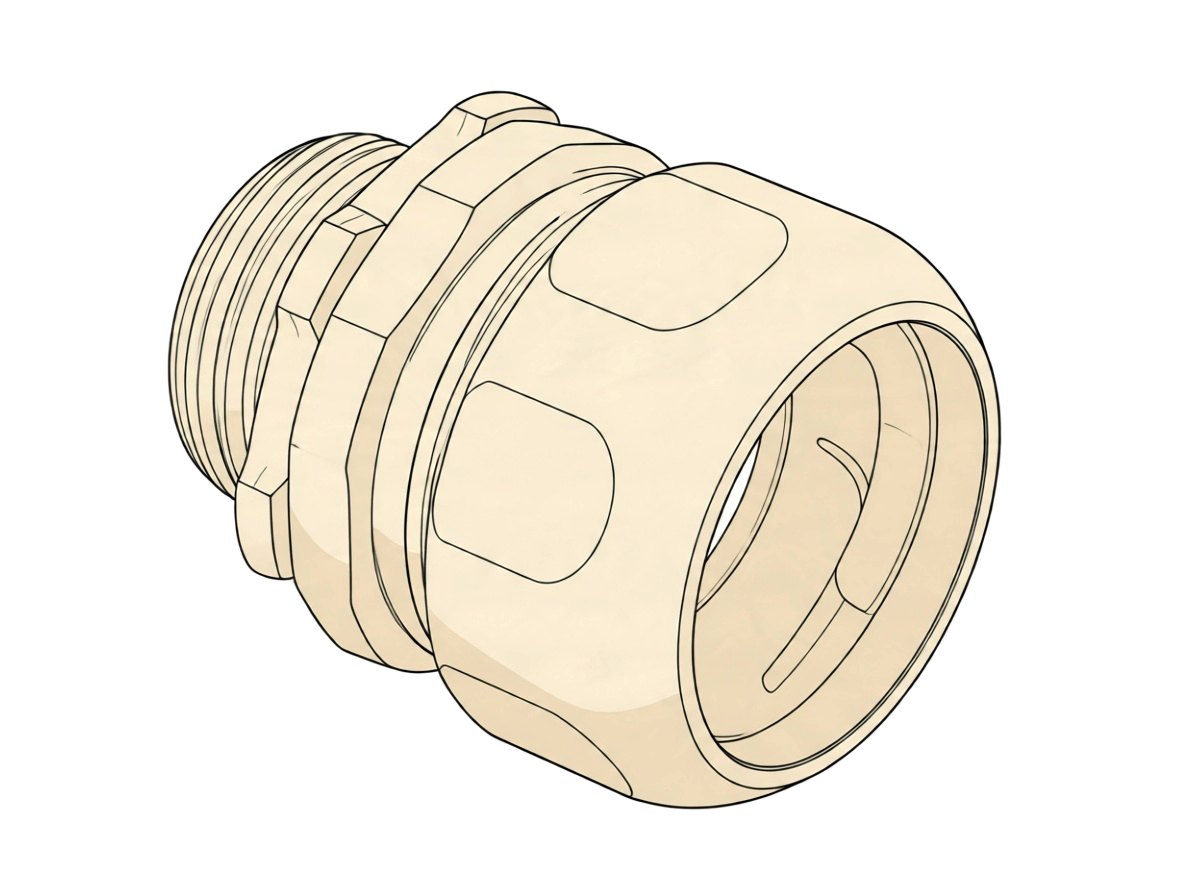
How it connects
Conduit slides into the socket to a stop; tightening the compression nut drives a split steel ring/gland onto the conduit OD, gripping it mechanically and providing electrical continuity. Raintight versions add a sealing ring.
Male and female halves
This is the female (socket) side; the male is the bare conduit end itself. The other end of the fitting is typically a male NPS/NPT-style enclosure thread with locknut (connector) or a second compression socket (coupling).
Usually connects to
- Plain, unthreaded cut end of matching RMC, including rigid steel conduit
- Plain-end matching IMC
Common sizes
- RMC/IMC trade sizes commonly 1/2–4 in, with some lines reaching 6 in; socket ID matches conduit OD.
- Example RMC ODs: 3/4 in = 1.050 in (26.7 mm); 1 in = 33.4 mm.
Where it is used
commercial and industrial electrical wiringconduit raceway systemselectrical conduit systems
Variations
- coupling (compression x compression)
- raintight/concrete-tight versions
- insulated-throat connectors
- set-screw threadless type (different grip method)
- compression coupling (socket both ends)
- compression connector (socket x male box thread)
How to recognise it
Zinc-plated steel or malleable iron fitting with a large hex compression nut over a smooth bore (no internal threads), often marked 'RGD/IMC' or 'Rigid'; a split ring is visible inside the bore. Connector versions have a short male thread and locknut on the other end.
Often confused with
| Confused with | How to tell them apart |
|---|---|
| EMT compression fitting | EMT fittings are sized for thinner, smaller-OD EMT tubing; rigid/IMC fittings are larger and heavier and labelled RGD/IMC. |
| Threaded rigid conduit coupling | Threaded couplings have internal NPT threads and no compression nut/ring. |
| Plumbing compression fitting | Plumbing types use a brass/copper ferrule for a pressure seal; electrical ones are zinc-plated steel or malleable iron grips, not pressure-rated. |
| Threaded rigid coupling (NPT) | Threaded couplings have internal tapered threads and no nut/ring; the threadless socket is smooth with a hex compression nut. |
| Set-screw threadless rigid fitting | Grips with radial screws instead of a nut and ring. |
Also called
rigid/IMC compression coupling endthreadless rigid couplingRGD/IMC compression fittingthreadless rigid compression connector endthreadless rigid fitting
Good to know
The sample part's port (3/4 in, ~27 mm socket) matches 3/4 in RMC/IMC OD. RMC and IMC share nearly the same OD per trade size, so one fitting serves both. UL 514B listing is from general knowledge, not a fetched source.
Related connections
Design with real parts
Crafti checks which parts connect, right in your browser.