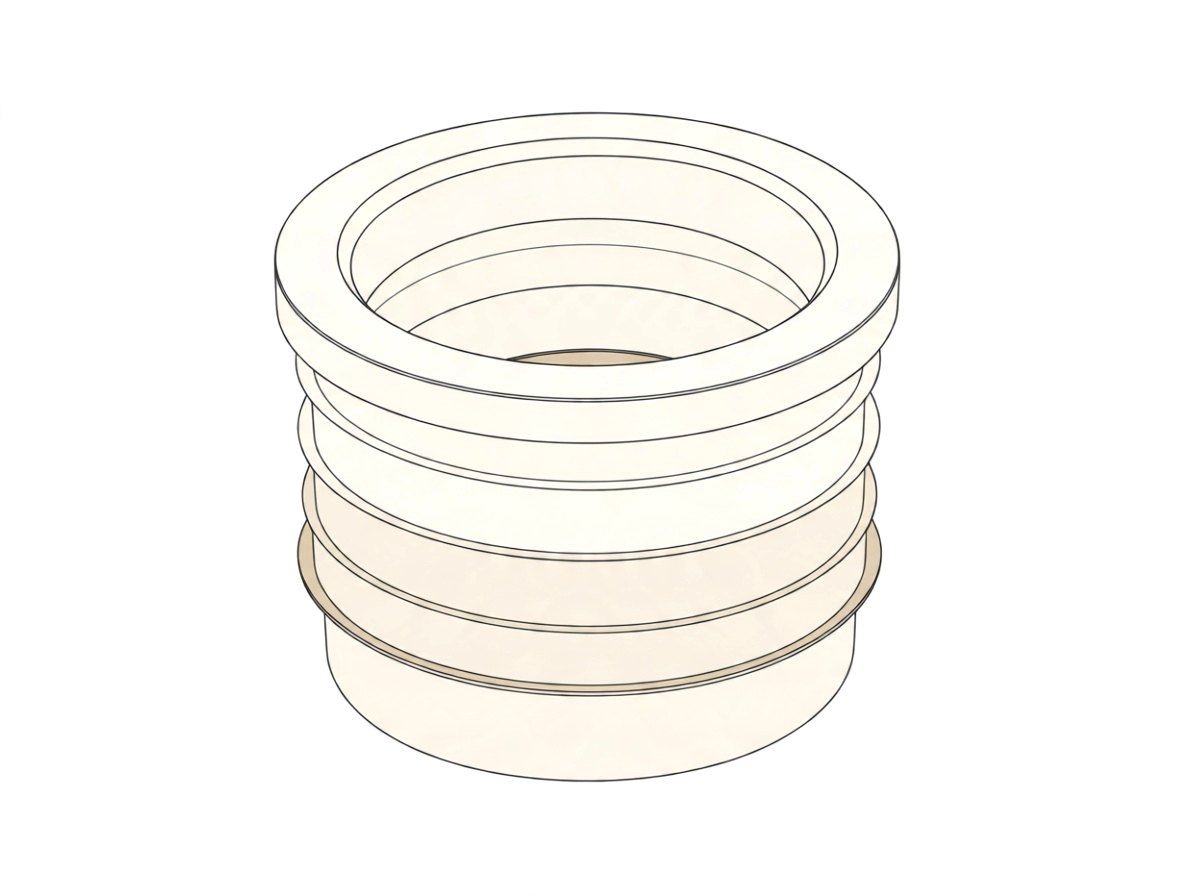
How it connects
The donut is seated in a clean hub with pipe through its bore. Compression between hub, donut and pipe forms the seal without threads, cement, lead or oakum.
Male and female halves
Here “male” describes the donut exterior entering the female hub. It is a port-model description, not a threaded male standard; the same donut has an inner receiving bore for pipe.
Usually connects to
- Inside of a matching service-weight cast-iron hub
Common sizes
- Fernco lists standard service-weight hub sizes of 2, 3 and 4 inches, with several pipe-size combinations. 22U-205 is 2-inch hub × 2-inch Schedule 40 plastic. Match actual hub bore and pipe OD when uncertain.
Where it is used
Sewer pipingDrain, waste and vent pipingPlastic pipe tie-ins to existing cast-iron hubs
Variations
- Same-size and reducing donuts
- Other donuts for extra-heavy cast-iron hubs or clay bells; not automatically interchangeable
How to recognise it
Look for an unthreaded annular flexible sleeve with circumferential sealing ribs and an inner pipe bore. Verify molded part number, intended hub class, hub bore and mating pipe size; nominal size alone is insufficient.
Often confused with
| Confused with | How to tell them apart |
|---|---|
| Extra-heavy cast-iron hub donut | Confirm hub class or measure its bore; Fernco states extra-heavy hubs are larger inside. |
| External flexible coupling for plain pipe ends | A donut seals inside a hub; a cut end without a hub requires a different coupling. |
Also called
Hub compression donutCompression joint sealCast-iron hub adapter gasket
Good to know
This connection describes the gasket’s outer seal against the cast-iron hub. Estimated dimensions are not fit specifications.
Design with real parts
Crafti checks which parts connect, right in your browser.