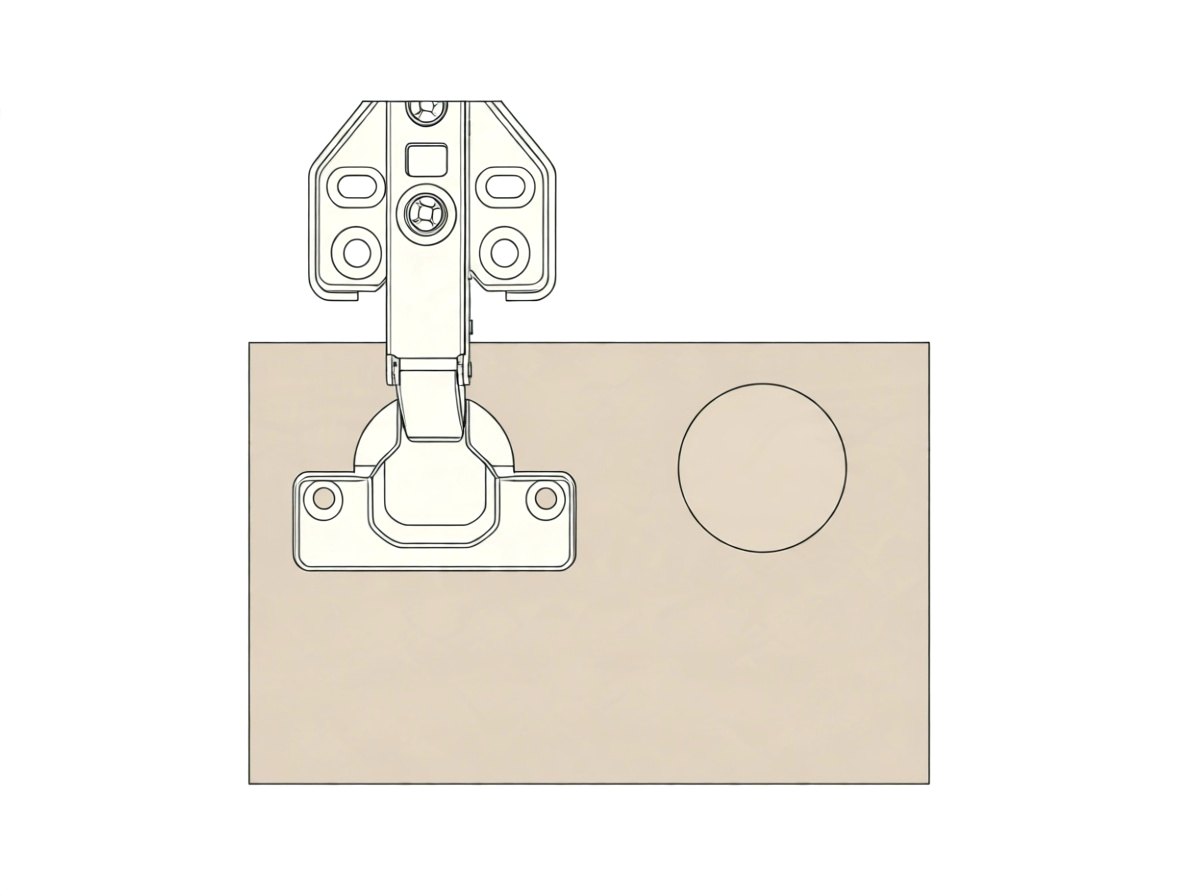
How it connects
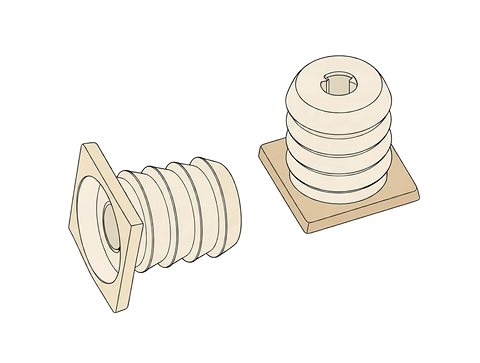
The hinge cup drops into the bore. It is held by screws through the cup flange, or by press-in dowels (pressed or knocked in), or by expanding inserts. The bore only locates the cup; the joint does not seal.
Male and female halves
The bore is the female half and the hinge cup is the male half. This port is the female bore; on a repair plate it is a through clearance hole with no lip.
Usually connects to
- Matching concealed-hinge cup, commonly 35 mm or corresponding 26/40 mm versions
- Matching 35 mm hinge-hole plug
- Cabinet mounting plate through the hinge arm’s separate clip/screw attachment
Common sizes
- 35 mm (about 1-3/8 in) is the common cup bore; mini 26 mm and less-common 40 mm versions also exist.
- Typical depth 11–13.5 mm, often 11.5/12/13 mm, with 3–6 mm boring distance from the door edge. Flange-hole spacings commonly 45–52 mm.
Where it is used
Furniture making/woodworkingKitchen/bath cabinetryFrameless/face-frame cabinetsArchitectural millwork
Variations
- 35 mm standard cup bore
- 26 mm mini or 40 mm heavy-duty bore
- Pilot screw holes
- Flanking 8 mm dowel bores at 45/48/52 mm spread
- Through-opening in a hinge repair plate
How to recognise it
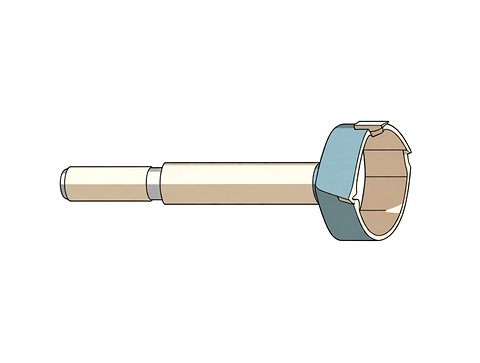
A flat-bottomed round hole, about 35 mm across, near the hinge edge of a cabinet door, made with a Forstner bit. It often has two pilot or dowel holes on a line parallel to the edge. On a repair plate it is a 35 mm through hole surrounded by screw holes.
Often confused with
| Confused with | How to tell them apart |
|---|---|
| Pipe or socket bore | A hinge cup bore is a shallow, flat-bottomed, unthreaded hole near a door edge, usually with two small screw or dowel holes beside it. |
| 26 mm mini hinge cup bore | 26 mm is smaller, typically used on small or lightweight cabinet doors. |
| Through-hole bore | A hinge cup bore is a flat-bottomed blind hole drilled only partially through the door (typically 11.5–13 mm deep) rather than penetrating through. Hinge cup bores are strictly blind (stopping 2–4 mm short of the outer door face) with a flat bottom machined by a Forstner bit, rather than penetrating through the panel. |
| Cam lock housing bore (minifix) | Cam lock bores are typically 15 mm or 12 mm in diameter and intersect with an edge-drilled bolt hole, whereas hinge cup bores are much larger (usually 35 mm) positioned near the door edge. |
| Hinge mounting plate (cabinet side) | The plate is a flat bracket screwed to the cabinet side/face frame; the cup bore is a round 35 mm recess in the door back. |
Also called
35 mm hinge cup hole; 35 mm concealed hinge hole; 35 mm hinge cup boreEuropean hinge boringForstner hinge holeEuro hinge cup mortisecabinet hinge cup borehinge cup recessconcealed hinge borehinge pot bore
Good to know
This is a hardware fit (hinge cup in a bore), not a fluid or electrical connection. Hole diameter is a de facto industry size; I found no formal standard. The sample part is a repair plate, so its port is a through clearance hole, not a blind bore.
Related connections
Design with real parts
Crafti checks which parts connect, right in your browser.