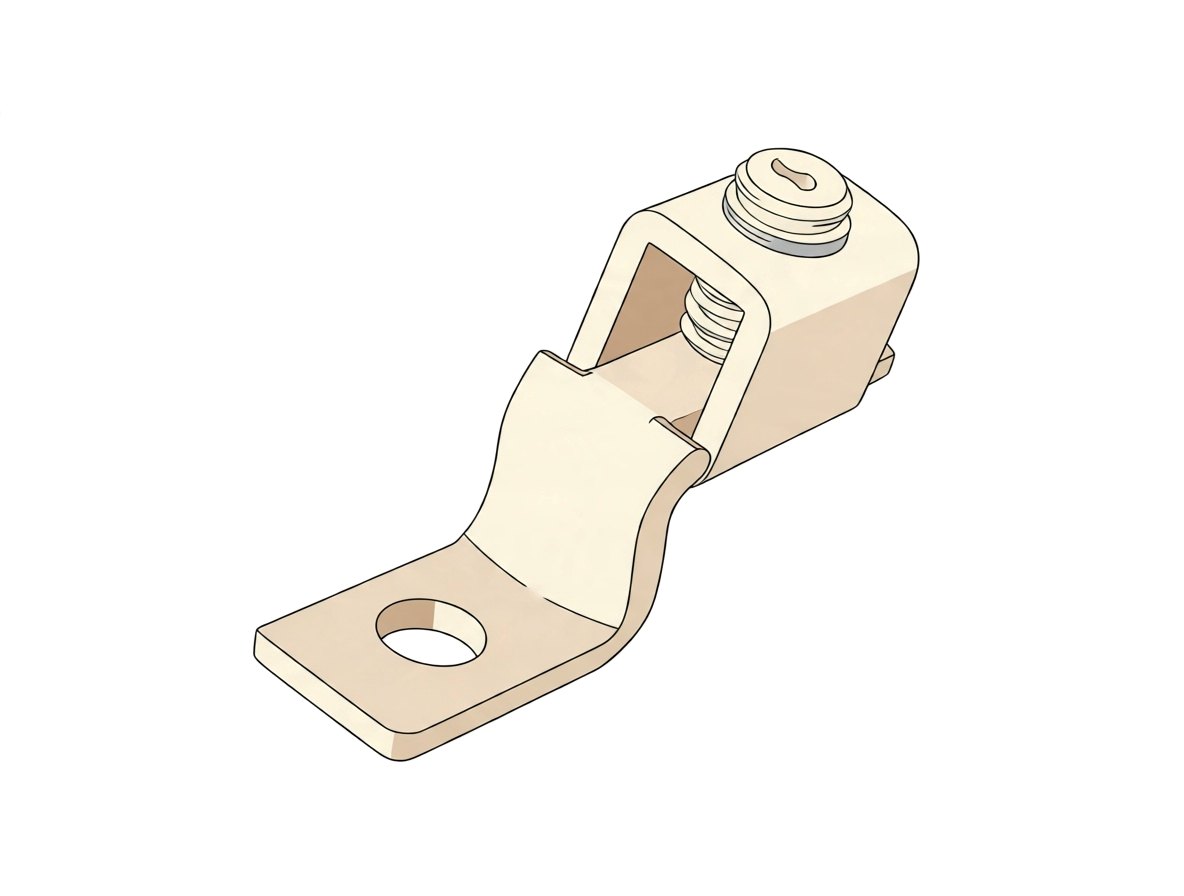
How it connects
A bolt or stud passes through the clearance hole; tightening the nut clamps the flat palm against the mating conductor surface, making a pressure contact. No seal.
Male and female halves
Not gendered in the plug/socket sense; the hole receives the bolt/stud (male), so it is often treated as the female side. The mating part is a stud or a bolt through a flat pad.
Usually connects to
- busbar
- threaded stud with nut
- bolt and nut through a terminal pad
- equipment ground/terminal block
Common sizes
- Usually given by bolt/stud size: #6 to 3/4 in (US), M4 to M20 (metric); one or two holes (NEMA two-hole spacing 1/2 in to 1-3/4 in); this part: one 3/8 in hole, about 10.3 mm.
Where it is used
power distributionswitchgear and panelboardsgroundingbattery and automotive cabling
Variations
- two-hole (NEMA spacing)
- straight, offset or 90-degree tongue
- long/short or reduced palm
- fork (spade) tongue
- mechanical (set-screw) or compression barrel
How to recognise it
A flat, usually copper or tinned plate at the end of a lug barrel, with one or two round smooth holes, often marked with stud size and wire range.
Often confused with
| Confused with | How to tell them apart |
|---|---|
| Threaded/tapped terminal pad | A tapped hole has threads and takes a screw directly; a lug palm hole is a smooth clearance hole. |
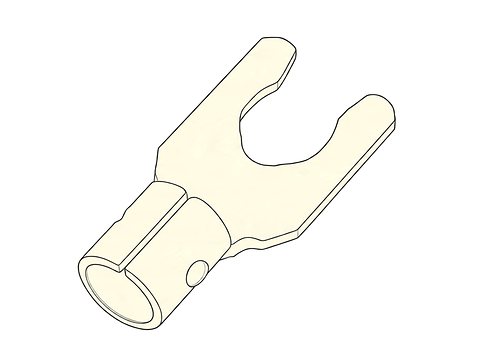
| Fork/spade terminal | A fork is open on one side; a palm hole is a closed ring. |
Also called
one-hole lug tonguelug padring tonguelug palmbolt-hole tongue
Good to know
The barrel side of the part (set-screw wire clamp) is a separate port. Hole size is the clearance size for the stated bolt.
Related connections
Design with real parts
Crafti checks which parts connect, right in your browser.