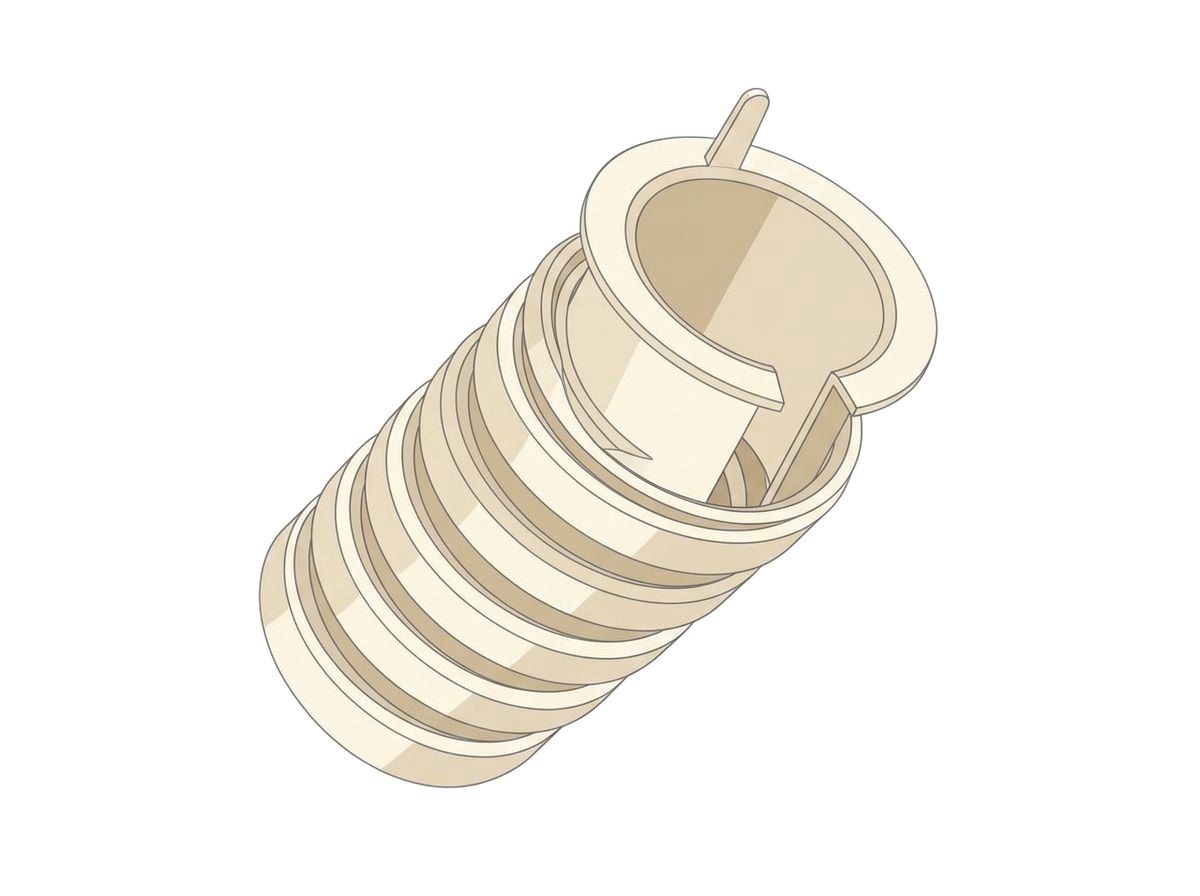
How it connects
The split sleeve is compressed and pushed into the conduit end between the armor and the conductors; it is held by friction/spring of the split and the helical armor convolutions, with the flange resting on the cut edge. Not threaded.
Male and female halves
The bushing sleeve is the male (insert) half; the bore of the cut FMC/armored-cable end is the female receiving half. This port is the bushing's insertion sleeve.
Usually connects to
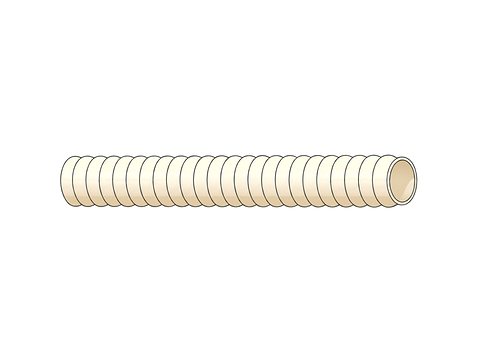
- inside bore of the cut end of flexible metal conduit
- armored cable (AC/BX) and MC cable cut ends
Common sizes
- Sized by conduit/cable trade size, commonly 5/16, 3/8, 1/2, 3/4 in, and larger up to about 2-2-1/2 in.
Where it is used
electrical wiringflexible conduit and armored cable terminations
Variations
- split sleeve with flange and pull tab
- tab with hole for inspection visibility
- large-size flanged split ring
How to recognise it
Small red (usually) plastic split cylinder with a flange at one end and often a protruding tab; sits flush in the cut end of spiral metal armor so the tab/flange remains visible through the connector after installation.
Often confused with
| Confused with | How to tell them apart |
|---|---|
| FMC connector / squeeze or screw-in flex fitting | A connector clamps the conduit outside or threads onto it and attaches to a box; an anti-short bushing is a loose plastic sleeve inside the conduit end. |
| Conduit male slip end | Male slip is the conduit's outside end entering a fitting socket; the anti-short bushing goes inside the conduit bore. |
| Snap-in plastic knockout bushing | Knockout bushings snap into a box hole; anti-short bushings are split sleeves with a tab that fit the conduit end. |
Also called
anti-short bushingredheadred head bushingBX bushingflex bushingASB
Good to know
Not a standardized mating interface but a protective insert; the 'male' is the bushing sleeve inside the FMC end. Usually used together with an FMC connector, which is the actual mechanical termination.
Related connections
Design with real parts
Crafti checks which parts connect, right in your browser.