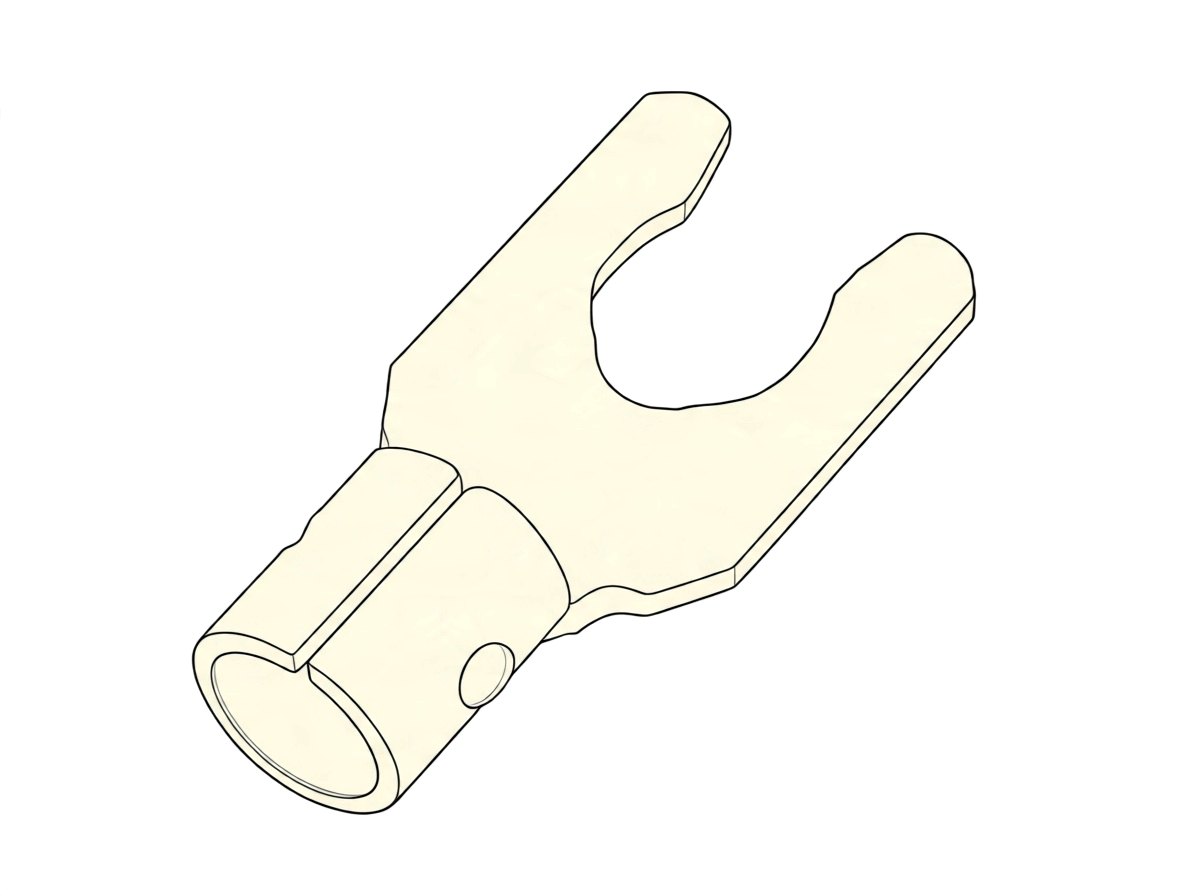
How it connects
The fork slides under a loosened screw head or nut around the shank; tightening the screw clamps the tongue against the terminal plate for electrical contact. The wire end is crimped (sometimes soldered) into the barrel.
Male and female halves
Not strictly gendered; the fork's open slot receives the screw/stud (so it is called female here) and the screw/stud terminal is the male side. Unlike a ring terminal it can be fitted without fully removing the screw.
Usually connects to
- Matching screw terminal on receptacles, switches or device yokes, such as #10, #6, #8 or 1/4 in
- Box grounding screw
- Terminal-block/barrier-strip screw or stud
- Binding post
- Threaded stud with nut and washer
Common sizes
- Stud/screw sizes include #4, #6, #8, #10, 1/4, 5/16 and 3/8 in, with metric M3–M10 versions. M3–M6 slots are about 3.2–6.4 mm in one range.
- Wire colors: red 22–16 or 22–18 AWG, blue 16–14 AWG, yellow 12–10 AWG.
- IDEAL 30-3284 uses a #10 fork and 12 AWG stranded wire. Screw size and wire gauge do not define exact tongue or slot dimensions.
Where it is used
Grounding pigtails and wiring devicesAutomotive/marine wiringHVAC/appliance wiringAudio/speaker binding postsControl panels, terminal blocks and barrier strips
Variations
- Locking/snap spade with inward-turned tips
- Flanged/locking fork with upturned tips
- Narrow block spade
- Vinyl/nylon insulated or bare
- Dual #8–#10 stud size
- Closed ring-tongue counterpart
How to recognise it
Flat metal tongue with two parallel prongs and a round-bottomed open slot sized to a screw, attached to a crimp barrel (often color-coded insulation) on a wire end. Slot about 5.2 mm wide for #10.
Often confused with
| Confused with | How to tell them apart |
|---|---|
| Ring terminal | A ring has a closed hole and needs the screw removed; a fork has an open slot. |
| Quick-disconnect (Faston) female spade receptacle | Faston receptacles have rolled edges that push onto a flat male blade; forks are flat plates clamped by a screw. A Faston 'spade' is a flat blade that pushes into a receptacle. It has no slot and no screw. |
| Quick-disconnect (blade/receptacle) spade, e.g. 0.250 in Faston | Quick-disconnects push on axially with a flat blade or rolled receptacle and no screw; a fork tongue is a flat U slot clamped under a screw. |
| Female push-on spade disconnect | A push-on disconnect has a spring receptacle for a flat blade. This interface has an open U-shaped tongue held under a screw. |
Also called
spade terminalU-type terminalspade lugSV terminal (insulated, metric part codes); SV terminal (insulated, Asian part numbering)split-tongue terminallocking fork / flanged spade (hooked-tip variant); locking fork terminal (flanged variant)fork tongue terminal; Open fork terminalFork lug
Good to know
The fork slot fits under a screw or stud clamp; size it to the screw, such as #10. UL 486A-486B is a general crimp-connector reference rather than a confirmed listing for every terminal.
Related connections
Design with real parts
Crafti checks which parts connect, right in your browser.