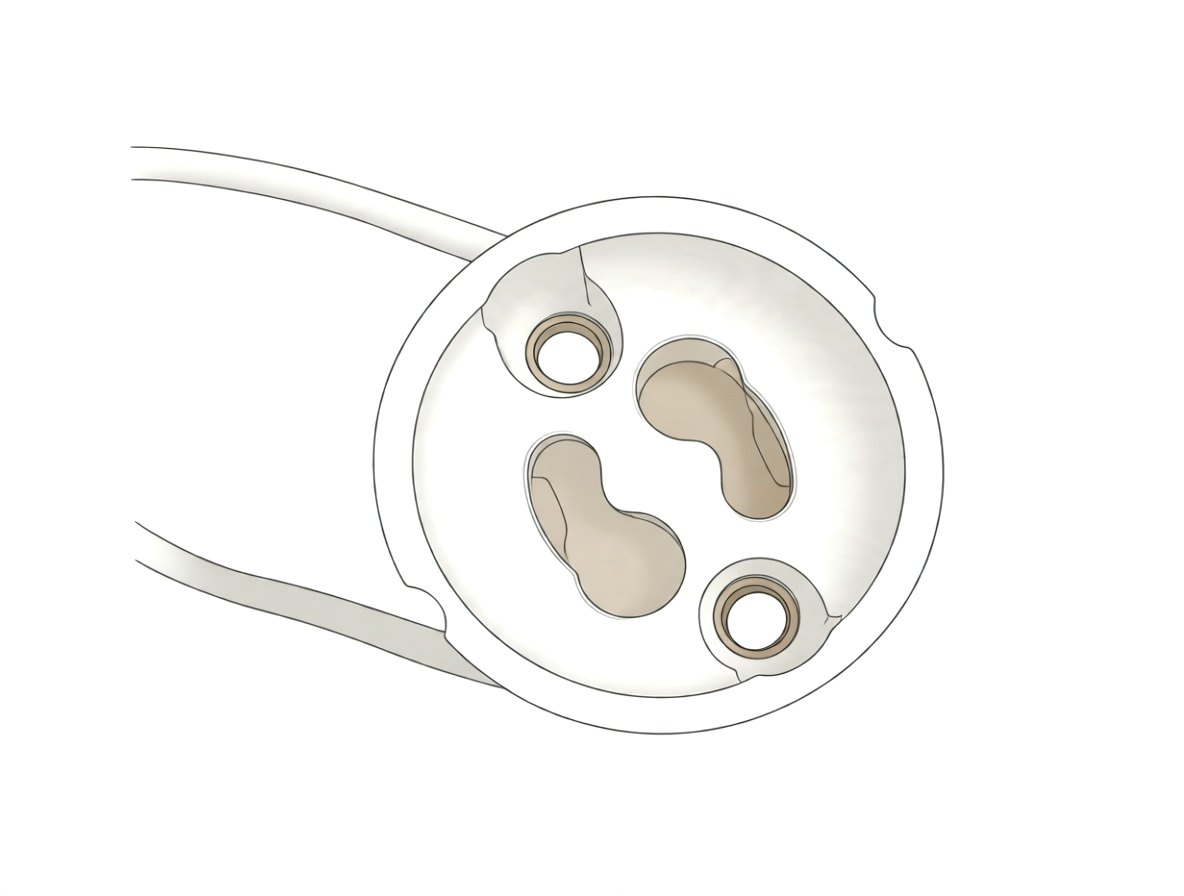
How it connects
Push the lamp's two stubby headed pins into the wide ends of the keyhole slots, then twist about a quarter turn clockwise so the pin heads slide under spring contacts that hold and power the lamp. No seal.
Male and female halves
The socket/lampholder is the female half; the lamp base with two headed pins is the male. This connection is the female socket.
Usually connects to
- GU10 halogen or LED mains-voltage lamp, including PAR16/MR16-size reflector bulbs
Common sizes
- 10 mm pin spacing; enlarged pin heads about 5 mm across.
- Socket body roughly 25–35 mm across, commonly ceramic; typical rating 250 V, 2 A for 120 V or 230 V mains lamps.
Where it is used
recessed downlightsrange hood lightsspotlightsresidential and commercial lightingtrack and spot lighting
Variations
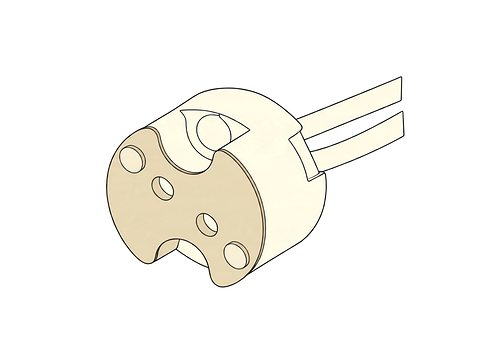
- GU10 with flying leads or screw terminals
- Ceramic or plastic body
- Threaded hickey/bracket mount, including 1/8 IPS
- GZ10 keyed dichroic-reflector variant, same pin pitch
How to recognise it
A small round socket, usually white ceramic, with two curved keyhole-shaped slots (wider at one end) about 10 mm apart and often two mounting holes. It is often marked 'GU10 250V 2A'.
Often confused with
| Confused with | How to tell them apart |
|---|---|
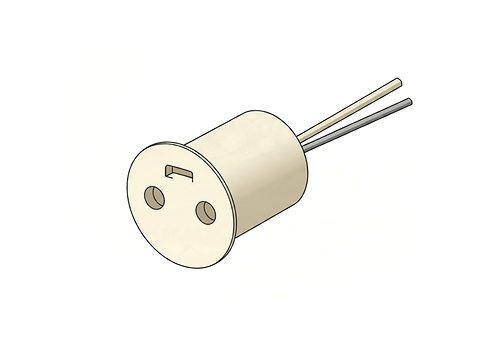
| GU5.3 / MR16 bi-pin socket | GU5.3 is for 12 V lamps with thin straight pins 5.3 mm apart that push straight in; GU10 has thick headed pins 10 mm apart and keyhole slots that need a twist. |
| GZ10 | Same 10 mm pitch and twist lock, but the pins differ slightly so a GU10 lamp won't fit a GZ10 holder; markings on the holder tell them apart. |
| GU24 | GU24 has 24 mm pin spacing and a larger socket. |
| GX53 / G9 | GX53 is a wide 53 mm flat puck twist base; G9 has looped wire pins pushed straight in. |
Also called
GU10 lampholderGU10 lamp holderGU10 base socketGU10 twist-and-lock socketGU10 bi-pin socket
Good to know
The part (a range hood light) uses GU10 lamps, so its lamp sockets are GU10 female holders. The images agree with this.
Related connections
Design with real parts
Crafti checks which parts connect, right in your browser.