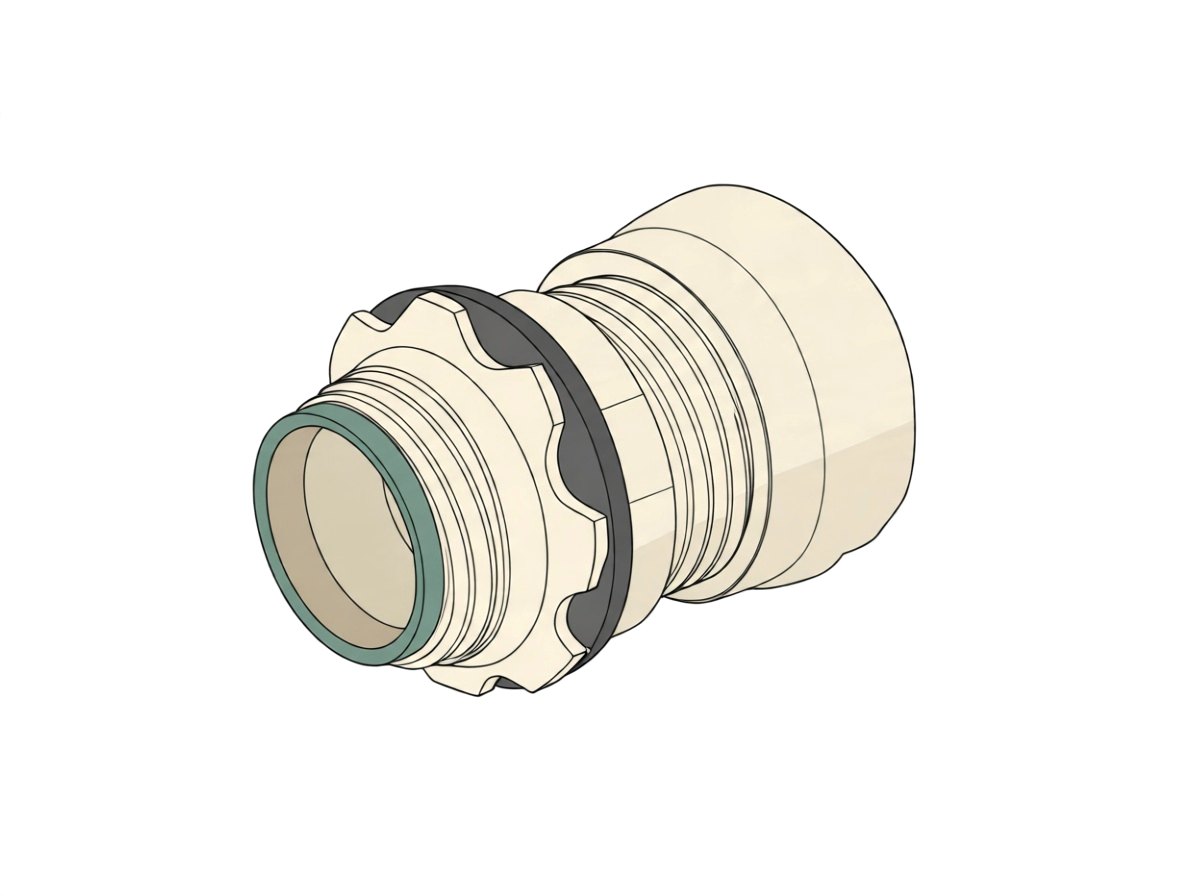
How it connects
Plain EMT slides into the nut and body until it bottoms on the tube stop; tightening the nut squeezes a split ring and sealing gland around the tube, giving mechanical grip, grounding continuity and a raintight seal. No threads on the tube.
Male and female halves
Female socket/hub that receives the male plain-end EMT tube. The other end of a connector is usually a male threaded (NPS straight) hub with locknut; couplings have this socket on both ends.
Usually connects to
- Plain, unthreaded steel or aluminum EMT conduit of matching trade size (ANSI C80.3 / UL 797)
Common sizes
- EMT trade sizes 1/2–4 in (metric designators 16–103), with OD about 0.706–4.5 in (17.9–114.3 mm).
- Example ODs: 1/2 in = 0.706 in (17.93 mm), 3/4 in = 0.922 in, 1 in = 1.163 in, 1-1/4 in = about 1.51 in (38.4 mm).
Where it is used
Commercial/industrial EMT wiring and racewaysResidential exposed conduitOutdoor/wet-location runsEMT entry into boxes/enclosures
Variations
- Compression-to-male-thread box connector
- Compression-to-compression coupling
- Raintight/wet-location type
- Insulated or uninsulated throat
- Steel or die-cast zinc
- 90° connector
How to recognise it
A hex or round compression nut on the end of the fitting, a visible colored (often green/yellow/black) gland or seal inside the nut, and RT or 'raintight' in the part number or marking; bore matches EMT OD.
Often confused with
| Confused with | How to tell them apart |
|---|---|
| standard (concrete-tight) EMT compression fitting | Non-raintight types have only a split compression ring, no polymer sealing gland, and are not marked RT/raintight. |
| EMT set-screw fitting | Set-screw type has a screw on the side of the socket instead of a threaded compression nut. |
| rigid/IMC threadless compression fitting | Sized for rigid conduit OD (larger than EMT for same trade size) and marked for RMC/IMC. |
| Rigid/IMC threaded conduit fitting | Rigid/IMC conduit is threaded (NPT) and thick-walled; EMT ends are unthreaded and grip by compression ring. Rigid conduit is threaded (NPT); EMT compression ends take unthreaded tube. |
| Plumbing compression fitting (ferrule) | Plumbing types use brass/copper ferrules sized to tube OD like 1/2 in copper; EMT fittings are zinc-plated steel/zinc sized by conduit trade size. |
Also called
EMT compression fitting/socketRaintight EMT compression connector/couplingRT fitting, such as 650RT/260RTEMT compression glandThin-wall conduit compression connection
Good to know
This is the tubing-gripping end only; the opposite end of a connector is a male straight-thread hub (NPS/conduit thread) with locknut, which is a separate port.
Related connections
Design with real parts
Crafti checks which parts connect, right in your browser.