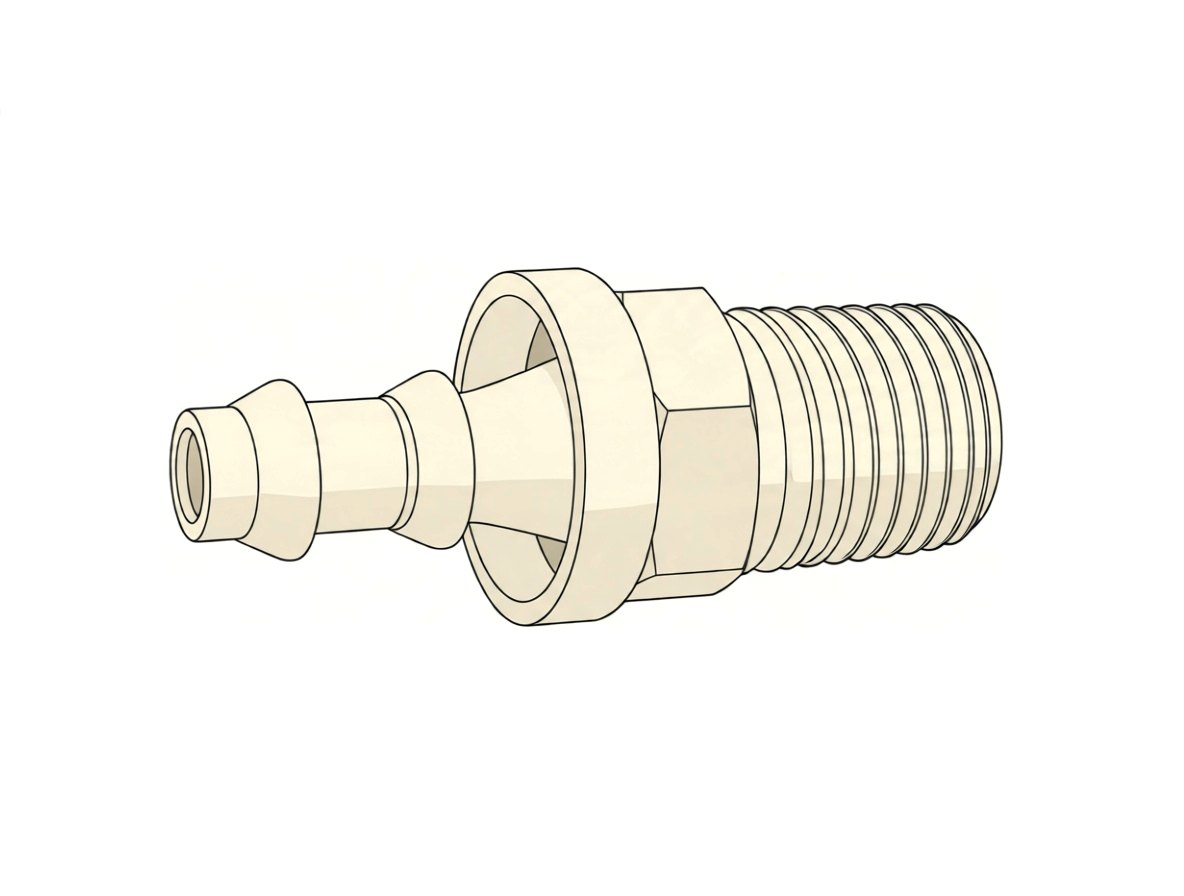
How it connects
The flexible push-lock hose is forced over the raised, sharp annular barb ridges until seated fully against the shoulder collar; the barbs mechanically bite into the hose liner under internal fluid tension to seal.
Male and female halves
Male fitting (barbed stem/nozzle) inserting into female flexible hose bore.
Usually connects to
- Push-on hose (push-lock elastomer hose)
Common sizes
- Typically 1/4" to 1" hose inner diameter (ID), commonly 1/4", 3/8", 1/2", 5/8", 3/4".
Where it is used
low-pressure pneumaticsindustrial air lineswater transferrain barrels and garden irrigationpetroleum and fluid transfer
Variations
- Standard brass push-on barb
- Plastic push-on nozzle
- Stainless steel / steel push-lock fitting
How to recognise it
Recognised by one or more pronounced, sharply angled annular barbs along a rigid cylindrical stem, often ending at a retention collar / cap ring over which an un-clamped flexible hose seats.
Often confused with
| Confused with | How to tell them apart |
|---|---|
| Standard hose barb | Standard hose barbs typically feature shallow or multiple gradual serrations requiring a worm-drive or crimp clamp, whereas push-on barbs have sharper, deeper ribs and often a plastic stop ring / collar requiring no clamp. |
Also called
push-lock hose barbLok-On hose fittingpush-on hose stem
Good to know
Used on garden equipment, rain barrels, and industrial fluid systems. When used with compatible push-lock hose, no external clamps are needed; general utility hoses may still use a band clamp for extra security.
Design with real parts
Crafti checks which parts connect, right in your browser.