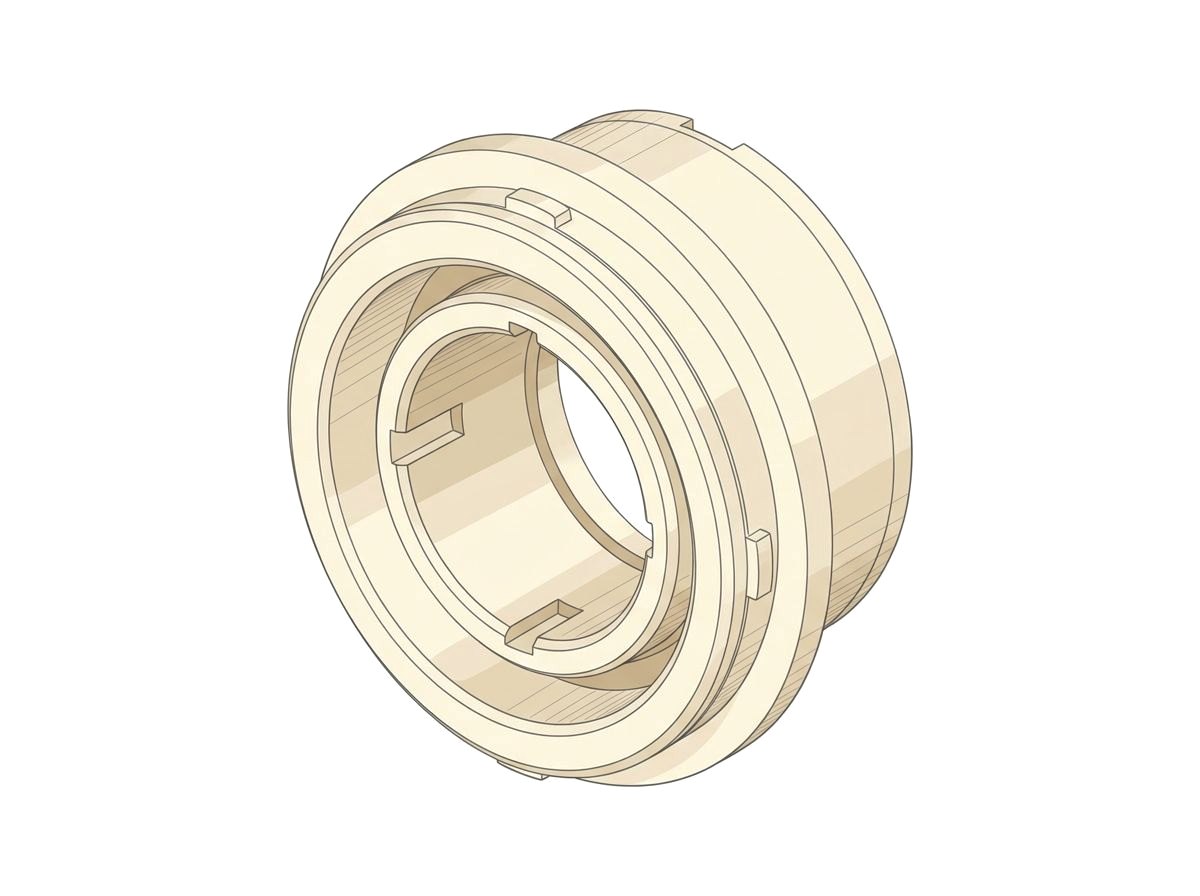
How it connects
The hose end inserts directly into the deflator port and is removed by pulling it out. The manual specifies no twist step for this port; seal construction and fit tolerances are not given.
Male and female halves
The tool-side receiving socket is female; the hose end inserted into it acts as the male mating half. These are descriptive genders, not a standardized connector designation.
Usually connects to
- The supplied RYOBI PCL031 high-volume hose end
Common sizes
- No standardized socket size is established; estimated 32.5 mm bore and 16 mm depth are not specifications.
Where it is used
Portable inflator/deflator high-volume suctionDeflating air mattresses, rafts and floats
How to recognise it
Identify the PCL031 and its deflator port (I in the manual overview; Figure 8 shows hose attachment). Look for the round recessed side-wall opening. Confirm using the model and manual; circular shape alone does not establish compatibility.
Often confused with
| Confused with | How to tell them apart |
|---|---|
| PCL031 high-volume inflator port | The inflator hose attachment requires rotation; the deflator instructions specify insertion and straight pull-out removal. |
| PCL031 high-pressure air chuck | The air chuck belongs to the separate tire-inflation hose; this socket receives the larger high-volume hose for deflation. |
Also called
PCL031 deflator portPCL031 high-volume deflation hose socket
Good to know
This identifies the RYOBI PCL031 high-volume deflator hose socket. No standardized size or cross-model compatibility is established; estimated 32.5 mm bore and 16 mm depth are not specifications.
Related connections
Design with real parts
Crafti checks which parts connect, right in your browser.