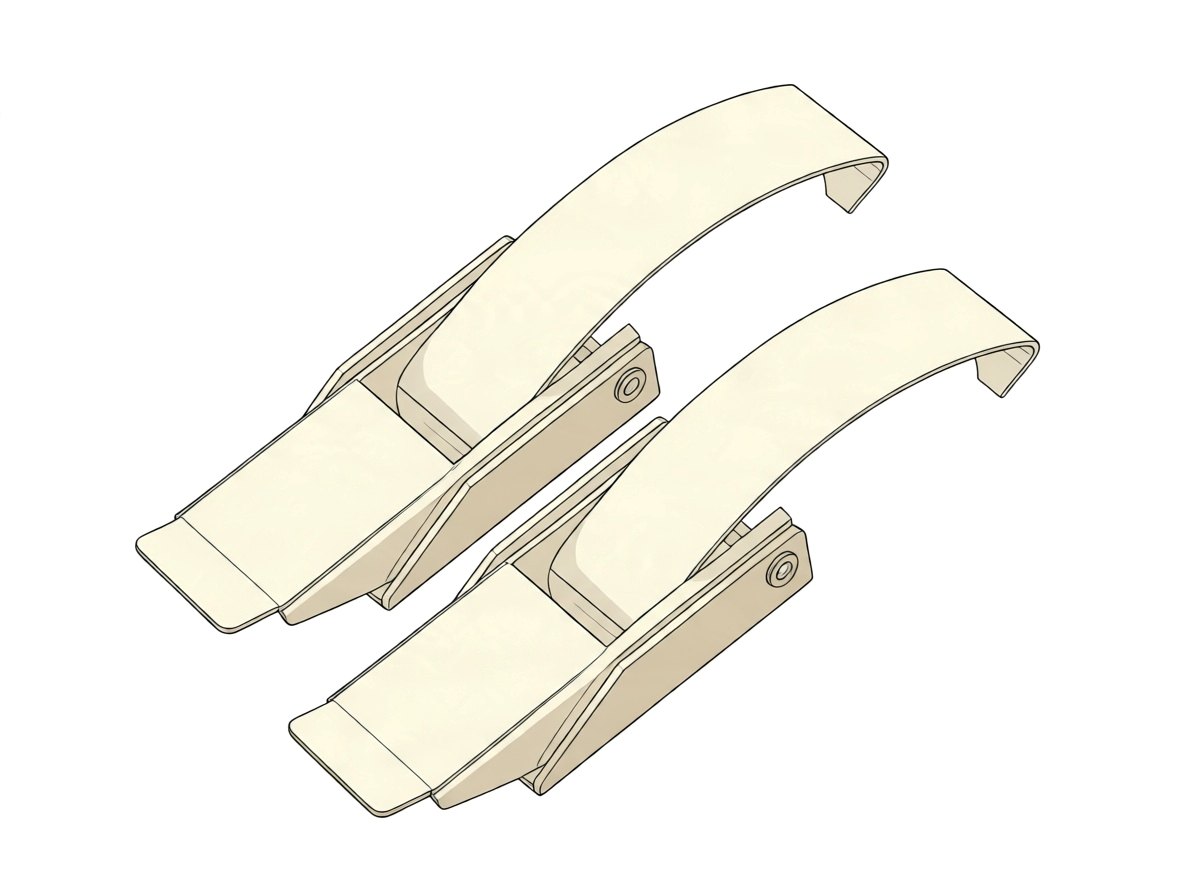
How it connects
The male hook reaches over and engages a fixed female keeper or catch; when the toggle lever is actuated over-center, tension pulls the hook tight against the keeper to draw panels or lids firmly together.
Male and female halves
Male hook or loop that reaches into and hooks onto a female keeper, strike bracket, or catch lip.
Usually connects to
- Draw latch keeper
- Draw latch strike plate
- Draw latch catch
Common sizes
- Overall latch lengths commonly range from 1.5 in (38 mm) to over 8 in (200 mm), with hook/wire diameters or blade thicknesses typically 2 mm to 8 mm.
Where it is used
industrial enclosurestoolboxes and flight casesHVAC equipmentvehicle hoods and engine compartmentsmarine cabinetry and hatches
Variations
- rigid flat blade hook
- curved wire J-hook
- threaded adjustable draw hook
- spring-loaded hook blade
How to recognise it
Recognizable as a downward-curved hook, loop, or curved metal blade extending from a hinged toggle handle or lever on a latch assembly, shaped to grip a fixed lip or bar on a mating keeper plate.
Often confused with
| Confused with | How to tell them apart |
|---|---|
| Draw latch keeper | The hook is the moving/tensioning arm attached to the toggle lever, whereas the keeper is the passive receiving bracket/lip mounted to the opposing surface. |
| Padlock hasp staple | A hasp staple is a passive loop that protrudes through a slot for padlocking rather than providing an active over-center drawing tension mechanism. |
Also called
draw latch clawtoggle latch hookdraw latch bladetoggle clamp J-hooklatch draw hooklatch catch arm
Good to know
Often part of an over-center toggle mechanism sold together with its mating keeper plate; in CAD part libraries, the hook and keeper are modeled as distinct mating connection ports.
Related connections
Design with real parts
Crafti checks which parts connect, right in your browser.