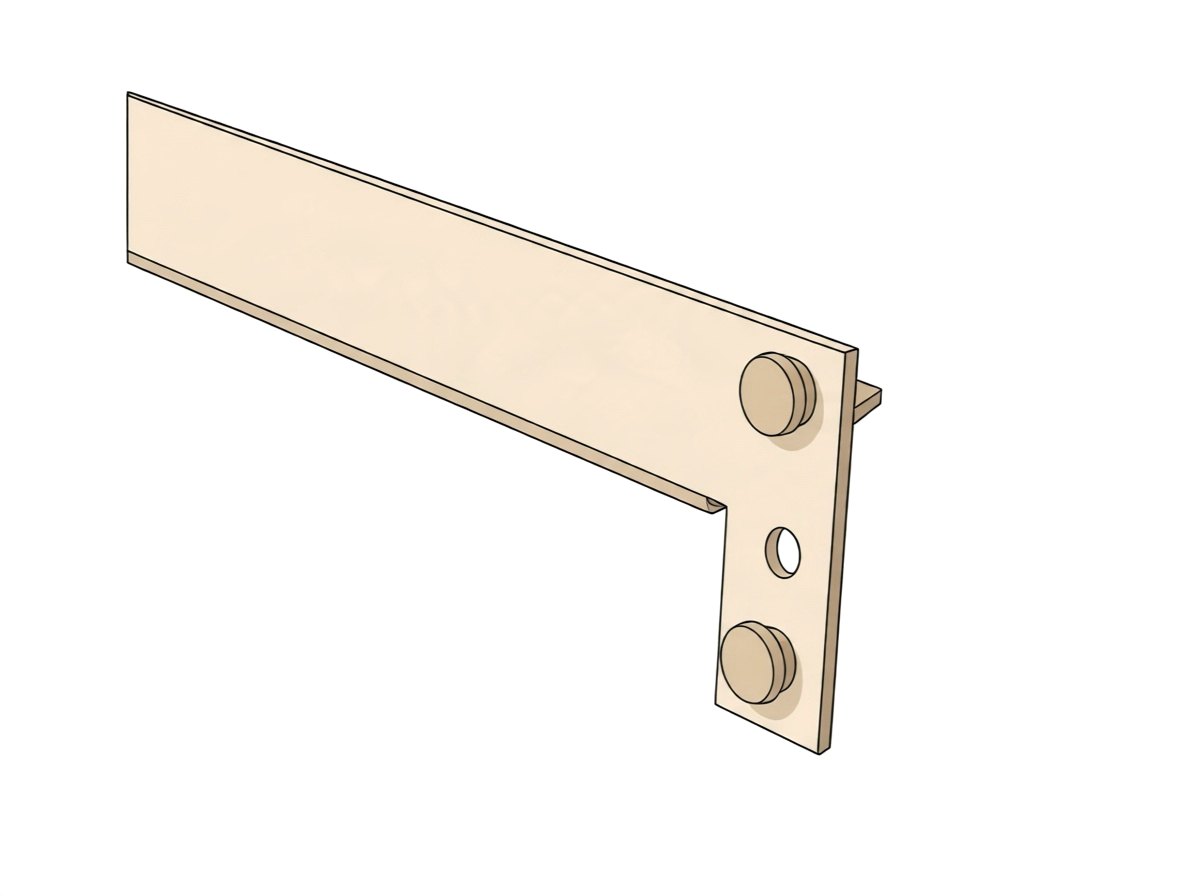
How it connects
The two shoulder rivets insert horizontally through the wide circular lobes of vertical keyhole slots on an upright post and drop into the narrow lower slots, seating firmly under gravity and wedging by downward force or mallet taps.
Male and female halves
Male double-rivet studs attached to the beam or shelf bracket mate into female keyhole/teardrop perforations punched along the angle upright post.
Usually connects to
- Matching boltless/rivet-lock upright keyhole slot in an angle or T-post
- Matching double-rivet shelf beam assembly
Common sizes
- Common rivet pitch 1-1/2 in (38.1 mm) vertically, with heads about 11–14 mm and shanks/necks about 6–8 mm.
Where it is used
Industrial/warehouse boltless storageGarage utility racksRetail stockrooms
Variations
- Single-rivet joint
- Double-rivet joint, commonly 1.5 in pin pitch
- Angle or heavy-duty channel beam
- Hidden-hole/concealed-slot upright
How to recognise it
Recognized by a pair of cylindrical shoulder rivets spaced vertically 1.5 inches apart on the ends of shelf beams, which slot into corresponding keyhole- or teardrop-shaped holes on an L-shaped (or T-shaped) angle post.
Often confused with
| Confused with | How to tell them apart |
|---|---|
| Teardrop pallet rack connection | Pallet rack teardrop connections are larger heavy-duty industrial framing with locking safety pins, thicker steel, and larger hook-pin brackets, whereas rivet shelving uses lighter gauge sheet angle posts with double rivets spaced typically Teardrop pallet racks are heavy industrial systems with pin clips and larger teardrop punchouts, whereas rivet-lock shelving uses stamped sheet angle beams with round shoulder rivets. |
| Single-rivet shelving connection | Single-rivet connections use only one rivet per beam end for light-duty low-profile shelf tiers, whereas double-rivet connections use two vertically stacked rivets for greater torsional rigidity. |
| Slotted angle bolt connection | Slotted angle systems use continuous oval or rectangular slots secured with standard hex bolts and nuts rather than tool-free drop-in shoulder rivets. Slotted angle shelving requires nuts and bolts through continuous open slots, whereas rivet shelving is boltless and locks via keyholes. |
Also called
Double rivet shelving connectionBoltless rivet rack connectionKeyhole rivet lockrivet rack keyhole slot jointboltless shelving rivet beam endrivet rack beam connectordouble rivet beam end
Good to know
Commonly used across major storage brands including Republic Storage, Lyon, Edsal / Muscle Rack, and Tri-Boro Rivet-Rak. While slot shapes and pitches are largely standardized to 1.5-inch centers, rivet head and shoulder tolerances can vary slightly between manufacturers.
Related connections
Design with real parts
Crafti checks which parts connect, right in your browser.