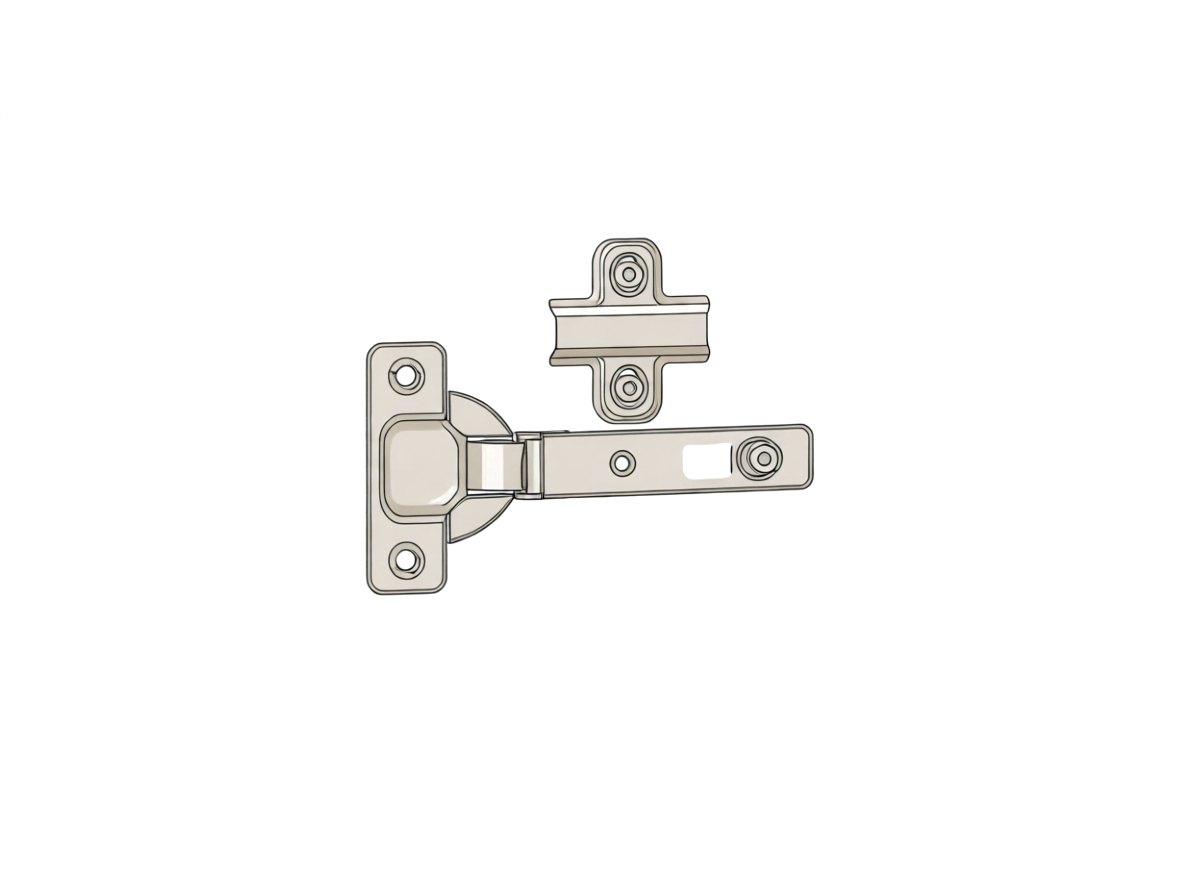
How it connects
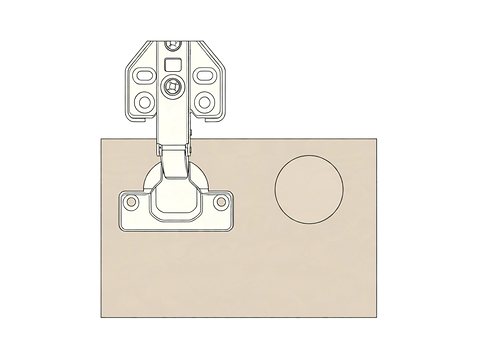
The cylindrical hinge cup body inserts or press-fits into a flat-bottom bored cup hole in the cabinet door, and is secured via mounting screws or expansion dowels through adjacent flange tabs.
Male and female halves
Male cup boss inserting into a matching bored cylindrical pocket (female recess) in the cabinet door panel.
Usually connects to
- Matching circular flat-bottom cabinet-door cup bore, commonly 35 mm × 11–13 mm deep
- Optional flanking mounting-dowel sockets, commonly 8 or 10 mm, with compatible insertion dowels
Common sizes
- Common cup OD 35 mm, depth about 11–13 mm (often 11.5–13 mm). Other cups include 26 mm mini, 40 mm heavy-duty, and 15/20 mm special thin-door versions.
- Flange screw spacings commonly 45, 48 or 52 mm; screw-on cups may use a 45/9.5 mm pattern.
Where it is used
Residential kitchen/bath furniture and cabinetryCommercial caseworkFrameless/face-frame or System 32 cabinetsArchitectural millwork
Variations
- 35 mm standard, 26 mm mini or 40 mm heavy cup
- Screw-on flange
- Press-in expansion dowels, including 8/10 mm
- Toolless expanding/locking-flap cup, such as Blum INSERTA
How to recognise it
Recognised by a stamped metal or cast zinc cylindrical cup (typically 35 mm diameter, ~11.5 mm deep) on one end of the hinge arm with two lateral mounting flange screw holes or plastic expansion dowels spaced 45 mm, 48 mm, or 52 mm apart.
Often confused with
| Confused with | How to tell them apart |
|---|---|
| European hinge mounting plate | The mounting plate attaches flat to the cabinet carcass/side panel or face frame, whereas the cup is a cylindrical recessed pocket inserting into a round bore on the door. |
| Concealed SOSS/barrel hinge | SOSS and barrel hinges mount into mortised slots or deep bores on the edge of the door rather than a circular face-bored pocket with flange tabs. |
| Hinge mounting plate (clip/slide-on) | The mounting plate screws flat to the cabinet side; the cup sits recessed in the door bore. |
| Press-in dowel cup | Press-in cups have plastic dowels under the flanges instead of screw holes. |
| 26 mm concealed hinge cup | 26 mm cups are significantly smaller, typically used for small lightweight or glass cabinet doors, whereas standard full-size cabinet doors use 35 mm cups. |
Also called
hinge cup boss35 mm Euro hinge cup; 35 mm hinge cup boringconcealed hinge boss35mm Euro hinge cupEuropean concealed hinge cuppot hinge cupcabinet door hinge cupscrew-on hinge cup
Good to know
Agents used 'European cabinet hinge cup male' to specify the physical cup boss that seats into the recessed bore in a wooden or composite door panel, distinct from the hinge mounting plate on the carcass.
Related connections
Design with real parts
Crafti checks which parts connect, right in your browser.