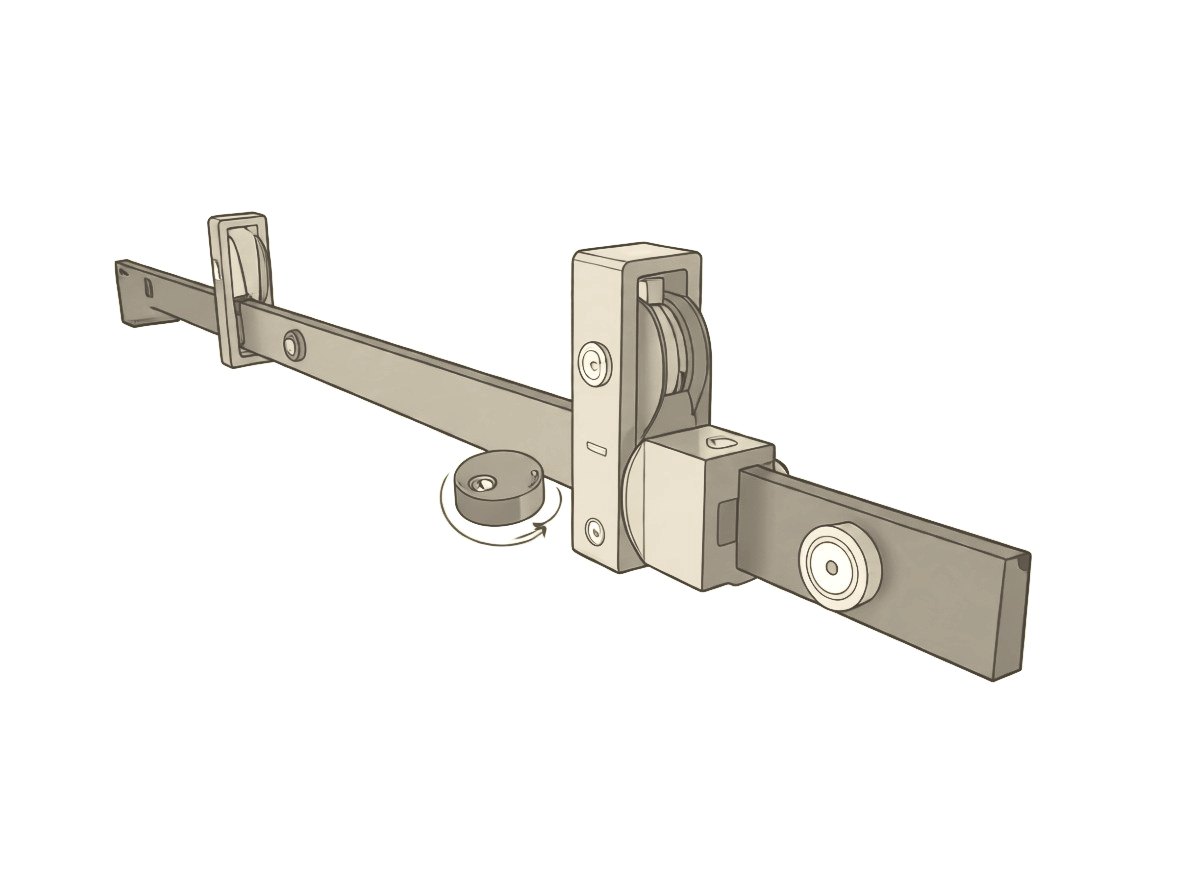
How it connects
Fastened via wood screw to the top edge of the door panel (or integrated into the hanger bracket) with minimal clearance under the track; limits upward vertical travel by contacting the track bottom if lifted.
Male and female halves
Door-mounted disc or tab (male/protruding stop) engaging against the stationary underside face of the flat track rail.
Usually connects to
- Matching flat barn-door rail bottom edge, commonly about 40 mm (1.5–1-9/16 in) high × 5–6 mm (1/4 in) thick
- Compatible end-stop/stopper bracket
Common sizes
- Track profiles commonly 36–40 mm (1-7/16–1-5/8 in) high and 5–6.35 mm (3/16–1/4 in) thick.
- Disc-style stops are about 1 in (24–25 mm) diameter and 3/8–1/2 in thick, with a listed 1/8–1/4 in clearance gap.
Where it is used
residential buildinginterior architectural sliding door systemscabinetry sliding hardwareCabinet sliding hardwareArchitectural sliding door hardwareinterior sliding barn door hardware
Variations
- round eccentric anti-jump disc (screwed to top of door)
- integrated hanger anti-jump tab/lip; L-shape anti-jump bracket
- spring-cushioned / buffered plunger stop; spring-cushioned end stop clamp
- solid rubber-faced stop clamp; soft-close trigger stop clamp
- Slip-on clamp with set screws (adjustable position along rail); C-clamp style with bottom/top set screws
- Bolt-through fixed end stop sharing the wall standoff lag bolt hole
- Twist-on / clip-on adjustable rail stop
- split two-piece bolt-together clamp
How to recognise it
Recognised as small circular pucks/discs (often black POM plastic or steel with an offset screw hole) screwed into the top edge of a sliding door directly under the rail, or as a small tab under the hanger roller wheel.
Often confused with
| Confused with | How to tell them apart |
|---|---|
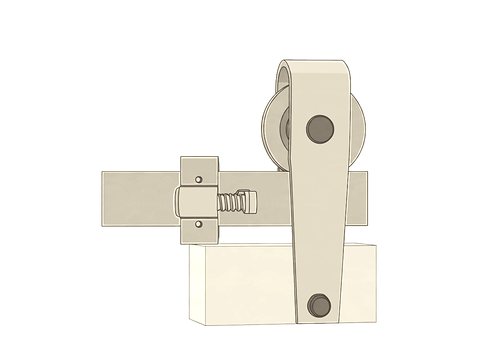
| barn door track end stopper | Track end stoppers mount on track ends to stop horizontal travel, whereas anti-jump devices mount on the door panel or hanger to prevent vertical lift-off. |
| barn door bottom floor guide | Floor guides keep the bottom of the door from swinging outward, whereas anti-jump devices prevent the top roller assembly from derailing off the upper rail. Floor guides mount to the floor or baseboard to prevent door sway, whereas rail end stops mount directly onto the overhead track rail. |
| fixed track end cap / bolt-on stop | Fixed stops use pre-drilled holes in the track bar with through-bolts, whereas adjustable stop clamps slide anywhere along the rail and clamp with set screws. |
| sliding door floor guide | Floor guides mount to the floor or baseboard to stabilize the door bottom, rather than clamping onto the overhead rail to limit travel. |
| Barn door track wall standoff | Standoffs mount between the track and the wall to space the rail off the wall, while rail stops mount onto the track surface in the path of the rollers. |
Also called
anti-jump discanti-jump blockanti-jump padanti-derailment stopanti-jump tabsliding barn door rail stop clamp; sliding barn door track stopper clamp; Barn door track stop mount; Sliding barn door end stop mountflat track adjustable end stop; flat track end stop clampFlat rail door stop attachment
Good to know
Anti-jump devices do not maintain continuous tight contact with the track under normal operation; they maintain a narrow clearance gap to prevent friction, only contacting the track if upward force or bouncing occurs.
Related connections
Design with real parts
Crafti checks which parts connect, right in your browser.