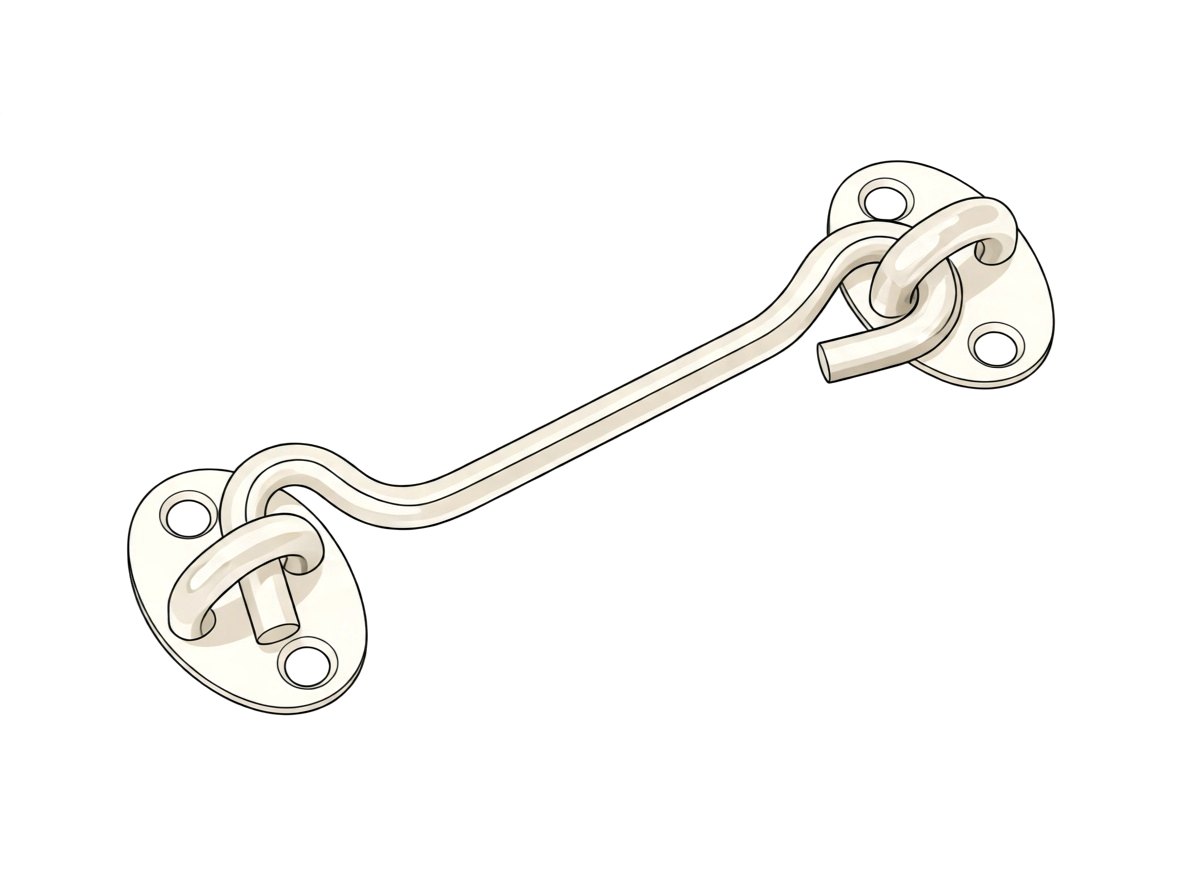
How it connects
Interlinked captive wire/cast loops form a loose, non-detachable hinge allowing multi-axis pivoting and swinging motion.
Male and female halves
Female (fixed closed loop / staple that receives and captively retains the male closed eye of the swinging latch hook arm).
Usually connects to
- Appropriately sized/rated shackle, including screw-pin bow anchor shackles, or connecting chain link/swivel
- Anchor rode/nylon line through a thimble
- Compatible hook, sling or captive cabin-hook pivot eye, subject to the hardware instructions
Common sizes
- Specify eye opening and section thickness, then check connector clearance and load rating. Stock diameters commonly 1/8–1/2 in (about 3–13 mm), including 3/16, 1/4, 5/16 and 3/8 in.
- Smaller eyes have roughly 10–20 mm clear openings; marine examples may be 1–3 in (25–75 mm).
- One reported 32.766 mm clear diameter and estimated 13.6 mm rim depth are product-specific measurements, not universal sizes.
Where it is used
architectural hardware; farm and hardware chain; light chain repairdoor and gate latchescabin hook assembliescabinetry and shuttersmarine rigging; lifting and riggingboat anchoring systems; anchoring and securementcommercial and recreational boatingmachinery handling
Variations
- screw-mounted backplate with welded or stamped loop
- screw-eye threaded shank; Fixed forged eye on anchor shank head
- cast eyelet plate
- Sliding slip-ring on fluke anchor shank
- Weldless round marine rigging ring
- Forged eye on shoulder machinery eye bolts; Eye on nut eye bolts; Shouldered and non-shouldered eye-bolt bodies
- zinc-plated steel; stainless steel
- hot-dip galvanized
How to recognise it
A raised metal loop or U-staple welded, cast, or riveted to a flat mounting base plate, permanently intertwined through the closed loop end of a latch arm.
Often confused with
| Confused with | How to tell them apart |
|---|---|
| Hook Catch / Strike Eye Female | The strike eye temporarily receives the open hook tip to secure a door, whereas the pivot loop is permanently interlinked with the closed captive eye of the hook arm to allow pivoting. |
| Bent or open screw eye | A screw eye features an integral threaded wood screw shank rather than an eye formed on or welded to a surface-mounting plate. A bent eye may have a visible end gap or seam; a forged closed lifting eye is continuous. Similar appearance alone does not establish a lifting rating. |
| Anchor retrieval ring | An anchor retrieval ring is an oversized hoop used with a buoy to slide over the rode for lifting, not an attachment ring fixed to or sliding on the anchor shank. |
| Anchor shackle bow | The shackle bow is a U-shaped removable rigging fitting with a threaded pin, whereas the attachment ring/eye is captive on the anchor itself. |
| Eye bolt mounting thread | The shank has helical external threads; the attachment eye has a smooth interior. The sample 5/8-11 designation identifies the shank, not the eye opening. |
Also called
hook eye plate; cabin hook pivot eyeeye bracketstaple platehook eyelet mountAnchor slip ring; Anchor attachment ring; Anchor shank eye; Anchor attachment eye; closed attachment eyelifting eye openingrigging eye; eye bolt eyecold shut
Good to know
In cabin hooks and hook-and-eye hardware, both mounting plates often feature identical eye loops; the pivot end is captured during manufacturing by closing the hook eye around the loop, while the opposite plate acts as the strike catch. Additional standard references: ASTM A229; DASMA 102.
Related connections
Design with real parts
Crafti checks which parts connect, right in your browser.