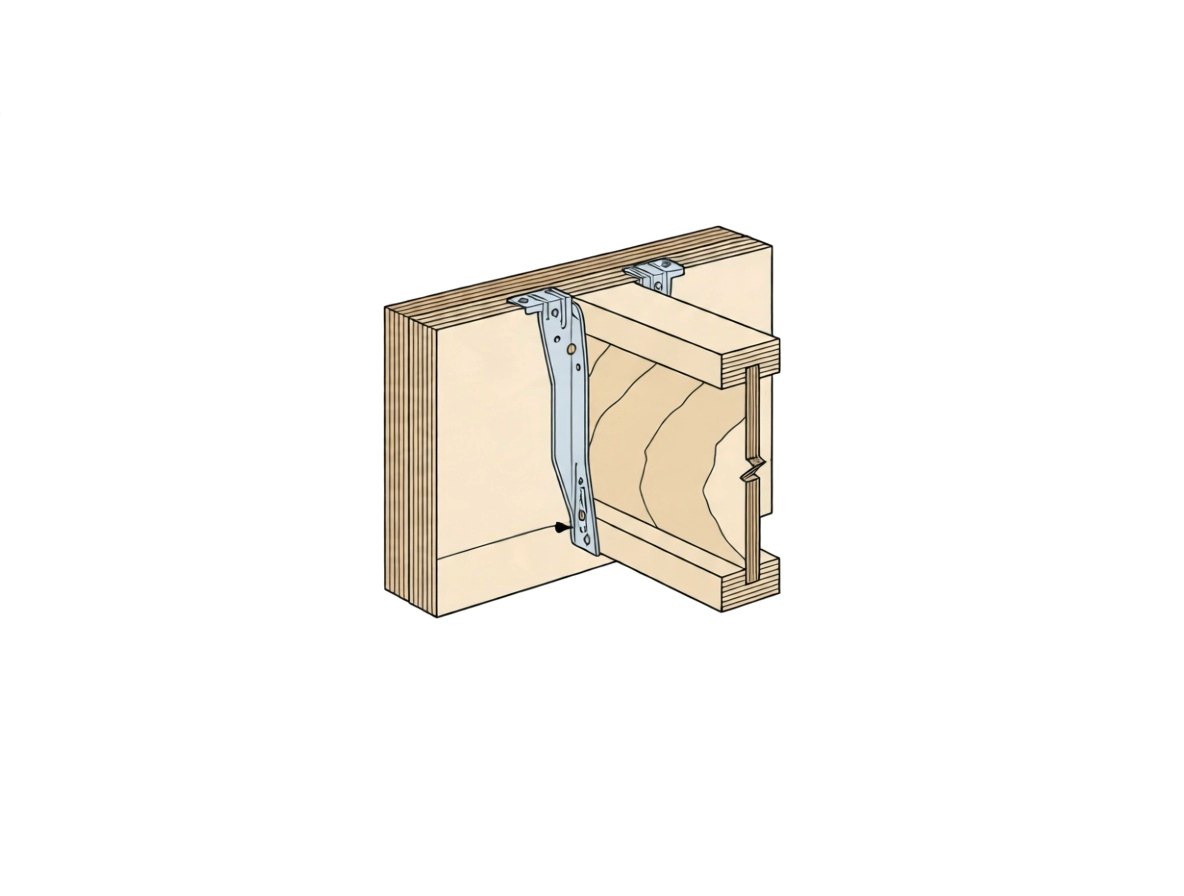
How it connects
The engineered wood joist is inserted downward or slid horizontally into the U-shaped pocket seat, bearing directly on the bottom horizontal seat tab. Fastening is completed using structural nails or screws driven through side nail holes.
Male and female halves
Female receiver (the sheet-metal bearing seat pocket) which receives the male member (the end of the engineered timber joist or beam).
Usually connects to
- Size-approved engineered I-joist end, including web and LVL/solid-sawn bottom flange
- Matching LVL, glulam or timber joist end
Common sizes
- Match I-joist bottom flange: listed flange/seat pairs in inches are 1-1/2/1.56, 1-3/4/1.81, 2-1/16/2.06, 2-5/16/2.37, 2-1/2/2.56 and 3-1/2/3.56.
- Single/double seats commonly span 1-3/4–3-1/2 in (45–89 mm), with wider double/triple options and a listed 3-9/16 in seat.
- Member depths range from 7-1/4 in (184 mm) through 18 in (457 mm) and 24+ in; bearing lengths are commonly 2–3-1/2 in.
Where it is used
Residential/commercial timber constructionEngineered I-joist floor/roof framingLight-frame wood construction
Variations
- Face-mount cradle, including Simpson IUS
- Top-flange cradle, including Simpson ITS
- Concealed-flange hanger
- Straight seat
- Sloped/skewable or snap-grip seat
- Tab-guided I-joist hanger
How to recognise it
Recognizable as the U-profile saddle/stirrup formed by cold-formed galvanized sheet steel with pre-punched round and triangular fastener holes in the side flanges and bottom bearing plate.
Often confused with
| Confused with | How to tell them apart |
|---|---|
| Masonry beam pocket | A masonry beam pocket is a recessed void cast or blocked out directly into a concrete or masonry foundation wall, rather than a light-gauge cold-formed steel bracket seat. |
| Post base / column base socket | Post bases support vertical compression columns on horizontal foundations, whereas a joist bearing pocket supports horizontal bending joists hung from headers or ledger beams. |
| standard dimensional lumber joist hanger seat | Engineered I-joist hanger seats are specifically sized for manufactured I-joist flange widths (e.g. 1-3/4 in, 2-1/16 in, 2-5/16 in, 3-1/2 in) and taller depths, often with web stiffener nail requirements. |
| Solid sawn lumber joist hanger seat | Solid lumber joist seats are sized for nominal 2x (1-1/2 in) or 3x/4x lumber and require joist face/toe nails, lacking the specialized flange grip tabs sized for engineered I-joist flanges. |
| Hanger fastener holes | The cradle receives the wood joist end; the small punched holes receive the fasteners securing the hanger and member. |
Also called
hanger bearing seatjoist bucketI-joist hanger seat; I-joist seat cradlejoist hanger stirrupI-joist pocketStrong-Grip seat; Snap-Grip seatsnap-in bottom flange seatjoist bearing seat
Good to know
The term describes the bearing seat/pocket receptacle of a joist hanger designed specifically to dimensionally match standard engineered timber joist dimensions (e.g. 3-1/2 x 11-7/8 in). Additional standard references: IRC (Section R502 / IBC Section 2304); ICC-ES ESR-2614.
Related connections
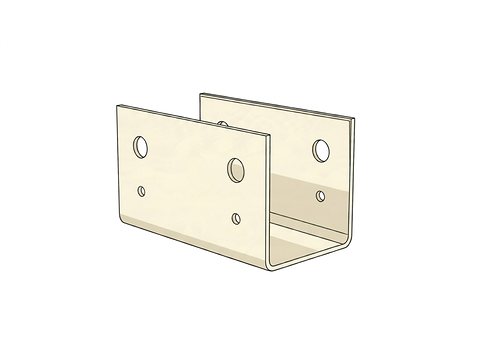 Dimensional Lumber Joist and Beam Hanger Seat
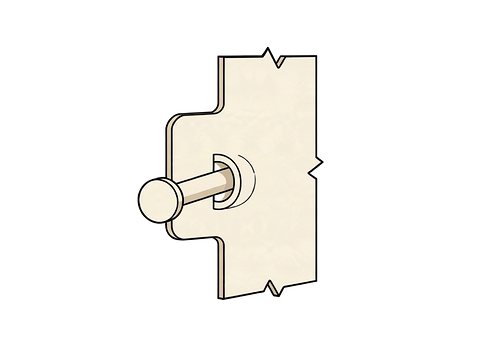 Angled Structural Connector Fastener Guide
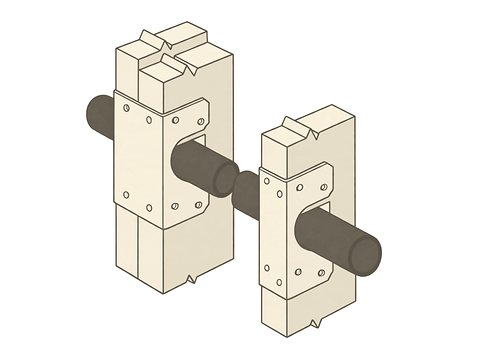 Wood-Stud Reinforcing Shoe
Design with real parts
Crafti checks which parts connect, right in your browser.