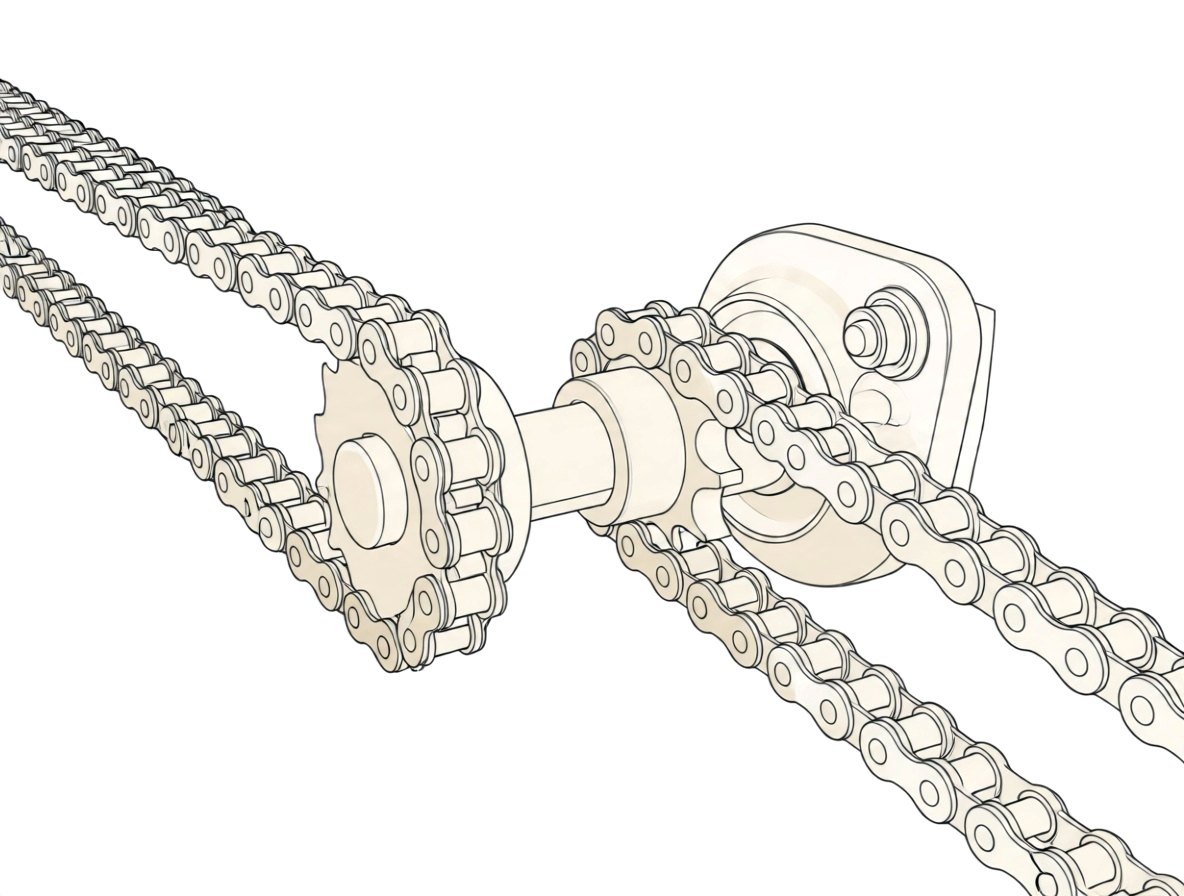
How it connects
Radial teeth of the rotating sprocket mesh between chain rollers, seating into the tooth root and pushing against the rollers via positive mechanical contact without slipping.
Male and female halves
Genderless or conjugate mating: the toothed wheel (sprocket) acts as the driving/driven toothed member and the chain acts as the conforming flexible link member.
Usually connects to
- ANSI or ISO standard roller chain
- Sprocket wheel
Common sizes
- Standard chain pitches from 1/4 in (ANSI #25) up to 3 in (ANSI #240); common light industrial/gate opener sizes include #40 (1/2 in pitch), #41, and #50 (5/8 in pitch).
Where it is used
gate openers and garage door drivesindustrial machinery and conveyorsmotorcycles and bicyclesagricultural equipment
Variations
- Single-strand (simplex)
- Multi-strand (duplex, triplex)
- Bushing chain (rollerless)
- Double-pitch chain sprockets
How to recognise it
Recognised by a disc or hub with radial, hook-like tapered teeth profiled with curved bottom roots designed to seat cylindrical chain rollers.
Often confused with
| Confused with | How to tell them apart |
|---|---|
| Gear mesh | Gears mesh directly tooth-to-tooth, whereas sprockets mesh with open gaps between rollers on a flexible chain. |
| Timing belt pulley engagement | Timing pulleys engage elastomeric or polyurethane toothed belts rather than articulated steel rollers and link plates. |
Also called
Sprocket tooth engagementRoller chain drive interfaceChain sprocket mesh
Good to know
On parts like chain-driven gate openers, this interface is typically an integrated or shaft-mounted drive sprocket designed to mate with a specific ANSI roller chain (most commonly #40 or #41).
Design with real parts
Crafti checks which parts connect, right in your browser.