How it connects
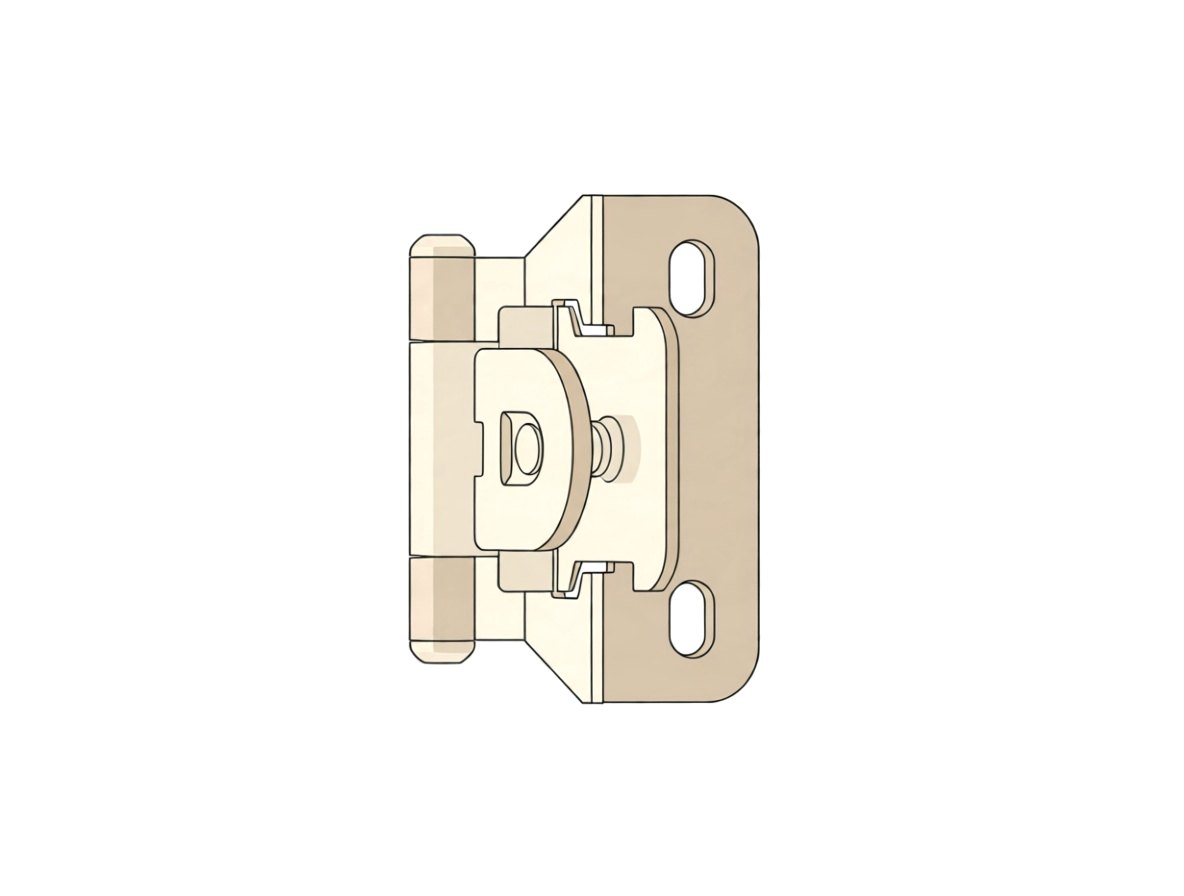
The hinge door wing plate and clamp insert into the routed door edge slot; tightening the central clamp screw pinches the clamp plate against the wood inside the slot to lock the door in position while allowing lateral and vertical adjustment.
Male and female halves
Female slot/mortise routed into the cabinet door edge/back that receives the male clamping plate assembly of the hinge.
Usually connects to
- Single-demountable cabinet hinge door clamp male wing
Common sizes
- Slot depth typically approx. 1/2 in (12.7 mm) to 5/8 in; kerf width roughly 1/8 in to 3/16 in; suited for 1/4 in, 3/8 in, and 1/2 in overlay doors.
Where it is used
kitchen cabinetryresidential face-frame cabinetrycabinet door manufacturing
Variations
- Double-demountable door slot (identical door slot interface, but paired with a face frame slot rather than screw-mounted frame wing)
How to recognise it
A precision T-slot or rectangular kerf routed along the back edge of a cabinet door, with no screw holes penetrating all the way through, into which an oval or rectangular clamping bracket slides and tightens via a single machine screw.
Often confused with
| Confused with | How to tell them apart |
|---|---|
| 35 mm European concealed cup hinge mortise | European cup hinges require a circular 35 mm blind bore on the rear face, whereas demountable hinge door slots are routed linear slots/kerfs entering from the door edge. |
| Double-demountable frame slot | Double-demountable hinges have slots on both the door and the face frame; single-demountable hinges use the slot clamp only on the door wing while the frame wing attaches with standard surface screws. |
Also called
demountable hinge door slotdemountable hinge door kerfcabinet door demountable hinge mortise
Good to know
Single-demountable hinges demount via a clamp only on the door side (the face-frame wing mounts conventionally with screws). Double-demountable hinges clamp into routed slots on both the door and the cabinet face frame.
Related connections
Design with real parts
Crafti checks which parts connect, right in your browser.