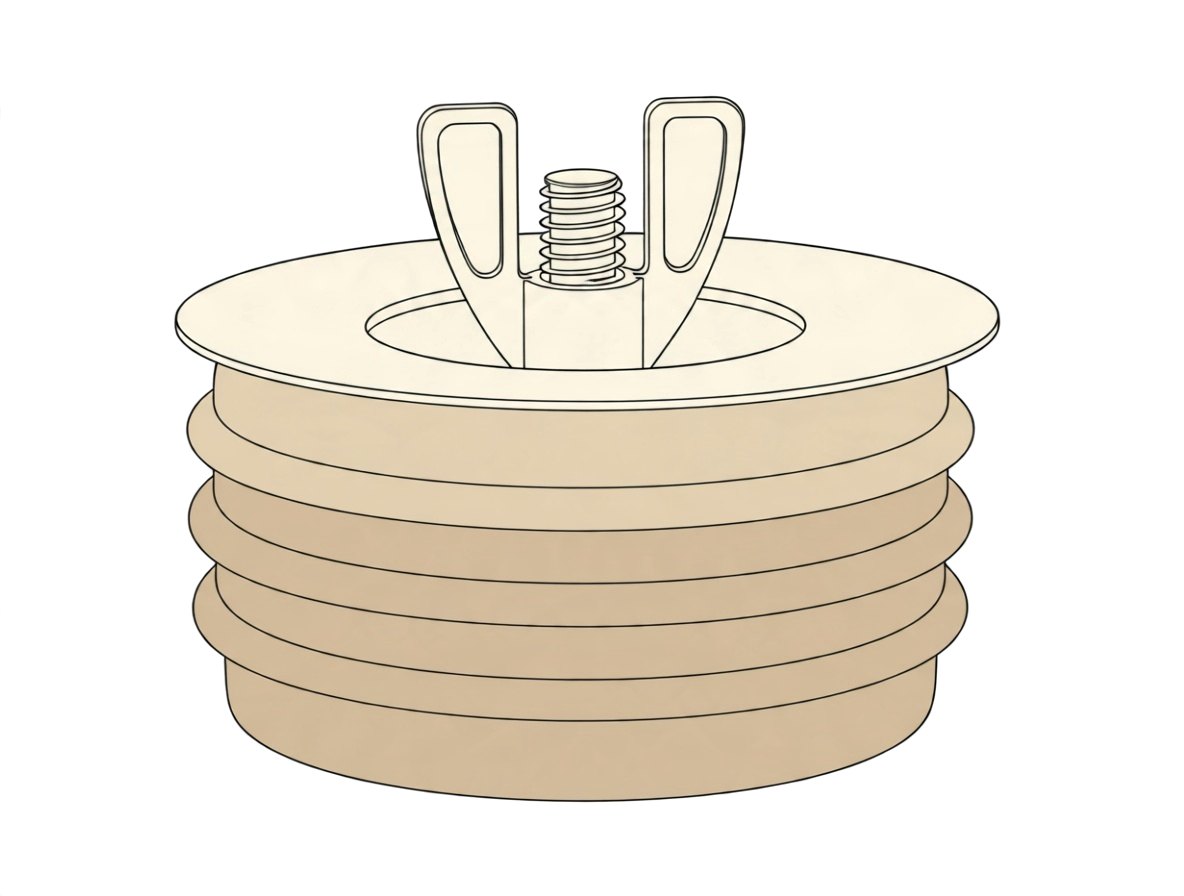
How it connects
The cylindrical rubber ring is inserted into the pipe end; tightening an axial bolt/wing nut compresses the elastomer axially between two rigid plates, forcing it to expand outward radially against the pipe ID to form a friction seal.
Male and female halves
Male expansion plug body mating into the female bore / internal diameter (ID) of a receiving pipe or fitting spigot.
Usually connects to
- Smooth unthreaded inside bore of pipe/tube or cleanout within the plug’s ID range, including PVC, ABS, cast iron, copper, steel or clay; 2 in DWV is one example
Common sizes
- Test-plug families span nominal 1/2–18 in and larger, commonly 1-1/2, 2, 3, 4 and 6 in DWV.
- Each plug covers a limited actual-ID range, such as 3.78–4.5 in or 5.62–6.40 in for a 6 in plug; nominal size alone is insufficient.
Where it is used
DWV/sewer pressure/leak testsCleanout closuresTemporary pipe sealing/capping/blankingPool winterizingIndustrial pipes
Variations
- Wing-nut single-seal plug
- Hex/bolt/Allen flush plug, including Zurn LC
- Cam-lever plug
- Bypass/test/gauge-port version
- Double seal
- Plastic body, such as Oatey Gripper
- Stainless/galvanized hardware
How to recognise it
Recognizable by an elastomeric rubber band or cylinder sandwiched between two rigid plastic or metal discs, driven together by a central bolt, wing nut, or hex screw.
Often confused with
| Confused with | How to tell them apart |
|---|---|
| NPT pipe thread | Expansion plugs seal against smooth interior pipe walls via compressed rubber, without threads engaging the pipe. A threaded plug has a tapered metal or plastic thread and screws in; the expansion plug has a smooth or ribbed rubber body with a wing nut. |
| Pneumatic inflatable pipe test ball | Expansion plugs expand mechanically via plates and screws/levers rather than pneumatic inflation. An inflatable plug is inflated through a valve stem; a mechanical plug is tightened with a nut. Inflatable uses air via a valve stem and has no wing nut or compression plates. |
| test cap | A test cap fits over the outside of the pipe; this plug goes inside the bore. |
Also called
Mechanical cleanout plugin-pipe test plugGripper plugMechanical inside-pipe plugmechanical test plugwing nut pipe plug; wing nut test plugpipe-end closureRubber pipe expansion plug
Good to know
Commonly used in cleanouts where existing internal pipe threads are stripped or missing, or for temporary hydrostatic/air pressure testing of DWV piping systems.
Related connections
Design with real parts
Crafti checks which parts connect, right in your browser.