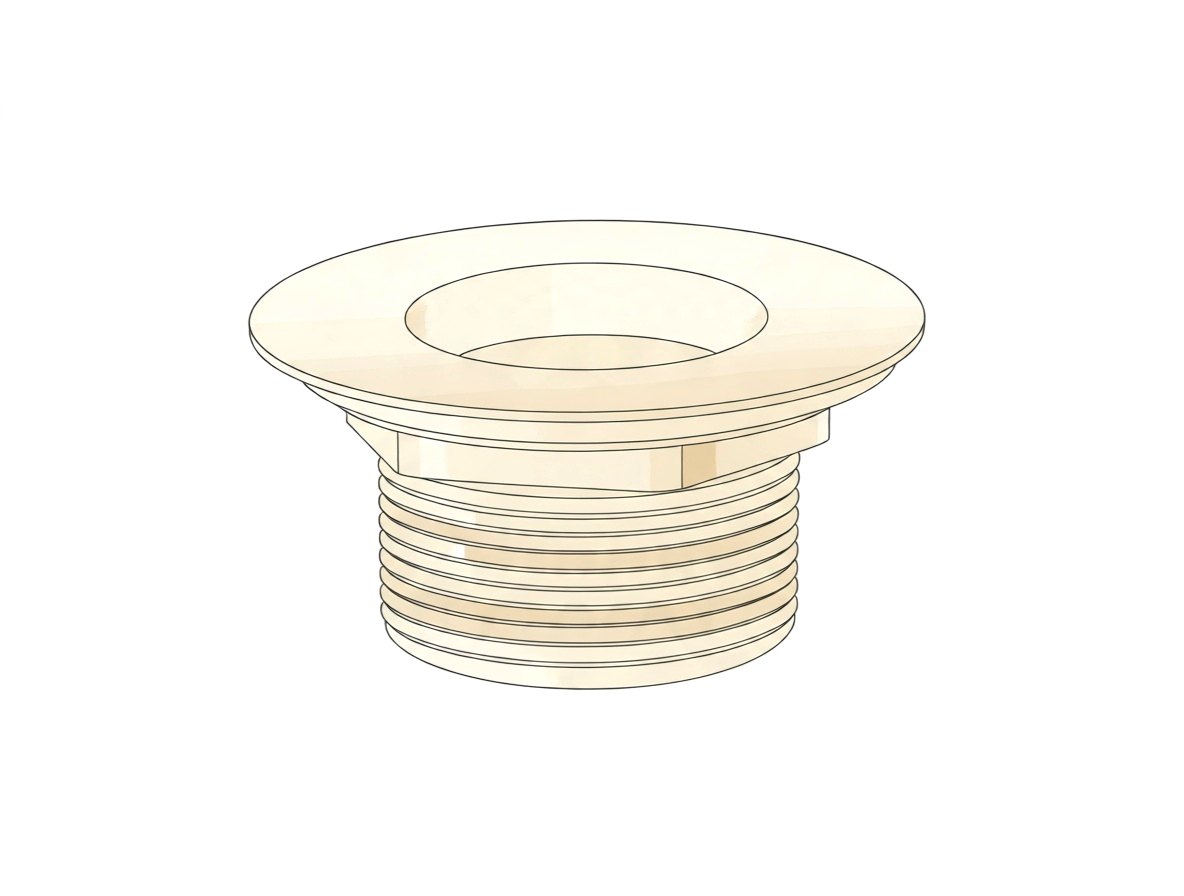
How it connects
The upper drain flange rests in the recessed sink seat sealed by plumber's putty or a silicone/foam washer, while the drain body passes through the bore and is compressed tightly from below via a rubber cone washer, friction ring, and locknut.
Male and female halves
Female opening on the sink basin; mates with the male threaded/tubular body and upper flange of a lavatory drain fitting.
Usually connects to
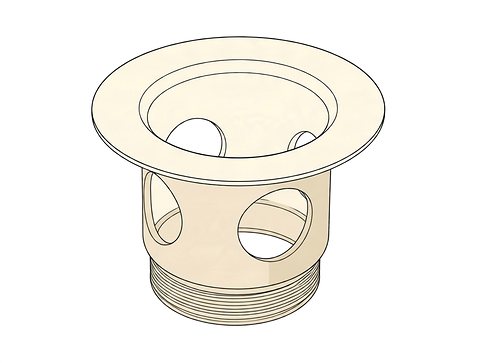
- Flanged lavatory pop-up or grid drain matched to sink hole/thickness, commonly nominal 1-1/4 or 1-1/2 in, with upper flange and lower nut
- Overflow or non-overflow version as the sink requires
- Matching waste/strainer body or basket assembly for its corresponding opening
Common sizes
- Lavatory holes commonly 1-1/2–1-3/4 in (38–45 mm), including 1.75 in (44.45 mm), for nominal 1-1/4 in drain bodies.
- Upper seats can be 2-1/8–2-1/2 in (54–64 mm). One non-overflow drain fits 1.5–1.75 in holes and basins up to 60 mm thick; another specifies a 1-1/2 in hole.
- Match hole diameter and basin thickness to the drain; standard kitchen openings are larger at about 3-1/2 in (89 mm).
Where it is used
Residential/commercial lavatory/vanity/vessel drainsBathroom sanitary fixturesCorresponding kitchen/utility sink assemblies
Variations
- Overflow-passage basin with matching drain
- Non-overflow vessel/solid-wall basin with matching drain
- Beveled/recessed or flat seat
- Related 3-1/2 in kitchen opening
How to recognise it
A smooth, unthreaded circular hole through the base of a bathroom sink or vanity bowl, usually featuring a slightly depressed or beveled outer seat on top to allow the drain flange to sit flush with the bottom surface of the basin.
Often confused with
| Confused with | How to tell them apart |
|---|---|
| Kitchen sink strainer drain opening | Kitchen sink drain openings are significantly larger, typically 3-1/2 in. (89 mm) in diameter, designed for 3-1/2 in. basket strainers or garbage disposals. |
| Bathtub drain waste opening | Bathtub drain openings are typically threaded (female coarse waste threads) to accept a screw-in drain flange rather than relying solely on a bottom clamp nut on an unthreaded ceramic bore. |
| NPT pipe thread | The ceramic opening has no internal thread. Visible external threads belong to the inserted drain body and its mounting nut. This is a basin opening and flange seat, without internal pipe threads; the drain mounting nut engages threads on the separate drain body. |
| Drain tailpiece slip-joint connection | The tailpiece-to-trap joint is downstream of the sink mounting aperture; its nominal tube size does not specify the sink hole diameter. |
| 1-1/4 inch drain tailpiece connection | The tailpiece is downstream of the basin mounting interface. Its nominal size does not establish the sink hole diameter. |
Also called
lavatory waste fitting openingbasin waste hole; sink waste holevessel sink drain hole; sink drain mounting hole; sink drain outlet holelavatory drain openingbasin drain holesink basin drain borelavatory drain hole with overflowbathroom sink drain opening with overflow
Good to know
Agents identified this on vanity tops and sinks where an unthreaded through-hole serves as the mechanical clamping and sealing interface for lavatory waste assemblies rather than a threaded or solvent-welded pipe connection. Additional standard references: CSA B45.4.
Related connections
Design with real parts
Crafti checks which parts connect, right in your browser.