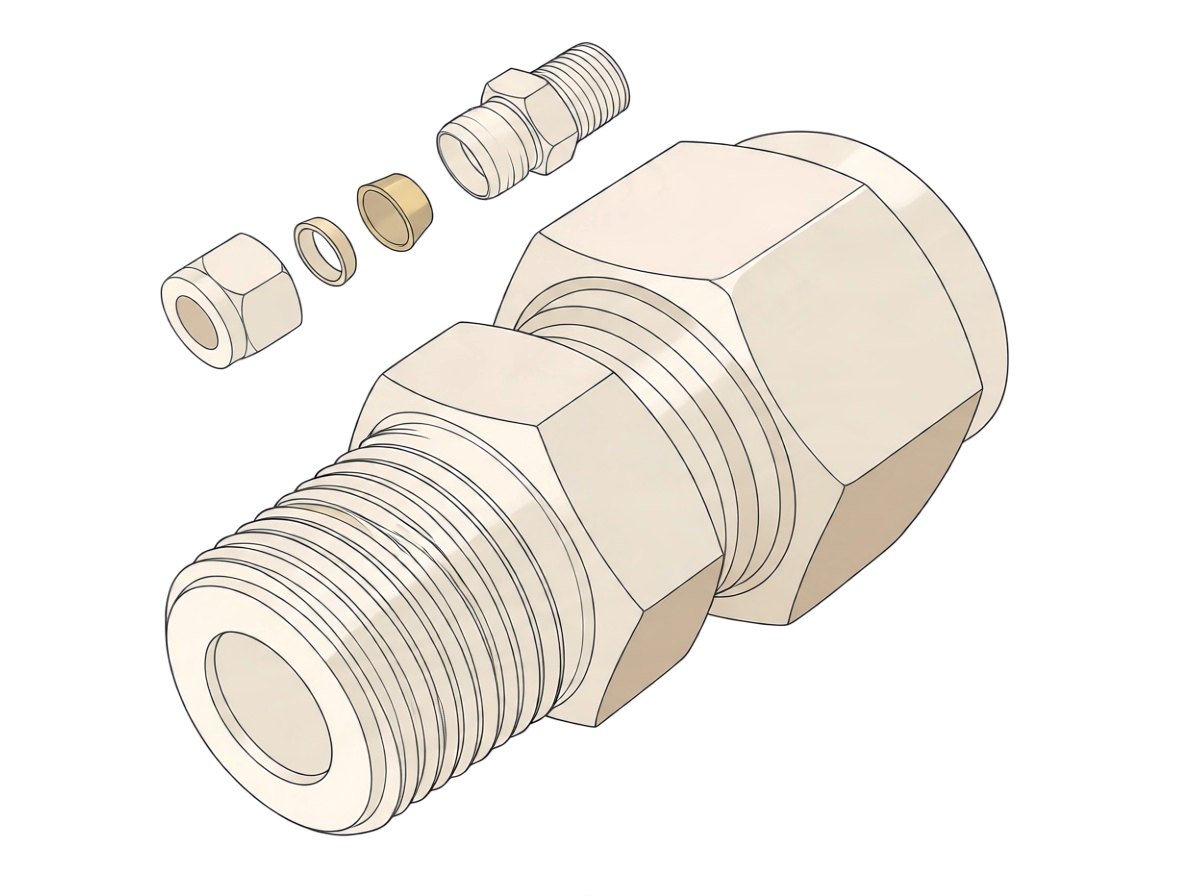
How it connects
Slide the nut and then the ferrule over the tube, insert the tube into the body bore up to its stop, and tighten the nut on the body's thread. The ferrule deforms and grips the tube, sealing between the tube, the ferrule and the body's taper.
Male and female halves
The tube is the male part going into this female socket (bore plus nut). The nut's thread to the body is an internal assembly thread, not the service connection. Some brass fittings reverse this and use a male nut that threads into a female body.
Usually connects to
- Matching-OD plain copper, brass, stainless, aluminum or plastic tube; plastic/CPVC/PEX needs the specified support insert
- 1/2 in nominal (5/8 in OD) Type K/L/M copper or CTS tube
- Matching 1/4 in compression male outlet (7/16-24), including refrigerator/ice-maker valves
- Matching 3/8 in compression male stop/adapter outlet (9/16-24)
- Matching 3/8 in copper/brass/plastic tube with ferrule
Common sizes
- Inch tube OD sizes span about 1/8–1 in, commonly 1/4, 5/16, 3/8, 1/2, 5/8, 3/4 and 7/8 in; 1/2 in nominal copper is 5/8 in OD and 3/4 nominal is 7/8 OD.
- Metric OD ranges span 3–42 mm, commonly 8/10/15/22/28 mm.
- Listed tube/nut pairs: 1/8 → 5/16-24, 3/16 → 3/8-24, 1/4 → 7/16-24, 5/16 → 1/2-24, 3/8 → 17/32-24 or 9/16-24, 1/2 → 11/16-24 or 3/4-20. Threads vary by maker.
Where it is used
Residential fixture supplies: stops, faucets and toiletsAppliance water/gas, refrigerator/ice-maker and dispenser linesHVAC/refrigerationInstrumentation/process tubingHydraulics/pneumaticsFuel/oil lines
Variations
- Single brass plumbing ferrule
- Double-ferrule instrumentation, such as Swagelok/Parker
- DIN 2353/ISO 8434-1 24° bite fitting
- BS EN 1254-2 UK olive
- Plastic sleeve/support insert for PE/nylon
- Male-nut arrangement
- Compression-to-FIP/MIP, union or stop body
- Short/long nut or self-aligning captive sleeve
How to recognise it
A hex nut on a threaded body with a smooth bore through it about the size of the tube OD, and a brass or steel ring (ferrule) inside the nut, which can be cone-shaped or barrel-shaped. Labels read 'X OD Comp' or 'Compression'. On the sample part, '3/8 in OD Compression x 1/4 in MIP' means this end takes 3/8 in tube and the other end is a 1/4 in NPT male thread.
Often confused with
| Confused with | How to tell them apart |
|---|---|
| SAE 45° flare fitting | A flare fitting needs a flared tube end and has a conical male nose with no separate ring. A compression fitting takes a plain tube end and has a loose ferrule ring inside the nut. |
| NPT pipe thread | A pipe port is just a tapered internal thread sized by nominal pipe size. A compression end has a nut over a smooth bore sized by tube OD. NPT is a tapered pipe thread for 0.84 in OD pipe; compression ports have a nut and ferrule and accept smooth tube. |
| Push-to-connect tube fitting | A push-to-connect fitting has a release collet ring and no hex nut or ferrule. |
| 1/2 in OD compression | 1/2 in OD tube is ~12.7 mm; 1/2 in nominal copper is 15.9 mm (5/8 OD). Measure the tube OD. |
| Two-ferrule instrumentation compression (Swagelok/Parker A-Lok) | Those use two stainless/brass ferrules and are sized by OD only; not interchangeable with plumbing single-ferrule parts. |
Also called
compression fitting (tube end); compression x tubeolive fitting (UK)sleeve/ferrule compression jointinstrument tube fitting (double-ferrule)5/8 in OD compression; 5/8" OD comp1/2" Nom Comp; 1/2" CTS compression15.9 mm compression1/4" compression nut; 1/4" OD compression female
Good to know
Compression fittings are sized by tube OD, separate from NPT/BSP pipe threads. Single-ferrule brass plumbing fittings and double-ferrule instrument fittings usually do not interchange even at the same OD. Inch and metric ODs differ: 3/8 in is 9.525 mm, not 10 mm. Additional standard references: ASME A112.18.6.
Design with real parts
Crafti checks which parts connect, right in your browser.