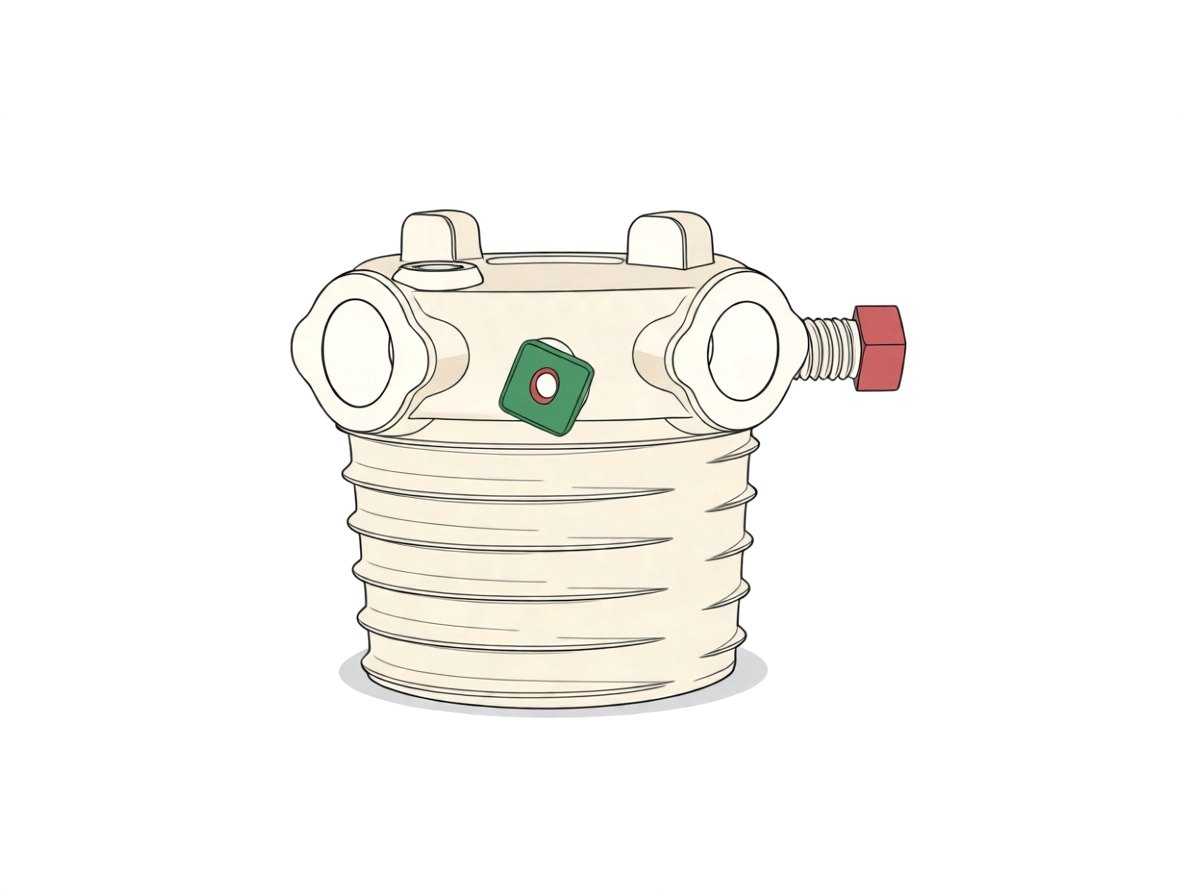
How it connects
Slip insertion of a cylindrical steel bar into the radial socket, transferring manual lever torque to wind or unwind the torsion spring before tightening the shaft set screws.
Male and female halves
Female radial blind hole mating with a solid cylindrical male winding bar end.
Usually connects to
- garage-door winding bar (male cylindrical rod)
Common sizes
- Nominally 1/2 in (12.7 mm) diameter in residential systems (socket bore approx. 0.50–0.62 in / 13–16 mm, 1 to 1.5 in deep); 5/8 in (15.9 mm) in heavy commercial systems.
Where it is used
overhead sectional garage doorstorsion spring counterbalance systems
Variations
- 1/2-inch nominal socket (residential)
- 5/8-inch nominal socket (commercial)
- 4-hole 90-degree spacing pattern
How to recognise it
Recognised as four smooth, round, unthreaded radial holes spaced 90 degrees apart around the outer rim/collar of a torsion spring winding cone.
Often confused with
| Confused with | How to tell them apart |
|---|---|
| set screw threaded hole | Set screw holes are tapped/threaded and pass through to clamp against the torsion shaft; winding sockets are unthreaded blind holes placed at 90-degree intervals around the cone perimeter. |
Also called
winding cone socketwinding plug socketwinding cone holetorsion spring winding hole
Good to know
Used exclusively as a temporary tool-engagement interface during spring installation, adjustment, or replacement.
Related connections
Design with real parts
Crafti checks which parts connect, right in your browser.