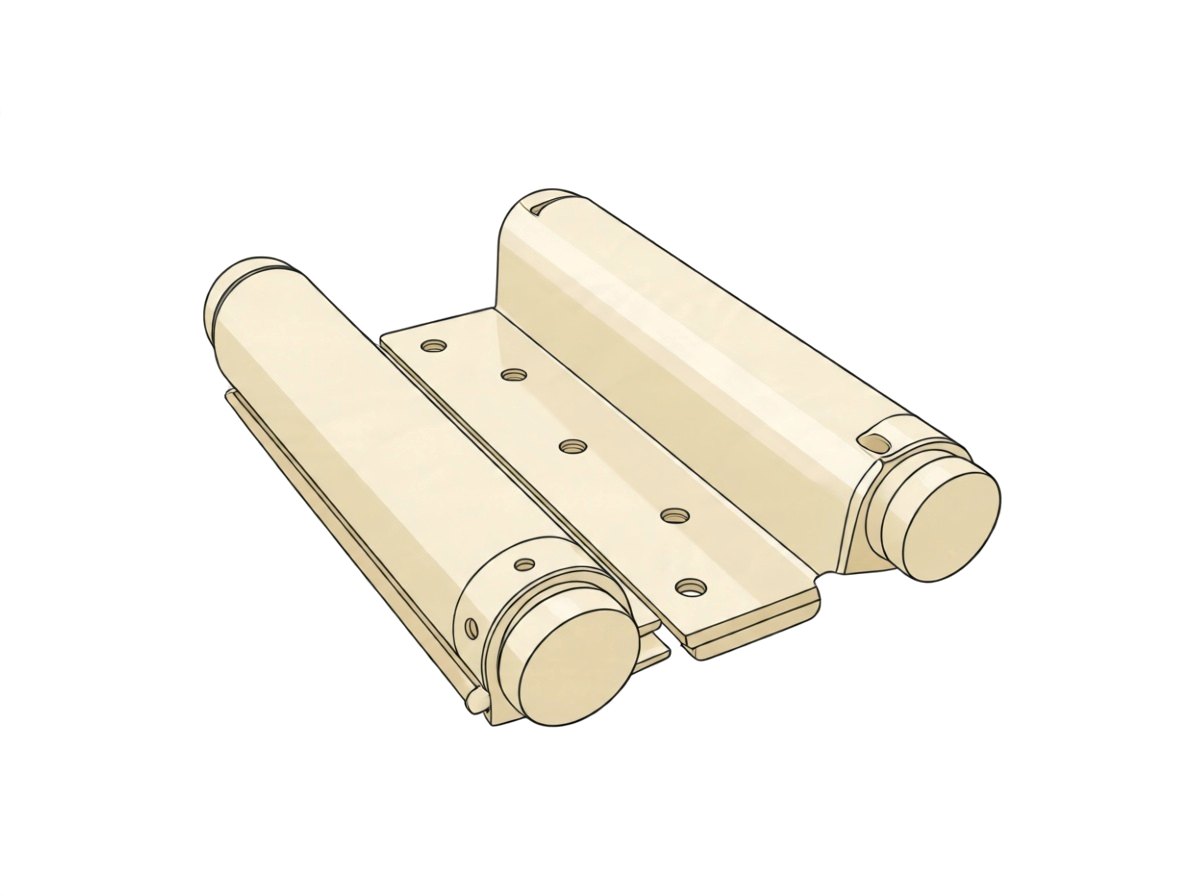
How it connects
A temporary mechanical lever interface where an adjustment pin or rod is inserted into the radial hole to manually rotate and torque the internal spring against hinge barrel resistance before inserting a locking pin.
Male and female halves
Female radial blind hole mating with a cylindrical male adjustment rod / tension bar.
Usually connects to
- Spring hinge tension adjustment rod (tension pin / tommy bar)
Common sizes
- Typically 2 mm to 4 mm (approx. 5/64 in to 5/32 in) in diameter, frequently around 2.5 mm to 3 mm.
Where it is used
door hardwarecommercial and residential spring hingessaloon doorscafe / double action spring hinges
Variations
- hex socket axial adjustment (alternative design using Allen wrench in top of barrel)
- multi-hole radial tension collar
- through-hole tension collar
How to recognise it
Recognized as small, unthreaded circular holes spaced circumferentially around the cylindrical collar/knuckle at one or both ends of a spring hinge barrel.
Often confused with
| Confused with | How to tell them apart |
|---|---|
| Spring hinge locking pin hole | Locking pin holes hold the static retaining pin in place against the hinge barrel stops to maintain tension, whereas the adjustment rod socket is rotated dynamically using a lever rod to wind the spring. |
| Axial hex socket adjustment | Axial adjustment uses an internal hexagonal recess at the top of the hinge pin driven by an Allen key, whereas the radial socket is a cylindrical hole on the cylindrical outer perimeter of the collar. |
Also called
spring hinge tension adjustment holespring hinge adjustment rod holetension collar pin holetension lug holetommy bar hole
Good to know
Often double action spring hinges come with an adjustment rod (or tommy pin) and locking pins; the same diameter rod or a dedicated pin is inserted into these radial holes to rotate the collar incrementally.
Related connections
Design with real parts
Crafti checks which parts connect, right in your browser.