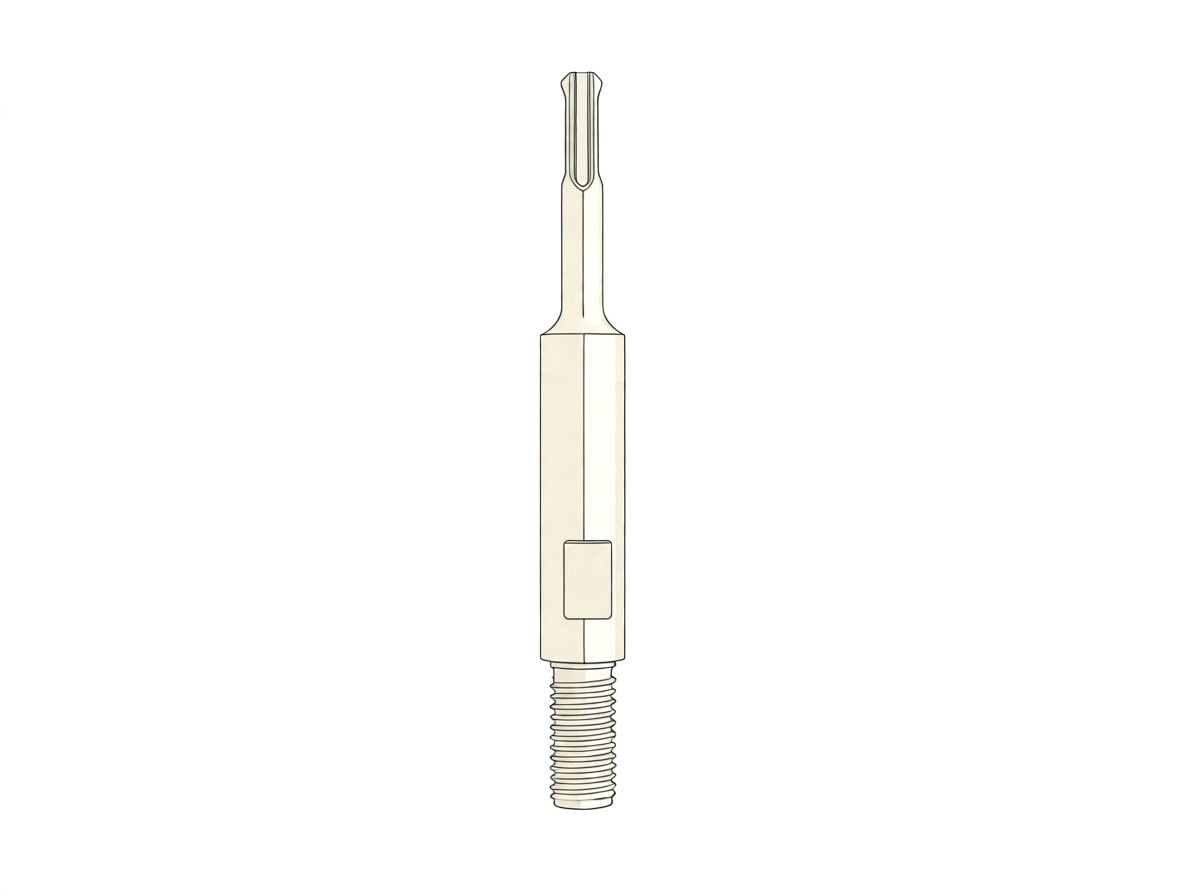
How it connects
Pushed straight into spring-loaded rotary hammer chuck where internal ball bearings seat into the closed grooves to retain the shank axially while allowing reciprocation, and ribs/splines engage open grooves for rotational torque.
Male and female halves
Male shank on the tool bit inserts into a female spring-loaded chuck or tool holder on the rotary hammer.
Usually connects to
- SDS-Plus female chuck
- TE-C rotary hammer chuck
Common sizes
- 10 mm diameter shank (~40 mm insertion/engagement depth); tools typically range from 4 mm to 32 mm drill/bit sizes.
Where it is used
constructionmasonry drillingconcrete anchoringchiseling
Variations
- SDS-Plus 2-cutter
- SDS-Plus 4-cutter
- stop drill bits
- chisel shanks
- anchor setting tools
How to recognise it
Recognised by a cylindrical 10 mm (approx. 25/64 in) diameter shank at the bit base with 4 parallel grooves: 2 opposite open-ended splines reaching the end face for rotation drive, and 2 closed oval detent indentations for ball-bearing retention.
Often confused with
| Confused with | How to tell them apart |
|---|---|
| SDS-Max (Hilti TE-Y) | SDS-Max has a significantly larger 18 mm shank diameter with 5 open and 2 closed slots, whereas SDS-Plus is 10 mm. |
| SDS-Top (Hilti TE-T) | SDS-Top features an intermediate 14 mm diameter shank, compared to the 10 mm shank of SDS-Plus. |
| SDS-Quick | SDS-Quick has a smaller 6 mm or 6.5 mm shank with shorter driving wings used in compact DIY tools. |
Also called
SDS-PlusTE-CSDS 10mm shank
Good to know
Hilti designates the universal Bosch-developed SDS-Plus shank standard as 'TE-C' across its product lines; TE-C bits and SDS-Plus bits/chucks are fully interchangeable.
Related connections
Design with real parts
Crafti checks which parts connect, right in your browser.