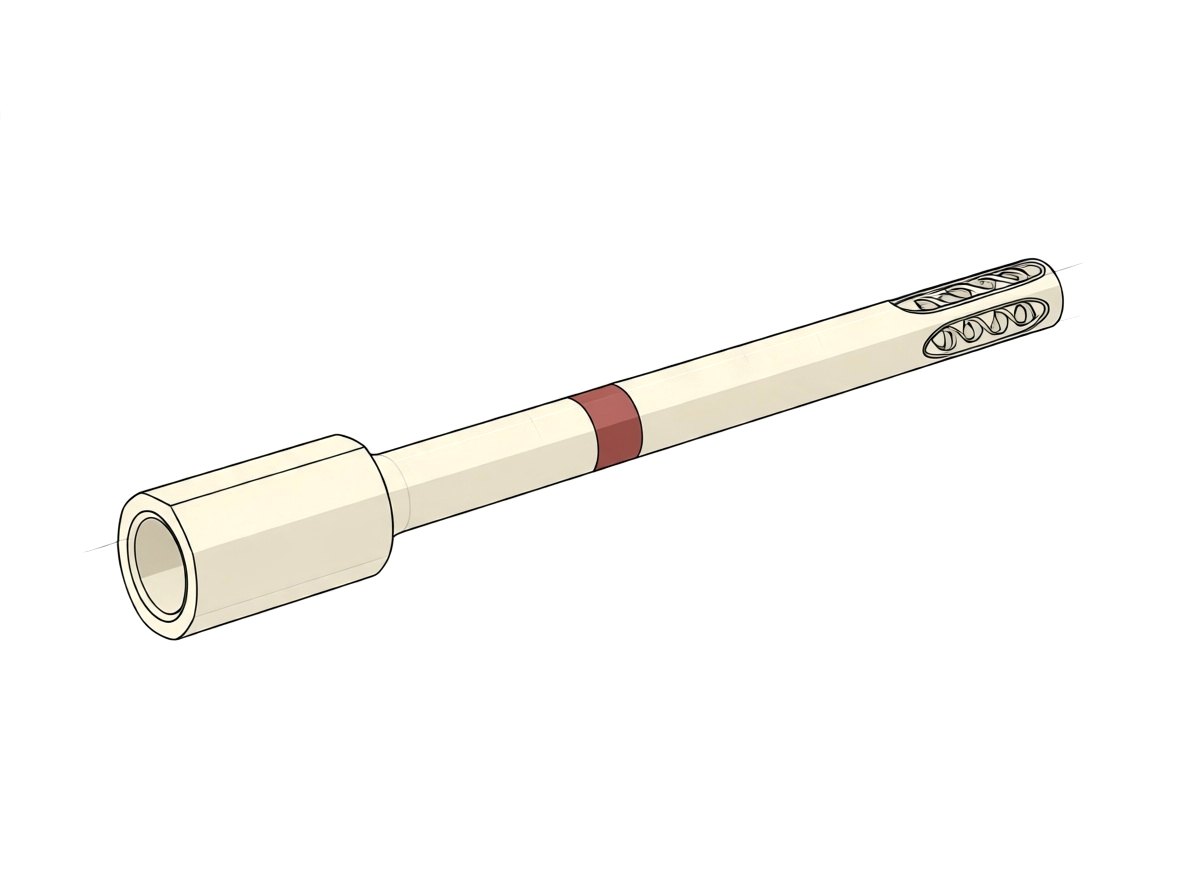
How it connects
Slips loosely over the threaded stud and nut of a 3/8-inch wedge anchor; the internal shoulder transfers axial percussion blows from a rotary hammer directly to drive the anchor into concrete without damaging threads.
Male and female halves
Female socket on the setting tool that accepts the male threaded end / nut of a 3/8-inch stud expansion anchor.
Usually connects to
- 3/8 in Kwik Bolt wedge anchor threaded stud and nut assembly
Common sizes
- 3/8 in nominal bolt/anchor diameter (approx. 10.5 mm internal bore diameter)
Where it is used
concrete anchoringstructural fasteningconstruction
Variations
- 1/4 in
- 3/8 in
- 1/2 in
- 5/8 in
- 3/4 in
How to recognise it
A smooth cylindrical recessed cup/bore at the working end of an SDS-Plus (TE-C) or SDS-Max shank tool, sized specifically to swallow the top threads and nut of a 3/8 in wedge anchor.
Often confused with
| Confused with | How to tell them apart |
|---|---|
| Drop-in anchor setting punch / tool | Drop-in anchor tools feature a male stepped pin or shoulder that inserts into the anchor core to expand the internal plug, whereas a Kwik Bolt setting tool has an open female cylindrical cavity that slips over an external threaded stud. |
| Standard hex socket | A standard hex socket has a 6-point or 12-point internal profile designed for rotational torque, whereas a Kwik Bolt setting socket has a smooth, round cylindrical cavity designed purely to deliver axial hammering impact. |
Also called
Kwik Bolt mechanical setting tool socketstud anchor setting tool socketwedge anchor setting socketHS-SC setting tool socket
Good to know
Used on tools like the Hilti HS-SC setting tool (e.g. PN 337918 / 337919). The opposite end of the tool features a standard rotary hammer shank (such as SDS-Plus / TE-C).
Design with real parts
Crafti checks which parts connect, right in your browser.