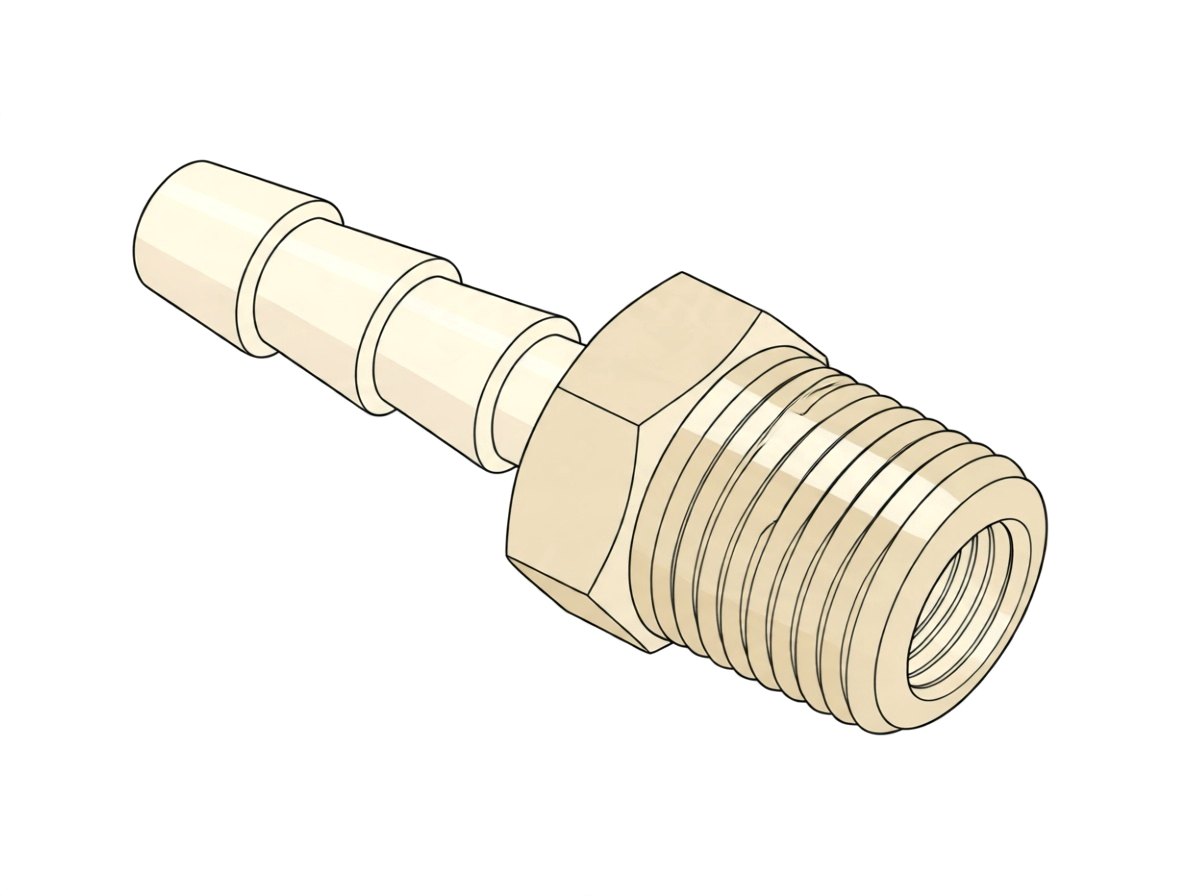
How it connects
The hose end is pushed (often warmed or lubricated) over the barbs; the stretched hose seals against the barb ridges and is held by interference. A worm-drive, ear/Oetiker or crimp clamp is commonly added for pressure or vibration.
Male and female halves
Always the male half; the hose bore is the female. There is no separate female barb fitting. This port is the male barb.
Usually connects to
- Matching-ID flexible vinyl/PVC/silicone/rubber/PE hose, including 1/2 or 3/8 in drain-hose examples
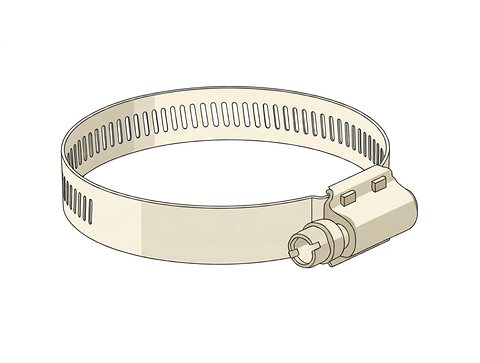
- Matching worm-drive, ear/Oetiker or spring clamp, or crimp ferrule around the hose
- Water-softener brine-tank sidewall opening in the described assembly
Common sizes
- Named by hose ID, about 1/16–2 in (1.5–50 mm) and larger. Common sizes: 1/8, 3/16, 1/4, 5/16, 3/8, 1/2, 5/8, 3/4 and 1 in.
- Barb crests are slightly larger than nominal hose ID; a 3/8 in barb is about 9.5 mm or slightly larger at the crests.
Where it is used
Compressed-air linesAutomotive coolant/fuel/PCV and vacuum linesIrrigation/pond/aquarium tubingLaboratory tubingAppliance drains/plumbingWater-softener drain/brine lines
Variations
- Single- or multi-barb
- Straight, elbow, tee or Y
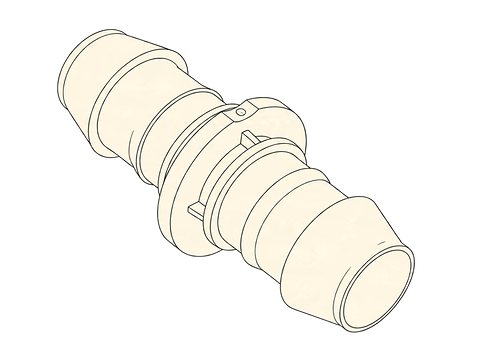
- Barb-to-barb splicer/coupler or reducer
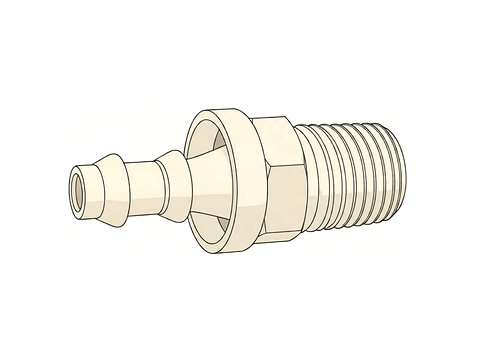
- NPT/BSP male-thread adapter
- Stepped multi-size barb
- Plain beaded hose tail (different from barbs)
- Brass, stainless, nylon or polypropylene
How to recognise it
A smooth-bore tube end with one or more conical rings whose sloped side faces the tip and sharp step faces the body, often beside a hex and a pipe thread on the other end. Size is marked or listed as the hose ID (e.g. '1/4 in barb').
Often confused with
| Confused with | How to tell them apart |
|---|---|
| Push-to-connect (instant) tube fitting | Push-to-connect is a female socket with a collet that the tube enters; a barb is a male ridged spigot the hose goes over. Push-to-connect is a female socket with a collet that takes rigid OD-sized tube. A barb is a ridged male spigot that goes inside soft hose. |
| Garden hose (GHT) or threaded hose fitting | Those mate by a thread and gasket; a barb has saw-tooth ridges, not a helical thread. |
| Compression fitting insert / ferrule | Compression uses a nut and ferrule on rigid tube; a barb has no nut and grips the hose by its own ridges. A compression fitting has a nut and ferrule over the tube OD. |
| Male pipe thread (NPT) | Thread is a continuous helix; barbs are separate annular rings that slope toward the tip. |
Also called
barbed fittinghose tailhose shankbarbed hose connector; hose nipple; barbed spigot; barbed nippleinsert fittinghose insert; insert barbbarb endBrine tank overflow elbow
Good to know
Barb size is not a thread size: '1/4 in barb' means for 1/4 in ID hose. On the sample part (1/4 in Barb x 3/8 in MIP), only the barb end is this connection; the NPTF end is a separate port. No single governing standard; dimensions vary by maker.
Related connections
Design with real parts
Crafti checks which parts connect, right in your browser.