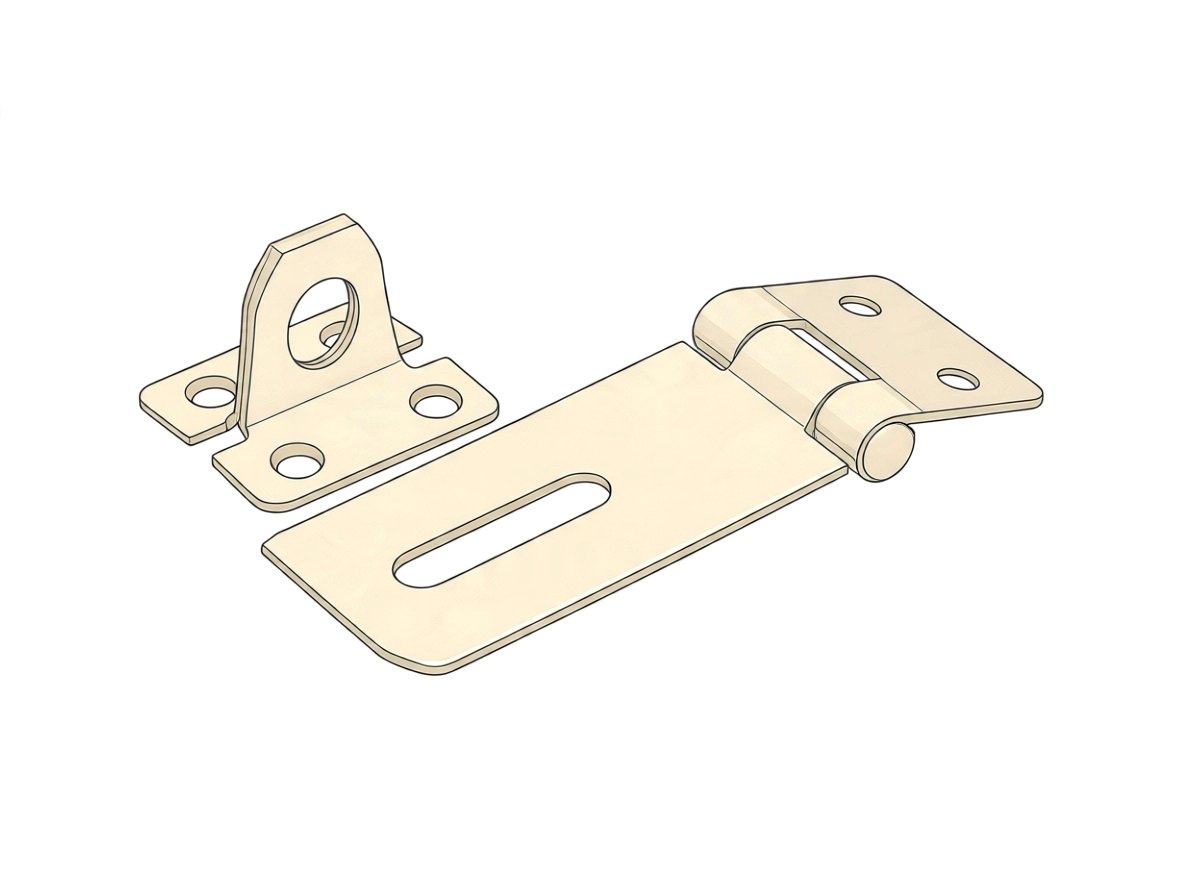
How it connects
The rigid U-shaped shackle of a padlock passes freely through the staple aperture and locks into the padlock body, preventing the slotted hasp leaf from being lifted off the staple.
Male and female halves
The staple aperture acts as the female receiving eyelet, while the padlock shackle serves as the male locking pin.
Usually connects to
- Padlock/safety-lockout shackle that fits the opening with adequate internal clearance
- Matching lockout hasp jaw, hook or scissor pin
- Security seal wire/shackle
Common sizes
- Common shackles span 3/16–1/2 in (about 5–13 mm), often 6–12 mm; some receivers take up to 7/16 in (11 mm).
- Receiver holes are described around 5–15 mm (up to 5/8 in), or clear openings around 10–25 mm (1/2–1 in). Match actual clearance rather than nominal shackle size alone.
Where it is used
Door/gate/shed/barn security hardwareStorage boxes/tool chestsUtility enclosuresIndustrial lockout/tagout
Variations
- concealed/shrouded staple; Concealed mounting staple
- hardened steel staple
- Fixed staple eye
- Swivel/rotating staple eye
- Straight padlock eye plate; Right-angle padlock eye plate
- Welded staple loop
- round shackle hole
- slotted padlock eye
How to recognise it
Identified by a projecting metal loop, bracket, or tab (the staple) containing a circular or oblong hole positioned to poke through the slot of a closed hasp latch.
Often confused with
| Confused with | How to tell them apart |
|---|---|
| Hasp slot / leaf opening | The hasp slot is the elongated cutout in the hinged latch plate that drops over the staple, whereas the staple aperture is the loop hole projecting through the slot to receive the padlock shackle. The hasp slot is the elongated cutout on the hinged leaf through which the staple eye protrudes, whereas the staple eye is the hole in the loop that receives the lock shackle. The hasp slot is the elongated cutout in the hinged leaf that passes over the staple, whereas the staple loop is the protruding eyelet that receives the padlock. |
| Screw mounting hole | Screw holes are countersunk or smaller holes located on the base mounting plate for fastening to wood or metal, rather than the elevated clearance eye. |
| Padlock eye plate / padlock bracket | A general padlock eye is mounted flat to receive a padlock directly without an interlocking hinged hasp plate. |
| padlock drain hole | A drain hole is a tiny weep hole (1-2 mm) at the base of the padlock body next to the keyway for water drainage, not for locking. |
Also called
padlock eyehasp staple eyepadlock staple aperturehasp loopstaple openingpadlock hole; padlock eyeletstaple shackle holehasp hole; lockout hole
Good to know
In builder's hardware nomenclature, a 'hasp and staple' consists of the hinged strap (hasp) and the protruding loop bracket (staple). The aperture in question is the opening in that staple.
Related connections
Design with real parts
Crafti checks which parts connect, right in your browser.