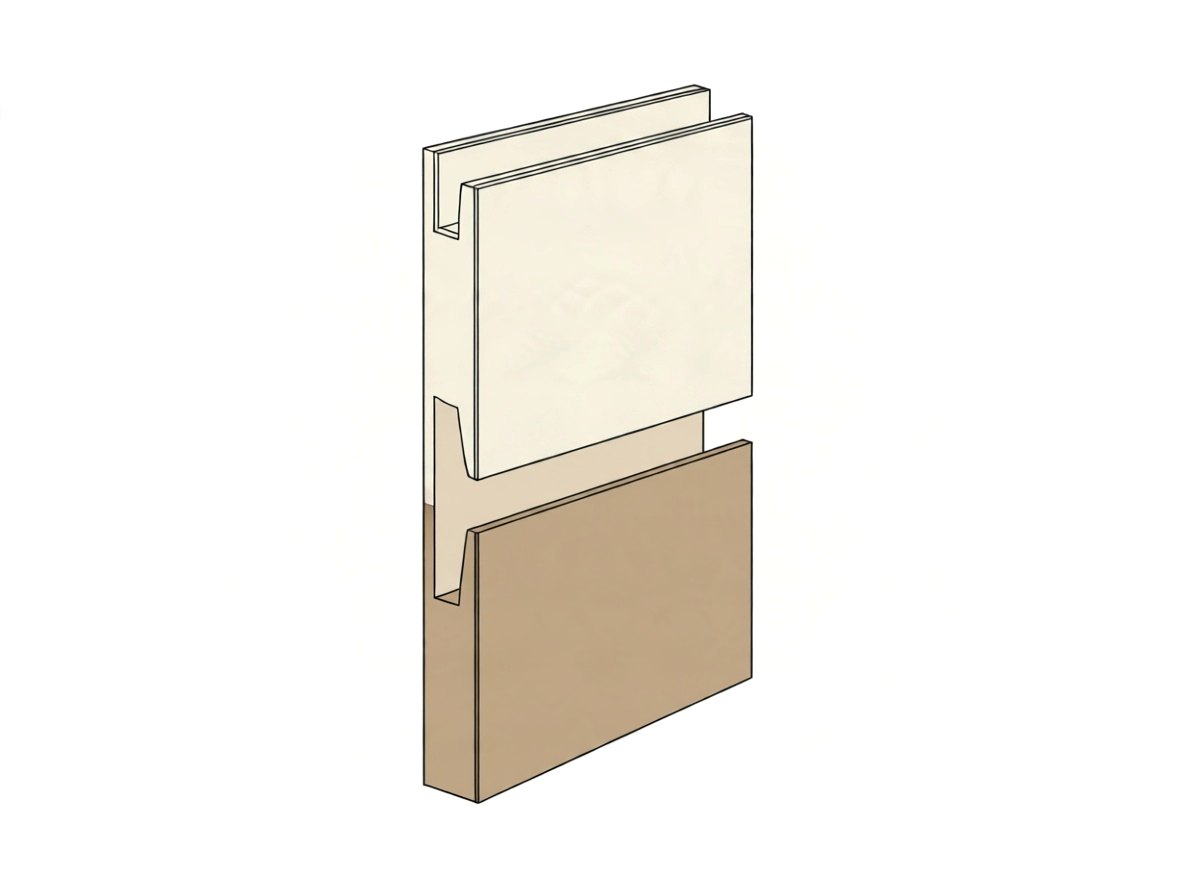
How it connects
Panels abut edge-to-edge flush on the wall; each half-profile contributes half of a standard T-groove slot, creating a continuous full-depth groove fastened to wall studs.
Male and female halves
Symmetric/genderless half-profile joint. Both upper and lower panel edges feature complementary halves of the T-slot cavity, uniting into a full female T-groove.
Usually connects to
- Matching complementary male tongue/half-groove stacking edge or top screw flange
- Matching aluminum/metal insert at the assembled joint
- Compatible slatwall hooks/display brackets once the two halves form the full groove
Common sizes
- Modular profiles commonly run 4–8 ft (1220–2440 mm), with panel heights/widths around 6–12.3 in and depths 10–15 mm.
- One 3/4 in (19 mm) panel profile has about 5 mm opening per half for a 10 mm (3/8 in) slot and 9–12 mm routed depth.
- Slatwall descriptions also give 3 in groove pitch and 3/8–1/2 in openings; confirm the edge joint rather than assuming it matches an accessory groove.
Where it is used
Retail display fixtures/shelvingGarage/workshop wall storageResidential/commercial paneling/cladding
Variations
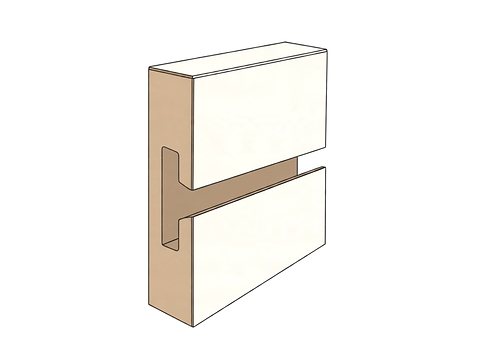
- Routed MDF/wood half-groove, bare or aluminum-lined
- Butted half-groove
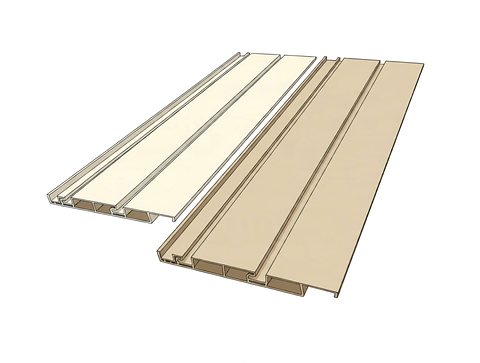
- PVC shiplap/tongue-and-groove
- Concealed fastener flange
- Friction or snap profile
- Proslat, Trusscore or NewAge product-specific edge
How to recognise it
Look at the top or bottom edge of a slatwall panel: instead of a flat square edge, the margin shows a routed cut representing the upper or lower half of a standard T-slot.
Often confused with
| Confused with | How to tell them apart |
|---|---|
| Full Slatwall T-Groove | A full slatwall groove is completely enclosed within the face of a single panel, whereas a half-groove is open along the outer horizontal edge of the panel. |
| Shiplap / Tongue and Groove | Shiplap or tongue and groove creates a purely interlocking wood seam without forming a load-bearing retail accessory slot. |
| Traditional T-channel slatwall slot | The T-slot is the front-facing horizontal channel used to hang hooks and accessories, whereas the interlock female groove is an edge-to-edge structural joint joining two panels. T-channel slots face frontward to receive hooks and brackets, whereas the interlocking edge is on the horizontal perimeter of the panel to join stacked panels. |
| Standard Wood Flooring Tongue-and-Groove | PVC slatwall joints incorporate specialized fastener screw-hem margins and hook channel alignments rather than standard symmetrical wood milling. |
| Tongue and Groove Joint | Tongue and groove has a protruding tongue fitting into a recessed mortise groove, whereas a slatwall half-groove forms a T-slot opening for fixture brackets. |
Also called
half-groove stacking edge; slatwall half-groove edgehalf slot edgeslatwall stacking joint; female slatwall jointPVC panel bottom interlock channelslatwall edge rebateslatwall ship-lap edgeslatwall interlocking bottom grooveslatwall panel female lip
Good to know
Used specifically on 2 ft or 4 ft tall stackable slatwall panels to allow stacking up to 8 ft or higher without interrupting the standard on-center groove pitch.
Related connections
Design with real parts
Crafti checks which parts connect, right in your browser.