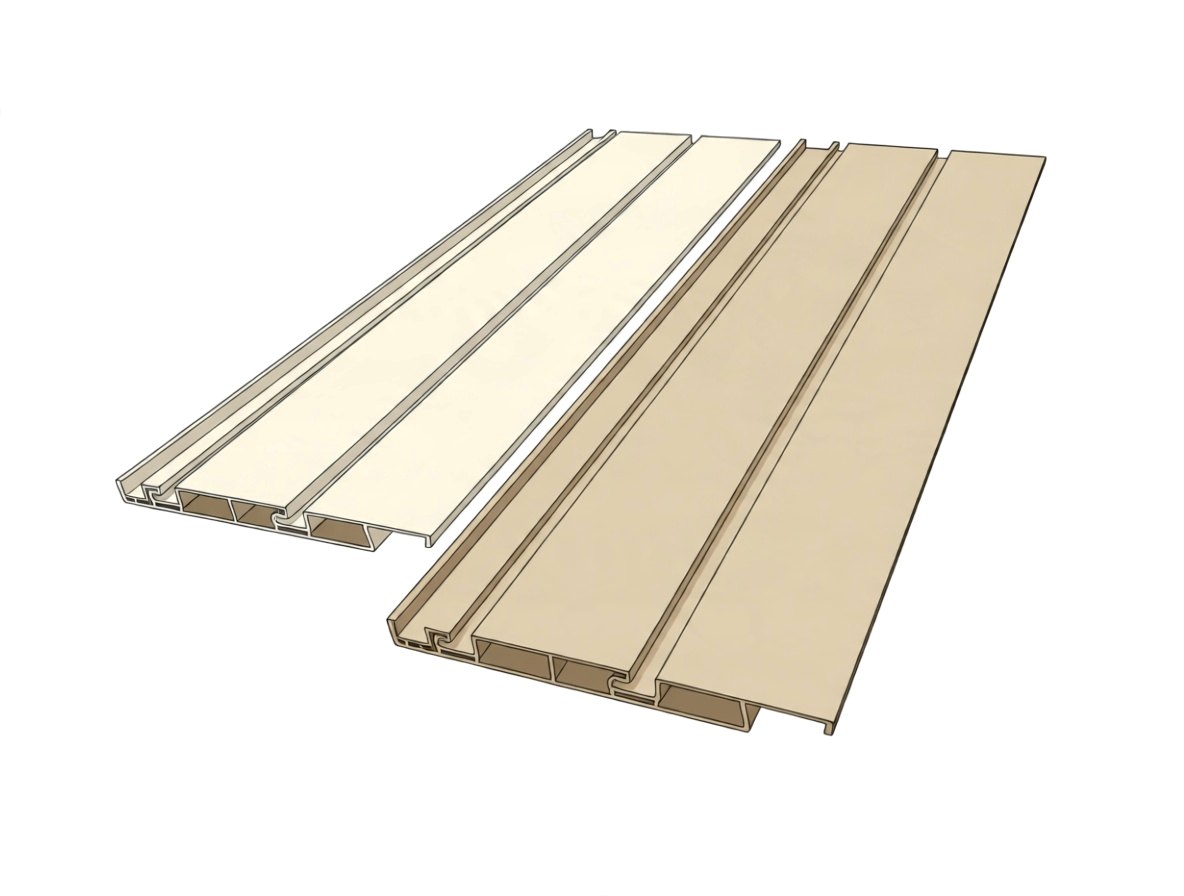
How it connects
One edge features a slotted fastening flange screwed to wall framing, while the complementary receiving edge of the adjacent panel slides or snaps over it, locking the panels together and concealing all mounting fasteners.
Male and female halves
Mating tongue (or nailing flange lip) and groove edges on opposite long sides of extruded panels; typically an upper flange accepts screws while the bottom groove of the next panel slips over it.
Usually connects to
- Matching upper/lower tongue/groove edge of an identical or compatible slatwall panel, including NewAge profiles
- Compatible starter strip or perimeter top/bottom J-trim
- Wall studs/drywall through concealed nailing-flange fasteners
Common sizes
- Panel lengths commonly 4–8 ft; one profile is 80 in (2032 mm) long, about 0.63 in (16 mm) deep with 5 mm (0.2 in) engagement.
- General thicknesses 1/2–3/4 in (12–19 mm); strip heights vary around 3–12 in, including 6–7.2 in PVC slats.
Where it is used
Garage/workshop wall organizationRetail displaysResidential/commercial utility storageModular PVC wall cladding
Variations
- Standard/deep tongue-and-groove hollow PVC
- Shiplap/L-overlap with hidden screw flange
- Snap/friction lip
- Bottom starter track
- 80 in PVC, white/silver/gray, in 40/80 sq ft sets
- Aluminum-reinforced profile, such as Proslat PROCORE
How to recognise it
Recognized as an extruded longitudinal lip or channel with a perforated or continuous screw flange along one long edge, and a mating undercut channel along the opposing edge that conceals fastener heads when nested.
Often confused with
| Confused with | How to tell them apart |
|---|---|
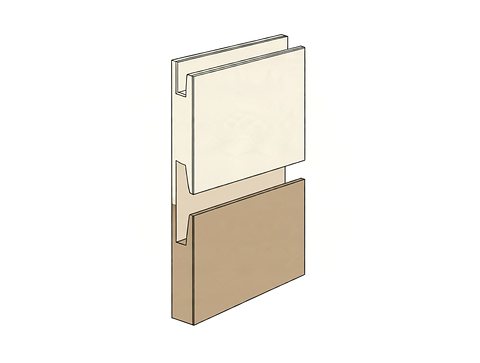
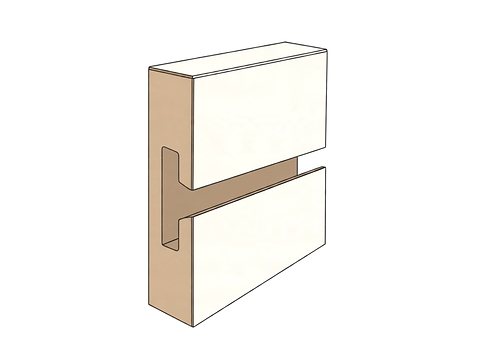
| Standard Slatwall T-Channel Slot | The T-channel slot runs horizontally along the face of the panel to hold hooks and accessories, whereas the interlock edge connects two adjoining panels edge-to-edge. The T-channel is the horizontal slot running across the face of the board to hold hanging hooks and brackets, whereas the board edge joint is the mating seam along the perimeter top/bottom edges that joins two boards together. The interlocking edge joins panel sections horizontally along their top/bottom seams to form the wall, whereas T-channels are horizontal face slots that accept hanging hooks and brackets. |
| Standard Wood/MDF Tongue and Groove | Extruded PVC slatwall interlocks incorporate an offset screw/nail flange directly into the profile to conceal mounting hardware, unlike symmetrical wood T&G joints. |
| Standard Shiplap / Tongue and Groove Wall Cladding | Standard T&G or shiplap siding lacks the integrated front-facing T-slots engineered to support slatwall accessories. |
| Proslat or Gladiator slatwall interlocking joints | Proprietary extrusion profiles with different tongue/groove dimensions and channel spacing that do not mate across brands. |
Also called
Slatwall tongue and groove edge; lower panel tongue/groove edgePVC panel interlock flangeConcealed fastener slatwall interlockinterlocking slatwall panel seam; slatwall panel interlocking joint; slatwall shiplap jointinterlocking bottom panel edgePVC slatwall bottom interlockNewAge slatwall interlocking top lipNewAge slatwall upper tongue
Good to know
While the front-facing T-slots for hanging hooks conform to standard slatwall accessory dimensions (often 3-inch centers), the panel-to-panel interlocking edges are manufacturer-specific proprietary extrusions (e.g., Trusscore, Proslat, EZ Slatwall, GarageEscape).
Related connections
Design with real parts
Crafti checks which parts connect, right in your browser.