How it connects
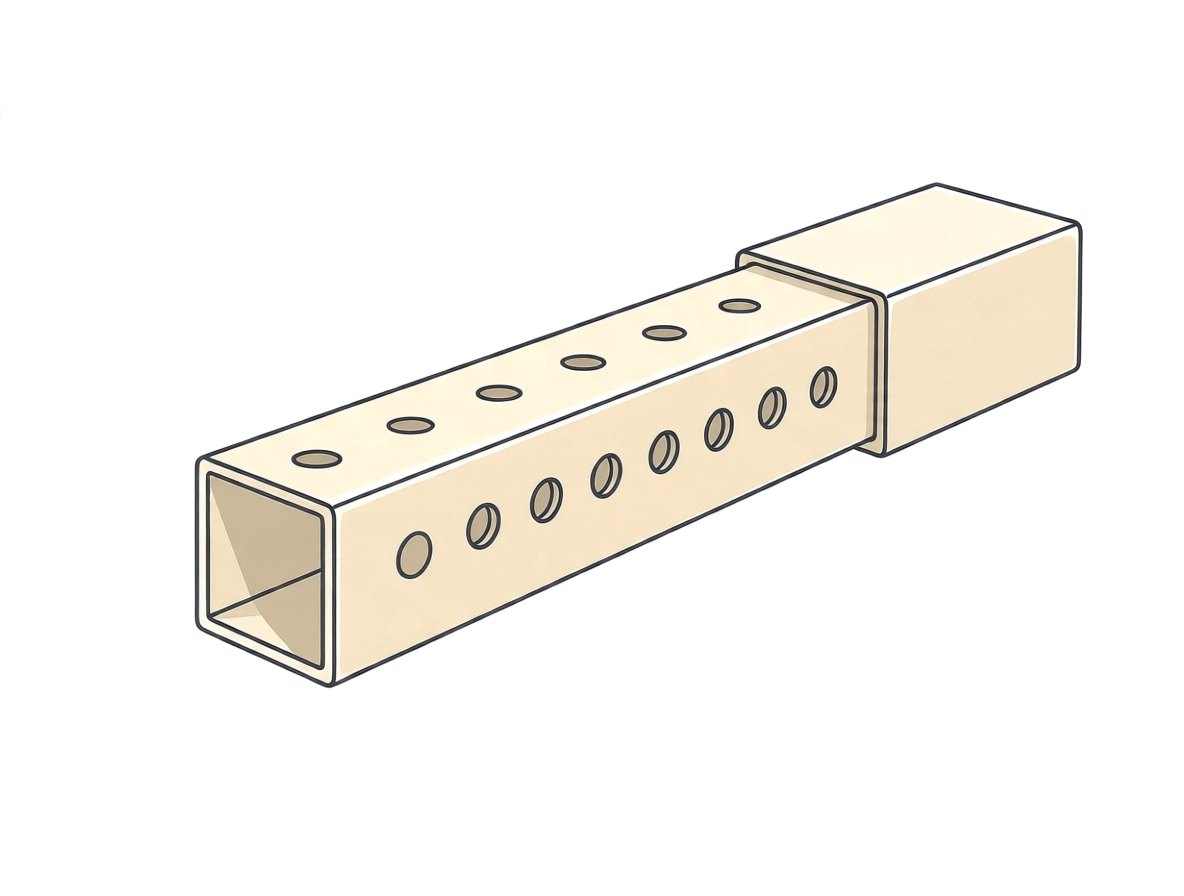
A slightly smaller square male tube inserts coaxially into the female sleeve and slides to the desired extension. Fasteners such as detent pins, quick-release pins, or through-bolts pass through aligned indexing holes to lock position.
Male and female halves
Female outer sleeve receiver that accepts a mating male inner square tube.
Usually connects to
- Smaller square tube/member sized to telescope inside the sleeve, including the Pylex 1-1/8 in spigot example
- Matching detent/quick-release pin or through-bolt
- Matching Pylex foundation-screw adjustable-saddle threaded stem
Common sizes
- Telescoping profiles commonly span 0.75–3 in or 20–80 mm; examples include 1, 1-1/4, 1-1/2, 1-3/4, 2, 2-1/4 and 2-1/2 in, and a 75 mm sleeve for 60 mm inner tube.
- One formed 1-1/4 in outer tube has a 1-1/8 in (28.6 mm) square opening.
- A nominal 1-1/4 in square-tube example suggests a 1 in insert or 1-1/2 in receiver, but these fits are not established. Check wall thickness and actual clearance.
Where it is used
adjustable height workbenches and desks; Adjustable structural framesfitness and gym equipment; display stands and stage equipmentsignage and traffic sign postsscaffolding and temporary support structuresdeck constructionhelical foundation screw piles; light residential foundationsSign supports; Extendable arms and supportsStorage racks and carts
Variations
- Perforated or unperforated telescoping tubing
- Full-length or end-only locking holes
- One- or four-sided indexing
- Weld-flash-removed tube
- Proprietary Telespar/Telestrut profile
- Pylex 24 in extension receiver or 32/50 in pile-head socket
- Bolt or pin retention
How to recognise it
Hollow square steel or aluminum tube section with an inner cross-section sized to closely slip-fit over a smaller square tube, marked by one or more series of evenly spaced indexing pin/bolt holes along the face.
Often confused with
| Confused with | How to tell them apart |
|---|---|
| trailer hitch receiver | Hitch receivers are fixed-length standardized female square tubes (typically 2" or 1-1/4") with a reinforced collar and a single hitch pin hole, rather than full-length or repetitive indexing holes for variable telescoping length. |
| round telescoping tube sleeve | Round telescoping tubing lacks anti-rotation geometry and typically uses push-button snap locks or friction collar clamps rather than square profile anti-rotation alignment. |
| 1-1/2 in or 1-3/4 in square telescopic tubing (e.g. Unistrut / Tele-Strut) | Standard architectural/signpost square telescoping tubing is significantly larger (1.5 in to 2.5 in) with perforated hole patterns, whereas Pylex uses a proprietary 1-1/8 in square profile on tubular screw piles. |
| Ordinary square structural tubing | A square cross-section alone does not establish telescoping compatibility. Verify inside clearance, wall thickness, corner geometry, weld seam and fastener-hole alignment. |
| Threaded pipe socket | This interface has a square sliding bore and transverse retention holes rather than mating helical threads. |
Also called
perforated square telescoping receiver; Square telescoping tube receivertelescoping square tube female sleeve; telescoping square outer tube; Outer square tube sleevetelescopic square sleevePylex foundation screw square socketPylex pile extension receiverfemale telescoping square tubingsquare tube slip joint femaletelescopic square tube socket
Good to know
Often encountered in modular furniture like adjustable workbenches (e.g., 75 mm outer sleeve over 60 mm inner leg) and sign posts (Telespar). The square profile provides intrinsic torsional anti-rotation resistance.
Design with real parts
Crafti checks which parts connect, right in your browser.