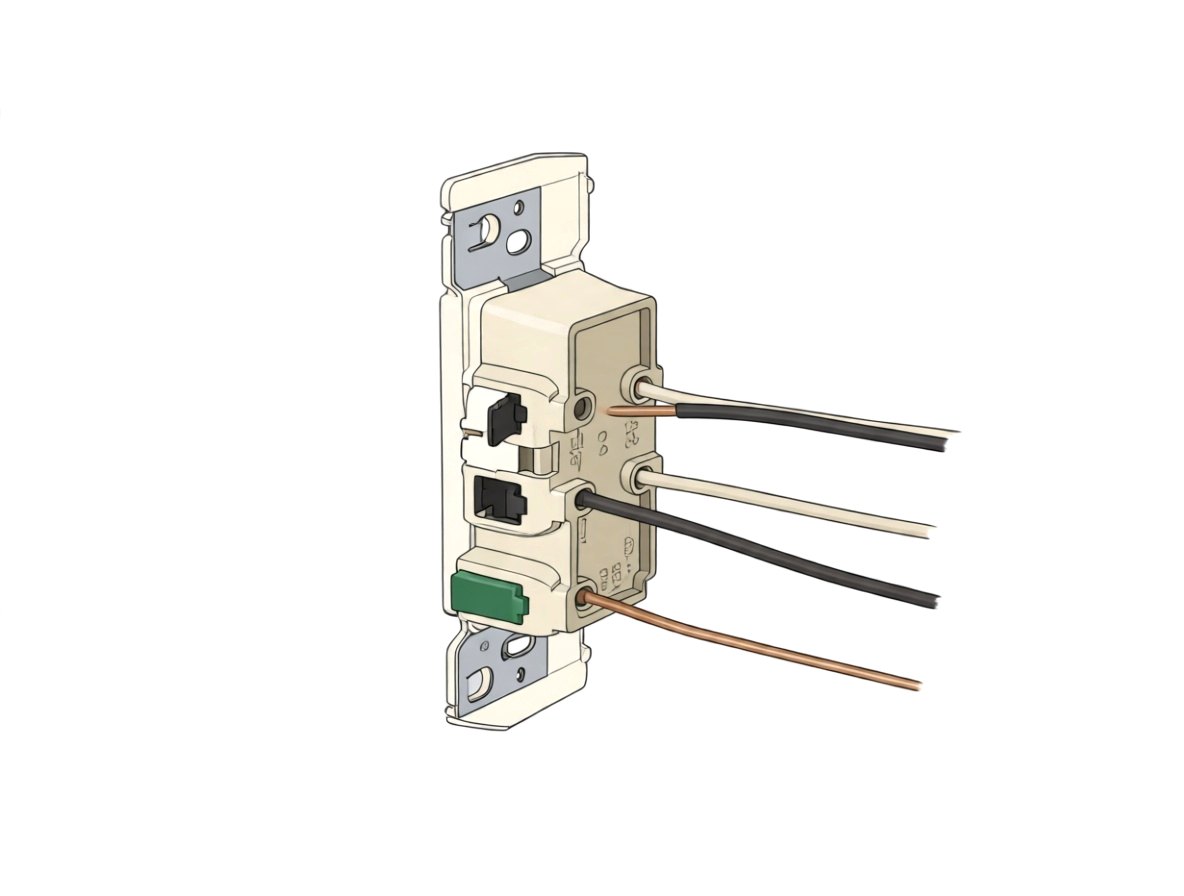
How it connects
Open the lever fully, insert the stripped conductor into the wire hole, then snap the lever closed to clamp it. This is an electrical termination; no fluid seal is involved.
Male and female halves
The terminal is the receiving side, informally described here as female. Its counterpart is a stripped wire, not a standardized male connector or plug.
Usually connects to
- Stripped 12 AWG or 14 AWG solid copper wire; Stripped 12 AWG or 14 AWG stranded copper wire
Common sizes
- The referenced residential E5325 receptacle accepts 12 AWG and 14 AWG solid or stranded copper. This is a device-specific conductor range, not a universal range for all lever terminals.
Where it is used
Building wiringReceptacle wire terminationsSwitch wire terminations
How to recognise it
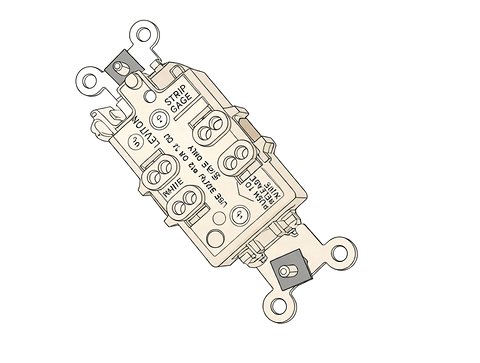
Look for wire-entry holes beside movable levers on the device back, conductor-size markings, and a strip gauge. Verify the manufacturer and model: the E5325 has color-coded levers and a 12/14 AWG copper specification.
Often confused with
| Confused with | How to tell them apart |
|---|---|
| NEMA 5-15R receptacle face | The NEMA interface receives a power plug at the front; these lever terminals receive individual stripped conductors at the back. |
| Generic lever wire-splicing connector | This item is an integral wiring-device terminal, rather than a separate connector joining wires. Similar operation does not establish interchangeable geometry. |
Also called
Lever Edge terminalDecora Edge terminallever-operated screwless wire terminal
Good to know
Lever clamping describes the operating method, rather than a dimensional mating standard. Lever Edge terminal dimensions and internal spring design should come from the specific device documentation, not its NEMA face rating.
Related connections
Design with real parts
Crafti checks which parts connect, right in your browser.